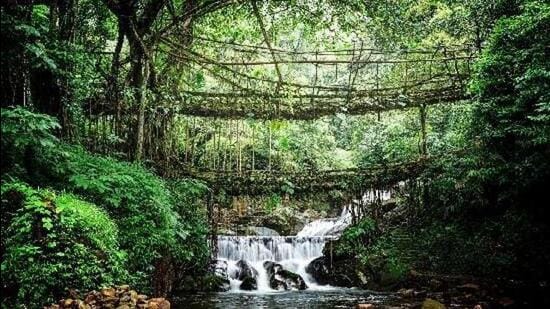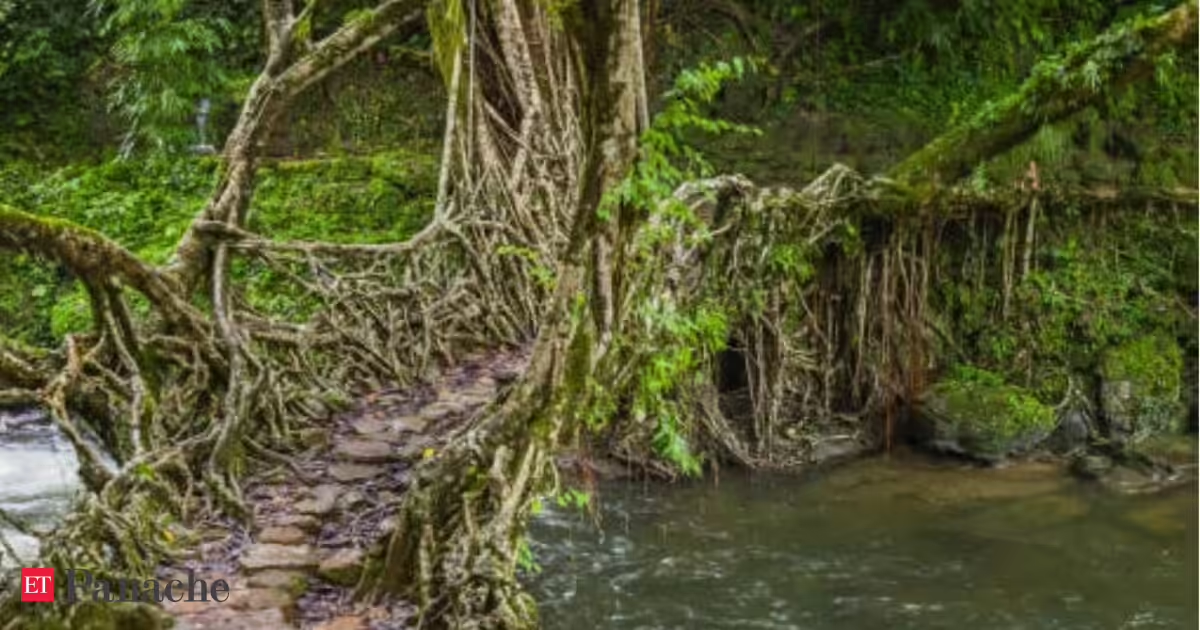
Have you heard of ‘living bridges’ ? A speciality of Meghalaya, these bridges, constructed from not steel and concrete, but live roots! Deep within the lush, mist-covered forests of Meghalaya, the indigenous Khasi community has mastered a remarkable form of natural engineering by growing bridges from living trees. Instead of relying on concrete or steel, they harness the aerial roots of the resilient rubber fig tree, scientifically known as Ficus elastica, to create durable pathways across fast-flowing streams and rivers. The roots are carefully directed through hollow betel nut trunks and other natural supports, allowing them to extend and intertwine over steep ravines. Over decades, these roots strengthen, fuse together, and develop into sturdy living structures capable of supporting generations of travelers. The painstaking process demands extraordinary patience, often requiring as long as three decades before a bridge becomes fully established and ready for regular use. These bridges, as per an article published in Atlas Obscura, can last more than 500 years and can hold up to 50 travellers. According to the article, there is a Khasi mythology behind construction of such bridges. They believe that these bridges called ‘jingkiengjriksiar’ is a golden bridge that connects heavenly abode and earth. The bridges were built by the tribe to adapt to harsh conditions according to Ian Lyngdoh, author of the book Ficus Khasiana. The southern Khasi hills of Meghalaya experience heavy rainfall for most of the year. Bridges made of wood or bamboo would disintegrate very quickly in such weather. Remarkably, certain living root bridges are formed solely through the careful shaping and guidance of the aerial roots of the rubber fig tree. In these cases, builders do not rely on scaffolding, support frames, or any other natural or artificial construction materials. Instead, generations of local artisans patiently direct the growing roots by hand, encouraging them to extend, intertwine, and strengthen across rivers and valleys.The roots are said to be sturdier than concrete and steel. Instead of decaying or withering away, the roots grow thicker and tougher over time.
Forget concrete, steel or wood. One state in India, has ‘living bridges’ which last for 500 years
Meghalaya's Khasi community crafts extraordinary 'living bridges' from the roots of rubber fig trees, a testament to natural engineering. These durable, self-strengthening structures, guided by generations of artisans, span rivers and ravines, offering a sustainable alternative to conventional materials. Believed to connect heaven and earth, these remarkable bridges can endure for centuries, showcasing incredible patience and ingenuity in adapting to the region's heavy rainfall.
Meghalaya's Khasi community constructs living root bridges from Ficus elastica that strengthen over decades and sustain 500+ years—exceeding concrete durability in extreme rainfall. Self-healing organic infrastructure without maintenance offers bio-engineering lessons for resilient, sustainable system design.