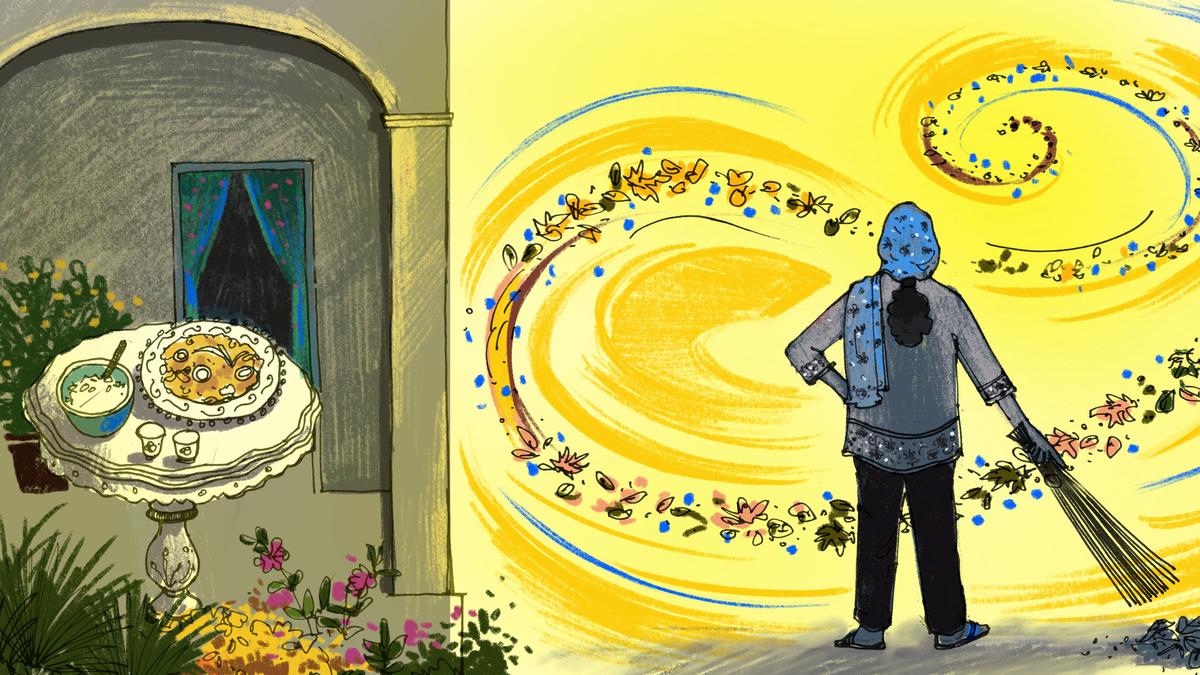
Your story “The Twice-Widowed Khala Helai” is a kind of companion piece to another story, “On the Night of the Khatam,” which appeared in The New Yorker in 2024. Can you explain how the two pieces fit together, and what made you want to return to that fictional gathering of Afghan refugees in Sacramento?Initially, I’d intended “On the Night of the Khatam” to be a much longer story, switching back and forth between the men’s side and the women’s side of this gathering, but it became too unwieldy, and I settled for focussing on the men’s side first, knowing that I would return to the women at some point in the future. I knew that I wanted the two stories, the two sides of the khatam, to sort of mirror each other, or be in conversation.Both stories are told in a collective voice. When we discussed “On the Night of the Khatam,” you said, “I just decided to let the singular first person evaporate into a collective voice, and it turned into this roving, bodiless, almost omniscient presence that is attempting to speak for (and about) the men in the story but, I think, is failing in the process.” Why was that failure important to you, and did you have the same experience when narrating the women’s evening?Barry Hannah once said, “You don’t have to be much but a stumbling fool” when writing in the first-person P.O.V., and, in general, that’s been my own approach to writing fiction. I stumble around, I make mistakes, I write sentences that are too long, and create worlds that are too strange, and failure becomes an essential part of that whole process. It’s what really allows me to experiment and be playful in a story. Because the casts of characters for both “On the Night of the Khatam” and “The Twice-Widowed Khala Helai” are so large, and there is so much going on at once, I was stumbling and making even more mistakes than usual. Even now, I’m not sure if I’ve done Khala Helai justice, if I’ve given her enough time and space to properly tell her story, but I just have to hope that even the shortcomings, the absences, are meaningful to the reader.We hear many snippets of conversation and short anecdotes from different women, but the fullest story comes from Khala Helai, who recounts something about her history that she has never revealed before: that she was married once before she met her second husband, who recently died. Why has she withheld this story from her friends?Part of it, I think, is out of practicality. It was a short-lived marriage and a painful memory, and so I imagine that it was difficult for her to discuss it. And it’s the sort of personal history that might have made her children and her second husband feel uncomfortable, so I wonder if she might have kept it to herself for their sake. Initially, I hadn’t planned for Helai’s second husband to die, but it made more sense to me that she would tell her story after he’d passed away, not before.Khala Helai’s story has a profound effect on the other women, making them feel distant from themselves, their bodies, and even their souls. Why is it so meaningful to them?I’d known from quite early on that Khala Helai would tell a final, impactful story to the other women at the khatam, but I didn’t come up with the story of Helai’s reunion with her former mother-in-law, Bubugul, until very late in the drafting process. When Bubugul evokes the ghost of her lost son, I think it is the ambiguity of this final story, the question of whether or not Bubugul was actually visited by the dead, that sort of unmoors the women from a stable sense of themselves.Of “On the Night of the Khatam,” you said, “At a gathering like this you may find yourself witnessing intense moments of vulnerability. One man might describe how he was tortured as a prisoner of war, or another might recall the day his brother was hauled away from their home, never to be seen again. But, even amid these memories, these recollections, so much is left unsaid that you can leave the encounter feeling that you know even less about the person, or the community, than you did before.” Is the same true for the women’s revelations and reflections, or do these women leave the khatam feeling they know a lot more about Khala Helai by the end?The thing is that a khatam can be a very familiar sort of gathering. It’s all your old friends coming together in a home you’ve visited dozens of times before. Often, there is a set routine to the khatam, and the regularity of it all can be both dull and comforting. But, every once in a while, you may encounter a story at a khatam that totally shatters this sense of normalcy or comfort or stability, and suddenly, in the middle of someone’s memory about a torture dungeon or a massacre or a drone strike, you come face to face with an unfathomable horror, or with the fact of your own mortality, and I think something like that happens when the women hear Helai’s story. They learn more about her, but, at the same time, she becomes even more mysterious and incomprehensible to them.“The Twice-Widowed Khala Helai” appears in this year’s Fiction Issue, which has a family theme. Many families populate this story, but there are also informal family-like groups: the Bibis, the new arrivals, the former in-laws. Even the women form a kind of extended family, as do the men. What is the relative importance of the bonds of marriage, blood, and origin among these characters?Well, I think those bonds have a dramatic impact on how these characters view or understand themselves and what is possible in their lives. That’s one of the reasons I chose to experiment with the first-person-plural point of view in the first place. It’s an odd and sometimes unwieldy perspective, but, for me, it has also been a much more expansive way to unfold a narrative. I see and hear things among the characters that I wouldn’t have noticed in the first-person singular. In the shift from the “I” to the “we,” from the individual to the group, time changes (collapses or stretches out) and so, too, does the shape of the world itself. ♦
Jamil Jan Kochai on Unmooring Memories
The author discusses his story “The Twice-Widowed Khala Helai.”
1,072 words~5 min read