Jameel had never given it a thought, but Zakir’s unexpected behaviour sparked an interest in his heart – or at least a nagging curiosity. It happened like this: One day in the visitors’ room, Zakir was sitting with his arm around Jameel’s waist when suddenly Nazru appeared from within the house. He lingered, eyeing the occupants of the room, then squared his shoulders, puffed his chest encased in the thick, dirty cotton vest whose colours had smudged with long use and become spotted and brown, his arms sticking out of the short sleeves, swirling his striped tehmad hitched above his ankles and twirling the black thread he wore around his neck with utter nonchalance, walked straight towards the table. Zakir’s eyebrows went up as soon as Nazru entered the room, and his eyes became fixed on him. His eyes followed Nazru as he walked, and his arm around Jameel’s waist became slack. As soon as Nazru left, Zakir tapped Jameel on the shoulder, then, putting his left hand on his knee in a resolute fashion, perked one eyebrow, pulling the other one down, his forehead wrinkled, and with a twinkle in his eye, asked, “Who is this gentleman, brother?”“Arrey, you haven’t seen him?” Jameel was perplexed because Zakir was a frequent visitor to his home. “He’s our new servant – Nazru – really, yaar, how come you didn’t know … huh?”Without a second thought about the substance of Jameel’s reply, Zakir said, “So you’ve been bitten by this bug too – since when? What are your intentions?’ The sparkle and sharpness of his eyes were loaded with suspicion, and the twitching corners of his lips had widened into a smile.Jameel did not want to treat this conversation as anything but frivolous banter, but the absurdity of the suggestion took such a hold on him that each time he saw Nazru that evening, he felt obliged to scrutinise him from head to toe, to verify the truth of Zakir’s allegation, but each time he felt it better to conclude that Zakir was only teasing him. Nevertheless, he had to admit that he found the new servant’s demeanour a bit strange, unusual, and mystifying from the very first day of his arrival. He had stood carelessly in the sun, arms across his stomach, one on top of the other. He had not offered greetings to anyone. When asked if he was ready to start work, he had responded, “Yes, yes, why not?” He claimed to be able to do everything. When quizzed about salary, he took off his yellowish, colourless turban, unwound and shook out the long piece of cloth, then re-tied it with such disdain as if to say that salary was the last thing on his mind. “Pay whatever you like.” He had no objection to the offer of three rupees. For two days, he worked silently, unhurried, but on the third day, he suddenly assumed an unexpected mode of conversation.Jameel was eating lunch in the kitchen before leaving for school when Nazru came up to him and said in a secretive manner, “Ajee, something saala peculiar happened today – shall I tell you about it, Jameel miyan?” Nazru’s pointed ears, round darting eyes, lips parted in laughter, the glimpse of redness on the inner side of his nostrils, and the dimples on his cheeks made Jameel pause with the food inside his mouth. He could barely manage a reluctant affirmative. Nazru didn’t need that anyway. “The Hindu lala who lives next door to us – ajee, just behind us,” Nazru was able to tack on his obscene thoughts about everyone and their sister without the least hesitation. He was doing that right now. “So when I stepped on the terrace today, Jameel miyan, what did I see – that saali, his wife – was sitting just like that … only wrapped in a sari … and what shall I tell you … curse the devil … curse … everything was visible … so then her husband appeared – the lala …” Nazru had crept closer, and Jameel’sface was red; he was swallowing food in quick gulps. “So as soon as he turned up, he took her to the cot …” Something stuck in Jameel’s throat, and coughing, he went towards the water pitchers, drank water, and left the kitchen without turning back. No servant had ever before talked to him like that. It had baffled him. Now Zakir’s insinuations on top of that! He tried hard to produce solid reasons, explanations, and examples to detract from this; he tried his best not to give any importance to all this; but still, he couldn’t trust his own conclusions.The next day, the news spread to the school. During break, when the ninth-grade boys gathered under the neem tree, a group came up to Jameel.“Flying high, Jameel – now you too …”“Thank God! At least he got there.”“Lay off! My friend knows nothing more than swallowing spit … can’t open his mouth in front of anyone. Just pretending to be a …”“You’ll end up swatting flies, my boy,” Mirza Baidar Bakht advised. “You’ll forget all about standing first in your class.”Jameel responded to these comments with dry, apologetic, embarrassed laughter and stared at them with blank eyes. But he really couldn’t dismiss this as a passing joke. His doubts were slowly being replaced with interest. He wanted to know more about what they were talking about – things whose image in his mind was yet blurry. He too wanted to enter Ali Baba’s cave.That same afternoon, Mirza Baidar Bakht landed atJameel’s house with Zakir. He announced that he was very thirsty. Nazru served him a glass of water and stood by, scratching his head. Mirzaji did not return the glass. He inspected Nazru for a good two minutes and then said, “What’s your name, my friend?”“My name? What will you get from my name?” Nazruresponded carelessly.“There’s no harm in asking.”“My name is Saiyyed Nazeer Ali,” Nazru replied.“And Nazru?” Mirzaji asked.“We are poor folk; you can call us whatever …”“Where are you from? Come, sit – sit down; we want to talk with you.”Nazru pulled up a chair and sat down. He normally had no hesitation in sitting on a chair in front of Jameel, but this instant his demeanour showed that he considered himself no less than Caliph Mamun.Passing his large, fleshy hand over his forehead and head, he remarked, “Why ask about the lives of us poor folk …”“Abbay saalay!” Mirzaji scolded, changing his tone. “Started acting up after being offered a chair; are you talking, or do we need to take recourse to the law?”Nazru laughed spontaneously. His hand moved from his head to his knee. Settling back, he stretched out his legs in a familiar fashion and, without any further ado, launched into his life story. “We are from Inayatpur – my father, Saiyyed Maqbool Ahmed – you may have seen him – he often visits Tausheer.”Mirzaji’s negative response did not dampen his enthusiasm, and he produced another reference “Okay, so there’s this Saiyyed Ashfaq Ali – lives right by the corner of the bazaar – plumpish man – big moustache – the one who roams around with phonograph records tuckedunder his arm – he’s my maternal aunt’s husband – marriedto my mother’s sister – now my father was … he was so strict, cruel in fact – if I didn’t go to school he would beatme up so badly that … I was ten years old then. One day, he hit me so hard that I couldn’t stand it anymore – I ran away and went to Badlu weaver’s. He incited me to go to Delhi – to the glass factory. I went off with him. From that day to now, I swear to God, I never glanced back in the direction of my home. It’s been five years; my father tried several times, but I wasn’t fooled by his ruses. I was employed at the glass factory in Delhi. The owner treated me like a son, I could practically do as I liked. He never denied me money. He really loved me. One day, I put the lead container on the furnace and went down to the bazaar for a minute. Over there, saala, a youngster started joking with me; I got delayed. On returning, I found the lead lying upside down. The owner shouted at me. I wouldn’t have minded, but it came down to obscenities. It was the timing. I flew into a rage. I fought with him and left. He wanted to take me back; he hung around a few days, cajoling me and saying that I was making too much of a small thing. But saab, look, I didn’t listen to him. We are Saiyyeds after all. We’re not his bonded labour. I told him, ‘Look, I’m leaving Delhi because of you.’ That was it; from there I came here.”Excerpted with permission from ‘Slipperiness’ by Muhammad Hasn Askari, translated by Mehr Afshan Farooqui, in The Best of Urdu Short Stories, edited by Mehr Afshan Farooqui, Penguin India.
Translated short fiction: Jameel’s outspoken servant, Nazru, puts him in a sticky situation
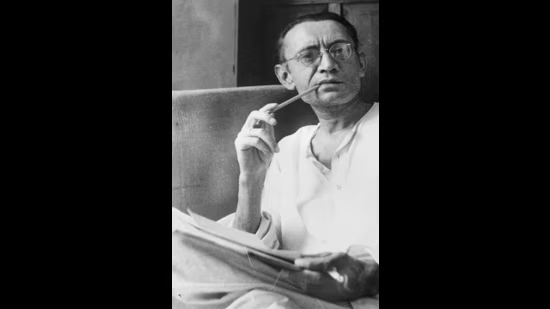
An excerpt from Muhammad Hasn Askari’s short story ‘Slipperiness’, in ‘The Best of Urdu Short Stories’, edited by Mehr Afshan Farooqui.
1,524 words~7 min read