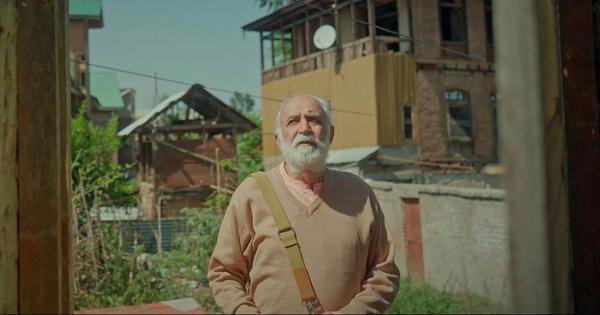
A Pandit family in Jammu keeps trying to return to the ancestral house in Anantnag in Kashmir from which they fled decades ago. Although part of the same region, Jammu and Anantang seems like different countries to Poshkar Nath Koul (MK Raina), his wife, their son, daughter-in-law and grandchildren. It’s easy enough to plan a trip, but there are invisible barriers to setting foot in the place that once was home.Batt Koch (The Lost Lane), directed by debut filmmakers Ankit Walli and Siddarth Koul and produced by Vinayak Razdan, is a story of displacement and resilience, cultural loss and memory. The Jammu household is a mix of Kashmiri, which the elders speak, and Hindi, which the grandchildren prefer.When Poshkar does find his way back, he finds that much has changed, and a great deal hasn’t. Unlike a few recent films about the Kashmiri Pandit experience, Batt Koch stresses on the importance of balance and cultural preservation over rage and vendetta.Following a theatrical release in March and screenings in American cities, Batt Koch is being shown at the New York Indian Film Festival, which concludes on Sunday. Batt Koch is nominated for Best Debut Feature Film and Best Actor for MK Raina. Apart from Raina, a veteran of the stage and cinema, the cast is entirely Kashmiri, with several Kashmiris in the crew too – a conscious choice for Siddarth Koul and Ankit Wali.The directors were born and raised in Jammu. They have worked extensively in Bollywood. Batt Koch was as emotional an experience for them as it was for the fictional characters, they said.Siddharth Koul thought of the film during the Covid lockdown, after being “deeply moved by the emotional relationship Amitabh Bachchan’s character has with his ancestral home” in Shoojit Sircar’s movie Piku, he said. Koul’s grandfather was a postmaster, like Poshkar in Batt Koch. “Somewhere through him I started imagining a story about memory, exile, and return within a Kashmiri Pandit household,” Koul added.In an email interview, Koul and Ankit Walli spoke to Scroll about visiting Kashmir for the first time with their characters and the idea of home for a community that largely continues to be cut off from its roots. Here are edited excerpts.Batt Koch seems to have emerged out of a deeply personal experience. What inspired the story?The film is deeply inspired by our own experiences of growing up in displaced Kashmiri households. So many moments come directly from memories, conversations with family members, rituals we grew up around, and the emotional texture of constantly hearing about a homeland that existed in memory before it existed in our own experience.Physically, the distance between Jammu and Anantnag may not seem very large, but emotionally and psychologically, it carries decades of history, fear, uncertainty, and displacement. For many Kashmiri Pandit families, return is not simply about geography. It is tied to questions of belonging, safety, memory, livelihood, and emotional continuity. And the safety question is not a historical one – it remains very much present.There are still targetted killings of Kashmiri Pandits. This is not something from the past that has been resolved. We did not want the film to look away from that reality, and there is a moment in the film where the family discusses visiting Kashmir and that anxiety surfaces naturally in the conversation. It felt important to include it honestly, because that fear is something many families still live with every time the question of return comes up.At the same time, there is also an undeniable longing to reconnect with Kashmir. Even among younger generations, there exists a powerful emotional relationship with the homeland despite growing up elsewhere. That longing is real and coexists with the fear – sometimes uncomfortably so.The film tries to capture that contradiction – the desire to return, alongside the emotional difficulty of imagining what return truly means after so many years, when the ground beneath that dream remains uncertain.Batt Koch (2026). Courtesy SearchKashmir.Poshkar Nath Kaul’s eventual return is emotional – was it that way for you too?Very much so. In many ways, his return carries the weight of generations of Kashmiri Pandits who have remained emotionally connected to home despite distance, time and displacement. But there was another layer to it – filming in Kashmir was our first time being there.For both of us, Kashmir had existed all our lives as an inherited landscape – in our grandparents’ stories, in family photographs, in the language, the food, the rituals, the quiet grief that surfaces in displaced households. And then suddenly, we were standing there. Walking through it. Filming in it.There was joy, but also a kind of ache. A sense of recognition for a place you are encountering for the first time. That contradiction stayed with us through the shoot.It did not feel like we were staging a dramatic return. It felt like we were quietly confronting something unresolved within ourselves, and perhaps within an entire generation of Kashmiri Pandits who have grown up between two worlds.The Kashmiri Pandit rupture is being explored with some depth only recently. Some films emphasise anger, hatred, the need for score-settling. But your film avoids recrimination, instead pointing to the importance of guarding against forgetting.The Kashmiri Pandit story is only now beginning to find the space it deserves. Wherever Kashmiri Pandit voices are genuinely involved in a project, regardless of the form it takes or the quality of the final work, some truth of that experience is being captured. That itself is important. That itself is a kind of reclamation.The specific story we wanted to tell was about the lived Kashmiri Pandit experience – the inner trauma, the quiet negotiations of daily life in exile, and what displacement does to a family across generations. We were drawn to the ordinary rather than the dramatic. How grief lives in language. How it surfaces in rituals, in food, in humour, in the way elders speak about a place their grandchildren have never seen. We also felt a responsibility toward something that has been largely absent – Kashmir on the big screen as a living, breathing culture. Kashmir does not have a strong cinematic tradition, and so much of its way of life, its intimacy, its domestic world, has simply never been documented in that form. We wanted to change that, even in a small way. To place that world on screen with honesty and tenderness, so that it exists, for Kashmiri Pandits, and for anyone else willing to step into it. Because at its core, this is a story with which anyone can connect at a human level. Exile, memory, the longing for home, the weight of inheritance: these are not exclusively Kashmiri experiences. They are universal.Siddarth Koul (left) and Ankit Walli.Batt Koch has Kashmiri actors and mainly crew members. Was that a conscious choice?Yes, it was a very conscious choice. A story as intimate and culturally rooted as Batt Koch needed to emerge from within the community itself.Language was one of the biggest reasons. Kashmiri is not simply about pronunciation. It carries rhythm, pauses, humour, silences and emotional texture. Those nuances could only come naturally to people who have lived the culture.At the same time, we were not trying to make the film feel exclusive. The intention was authenticity. We wanted the world of the film to feel lived-in rather than performed.There was also a larger purpose we felt responsible to. Kashmir has a rich but under resourced creative ecosystem. A film like this could play a small role in nurturing it. By bringing in local actors, technicians and crew, we wanted to contribute in a modest way to building a sustainable foundation for Kashmiri cinema. Apart from MK Raina, who else is in Batt Koch?MK Raina sir was incredibly gracious to be part of what is a small, independent film. He has spent decades championing Kashmiri folk theatre and has been one of the most important cultural custodians of the language and its performance traditions. Having him anchor the story gave the entire project a kind of legitimacy and emotional gravity that we could not have achieved otherwise.Anil Chingari Koul is a name that needs no introduction in Jammu & Kashmir, where he is widely loved as a comic performer. What excited us about casting him was the opportunity to see him explore a wider emotional register – quieter, more complex human dimensions that his audience may not have seen from him before. Kusum Dhar is a veteran of local art circles who has been contributing to Kashmiri cultural life for decades. Kusum Tickoo, while also a Kashmiri artist, is perhaps better known in the state for her extensive work in Dogri and Hindi. Seeing her return to Kashmiri for this film felt significant, both personally for her and thematically for what the film is trying to say about language and belonging.Then there are Sakshi Bhat and Ravin Bhat, who represent the third generation of Kashmiri Pandits – young people who carry the inheritance of displacement without having directly lived it. Through them, the film gets to explore what that inherited memory looks and feels like.Finding younger actors who could comfortably speak Kashmiri was definitely challenging, and that challenge itself reflects something the film is deeply concerned with – the gradual distancing from language within generations growing up outside Kashmir. But we were fortunate to find performers who were either already rooted in the language or emotionally committed enough to immerse themselves fully.
Batt Koch’s journey: ‘The Kashmiri Pandit story is only now beginning to find the space it deserves’
The film’s directors Ankit Walli and Siddarth Koul tell ‘Scroll’ about the joy and ache involved in returning home.
1,595 words~7 min read