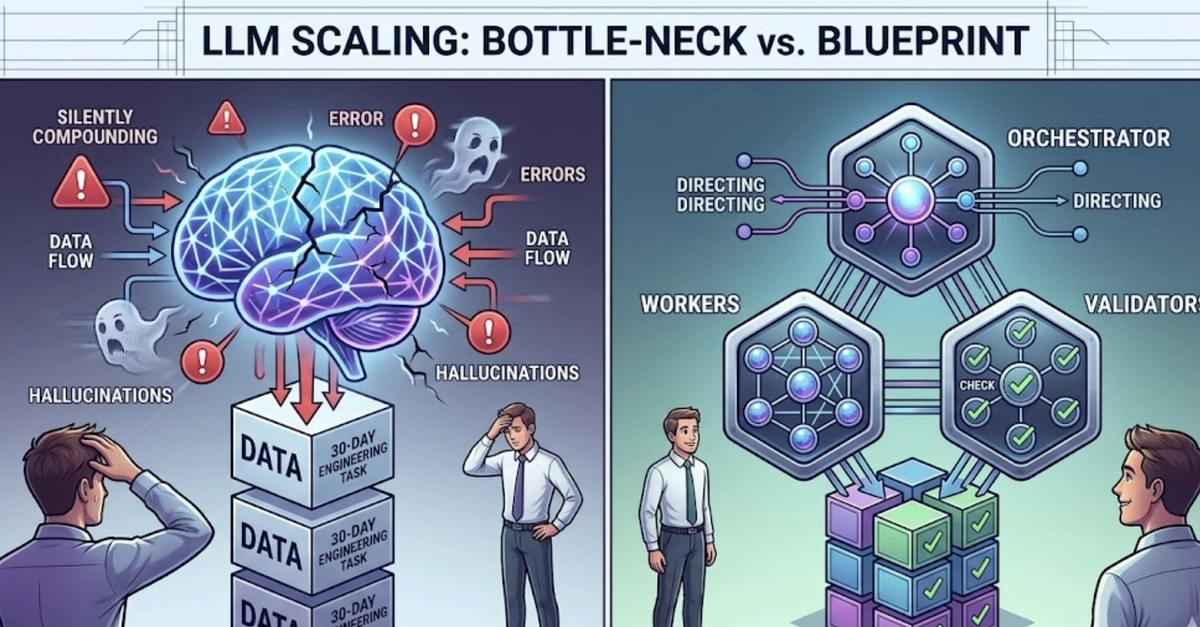
The naive assumption when building with LLMs is that a smarter single agent solves more problems. Just give it better tools, a longer context window, more powerful model and it scales.
It doesn't. Not because the models aren't capable, but because the architecture is wrong.
Human attention is a bottleneck. A single agent running a 30-day engineering task can't be supervised at every step and if it can't be supervised, failures compound silently until something breaks in production.
Add task complexity to the picture and single-agent systems hit a wall fast: they either hallucinate, lose context, or produce inconsistent output that requires constant human correction.
The fix isn't a better model. It's a different architecture. Here's the one that actually works.