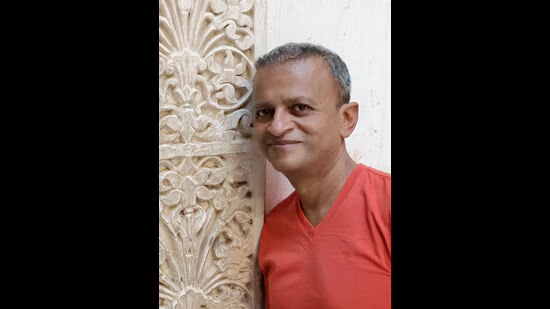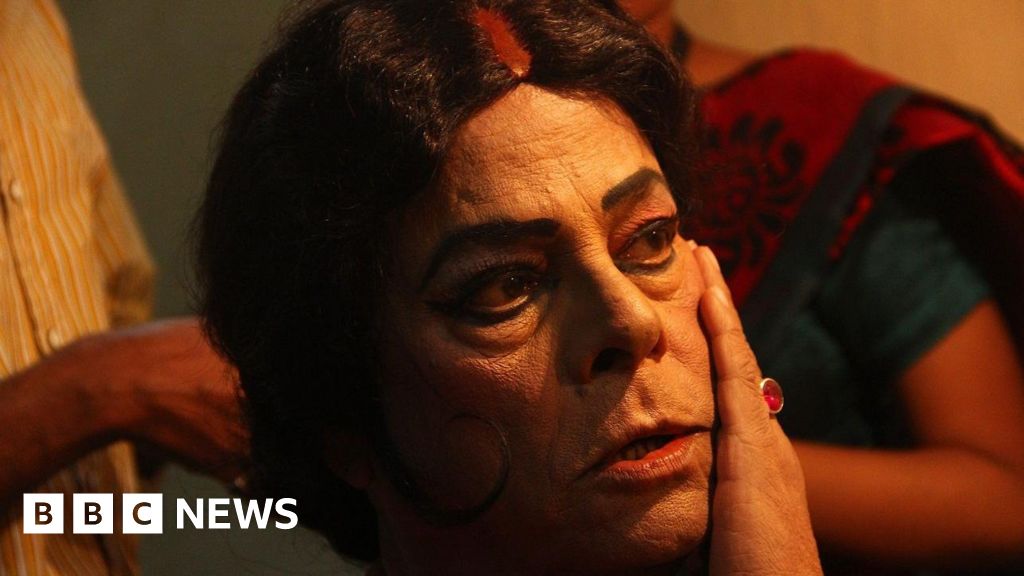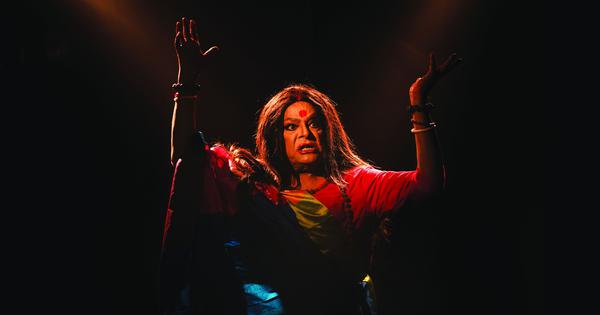
Many of us in Kolkata first learnt of Chapal Bhaduri through Naveen Kishore’s documentary, Performing the Goddess: The Chapal Bhaduri Story (1999). Of the many hats that Kishore wears, the best-known one today is, perhaps, that of publisher of Seagull Books. So, it is not surprising that he suggested that Sandip Roy write a book on the life and times of the actor Chapal Bhaduri, a jatra artiste who mainly performed as a woman. And so, we have Chapal Rani, the Last Queen of Bengal: The Life and Times of a Female Impersonator.It would be wrong to say that the book is only about Chapal Rani. Roy captures the many facets of Bhaduri’s astonishing life in this biography – the young boy from an illustrious theatre family who becomes a jatra queen, enjoys immense fame but finally has to leave the stage, a person who was probably India’s first openly gay actor, an actor who plays Ma Sitala for countless devotees, and later in life, also becomes a queer icon. Roy skilfully brings together the contradictions, complexities, highs and lows of Bhaduri’s life in a well-researched, eminently readable book.Born in 1939, Chapal, originally named Bhabesh, then Chapalesh, was one of many siblings. A sister was born several years after him but she died after a few months. Bhaduri’s mother, Prabha Devi, was a star of stage, screen and radio. She bought a three-storey house in Dalimtala Lane in north Calcutta in 1950 for Rs 14,000 and then renovated it completely with her own money.Not only was Prabha Devi a renowned performer and the bread earner for her family, but she was also an accomplished cook and deft with her needle. Her home was full of articles she had stitched and embroidered. Bhaduri says that the story of his childhood is largely the story of his mother. She was a disciple of Sisir Bhaduri, a revered theatre personality of Bengal. After she parted from her first husband, she met and married Tara Kumar Bhaduri, Sisir’s brother, a widower.Prabha Devi died in November 1952. She was 48 years old. The theatres were shut in mourning. After she died, her family fell on hard times. Several cinema production houses owed her money. Some, like Kanan Devi, paid without even being asked, but most refused to. Bhaduri’s formal education, too, came to an end. As did his dance lessons. Tara Kumar Bhaduri started drinking heavily and it was as if everyone forgot about the young son.An accidental startIn 1955, Bhaduri first went on stage as a woman, playing Morjina in Alibaba for a recreation club of the Indian Railways. His brother-in-law, a railway employee, helped to bring this about. A week after this, he was employed by the Indian Railways as a chainman earning Rs 75 a month. Since there were many departments in the Indian Railways with their own recreation clubs, Bhaduri became a sought-after dancer for their shows. Subsequently, advised by his friend, Subrata, he learnt to do his own make-up.After his stint with the Railways was over, Bhaduri worked in amateur theatre. He needed an income and got an offer to join Natta Company to play women’s roles. In his meticulous and detailed introduction to the book, Roy tells us that despite its glorious history, jatra, like queerness, always existed on the fringes of respectability in Bengal. Bhaduri’s family was dedicated to theatre and to people like his father, jatra was lowly. He was not enthusiastic about Bhaduri joining.Bhaduri joined Natta Company as a “change artiste” on a salary of Rs 100 in 1958. He was replacing Chhabi Rani, their renowned female impersonator. Natta Company was established in 1869. For the first eight years in Natta Company, Bhaduri filled in the roles that had been Chhabi Rani’s. Finally, in 1964, Brajendra Kumar Dey, the playwright of the troupe, wrote Chand Bibi with Bhaduri in mind. This play raised Natta Company to new heights, as it did Bhaduri, who finally became Chapal Rani, earning the coveted accolade of female impersonators.Bhaduri left Natta Company in 1967. His salary then was Rs 6,000. He joined Nabaranjan Opera and his first role was of Jahnavi, the mother of the poet, Michael Madhusudan Dutta, in the play Michael Madhusudan. The play was a huge hit and the company toured with it for several years. And in Nabaranjan, Bhaduri also got a chance to play a man on stage in Raktalekha.The second comingAs women began joining jatra, the demand for men to play women’s roles declined and in 1974, when Bhaduri was playing the heroine’s mother in a Kamala Opera production at a college in Uttarpara, someone threw a clay cup on the stage. They wanted real women and not impersonators. Bhaduri was 35 years old and left the stage.When Bhaduri was 18, he began a relationship with a 22-year-old man who is referred to as X in the book. X, unlike Bhaduri, was well educated and spoke fluent English. The relationship with X continued for a long period and we get a vivid account of the twists and turns and power dynamics of the relationship.When Bhaduri’s jatra career was coming to an end, he was offered the role of Goddess Sitala, who wards off smallpox. He was expected to go from one low-income settlement to another, appearing as the goddess to her innumerable devotees. Chapal Rani, the fading queen of jatra, had initially thought that such performances were beneath him and refused. However, when he remained jobless for a long period, he sought out his friend, Raju, and asked to play Sitala. When he finally began playing Sitala, he realised that it paid very little and was both physically and intellectually demanding. The players had to know the details of the mythological stories they enacted and the audience often asked them questions; and if they couldn’t answer the questions, the audience was disappointed and annoyed.Author Sandip Roy. Photo by the Jaipur Literature Festival.Bhaduri met Naveen Kishore in 1999, when Kishore and Samik Bandyopadhyay came to interview Bhaduri’s sister, the actress Ketaki Dutta. Kishore watched Bhaduri’s performances, photographed him and finally, helped to take his Sitala off the streets and into theatres. Bhaduri developed a show called Ekmukhi Sitala. This was followed by Kishore’s documentary on Bhaduri.Helped by Seagull, Bhaduri’s luck turned. He participated in a festival in Canada called A Dialogue with India. The new century saw Bhaduri back in demand on the stage, and finally, on television and in films. He also continued playing Sitala. He worked with director Kaushik Ganguly in two of his films – Ushnatar Jonno and Arekti Premer Golpo, and a television serial Ghare o Baire.In Arekti Premer Golpo, Rituparno Ghosh was the hero. Bhaduri felt used by Ghosh during the making of the film. The Rituparno of Arekti Premer Golpo was certainly different from the host of Ebong Rituparno, who had interviewed Bhaduri. Interestingly, Ganguly says that acting with Bhaduri impacted Ghosh deeply and points out the significant influence the encounter had on Ghosh’s subsequent works.Also read:‘Jatra icon Chapal Bhaduri negotiated his sexuality without ever bothering about identity politics’Roy says that this book emerged slowly over weeks, months and finally years, after many conversations with Bhaduri. He spoke not just to Bhaduri but to many others who could add to his understanding of this remarkable man and his times. Roy’s detailed Introduction gives us a vivid picture of early 20th-century Bengali commercial theatre, as well as the world of jatra. There is also an analysis of Bhaduri’s relationship to the LGBTQI+ movement, where he has managed to carve out a place for himself and doesn’t get fazed by the growing complexity of gender politics.Bhaduri’s queerness is upfront in Roy’s telling of his life story. It is not written as a footnote or an interesting sidelight. It is intrinsic to the story of a man who played Sultana Raziya, Queen Kaikeyi and Goddess Sitala, cooked up a storm for friends and acquaintances, and managed his lover’s home for more than a decade. “Chapal Bhaduri was queer in an older sense of the word,” writes Roy, “The proverbial square peg in a round hole. … He was a queer survivor.”Roy’s research is rigorous but doesn’t drag the story down. This book about Bhaduri and his times is truly a page-turner. The structure of the book plays an important part too. The Introduction and Prologue are followed by 13 chapters and an Epilogue. Each chapter is in two parts: there is the subject matter followed by an Interlude. The Interlude provides more features and angles on the subject matter and enhances the reader’s knowledge and understanding.Chapal Rani, the Last Queen of Bengal, is appropriately a part of Seagull Books’ Pride List and an invaluable addition to the history of theatre and the queer movement in India. The stories of many male queens of jatra, as well as those of other performers, have been lost. In fact, there are no books about Bhaduri’s mother, Prabha Devi or another actress of her time, Kankabati. It is indeed creditworthy that Chapal Rani’s story has been recorded for posterity.Anchita Ghatak is a literary translator from Bengali into English.Chapal Rani, the Last Queen of Bengal: The Life and Times of a Female Impersonator, Sandip Roy, Seagull Books.
‘Chapal Rani’: An ingenious biography of queer actor Chapal Bhaduri, commercial theatre, and jatra
Sandip Roy’s book is an invaluable addition to the history of theatre and the queer movement in India.
1,547 words~7 min read