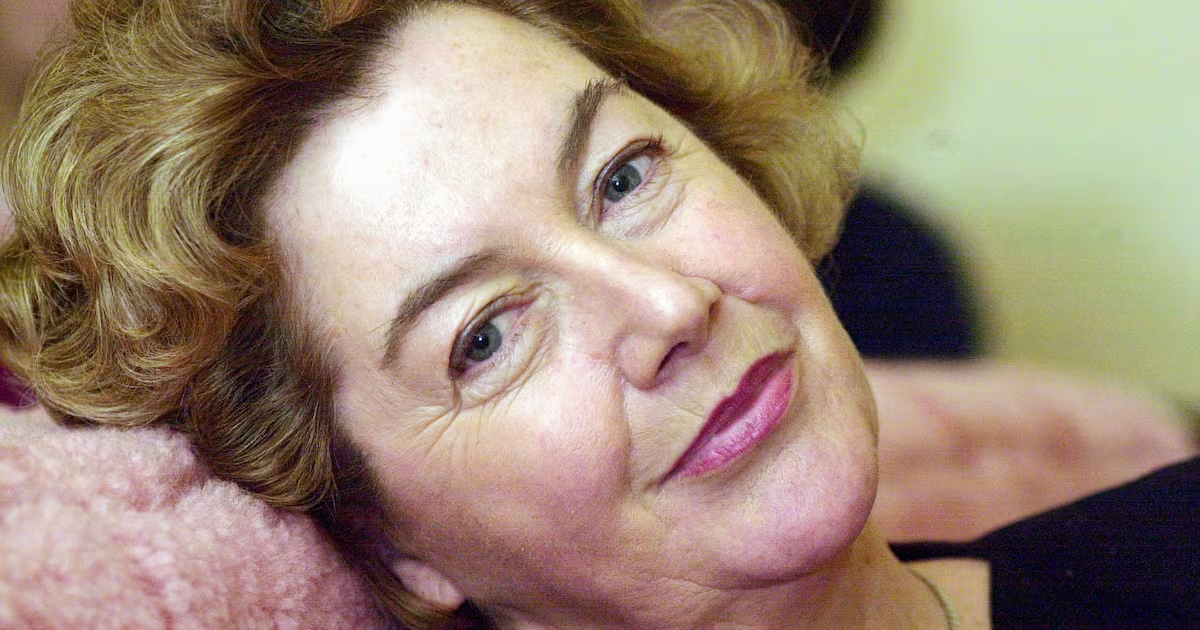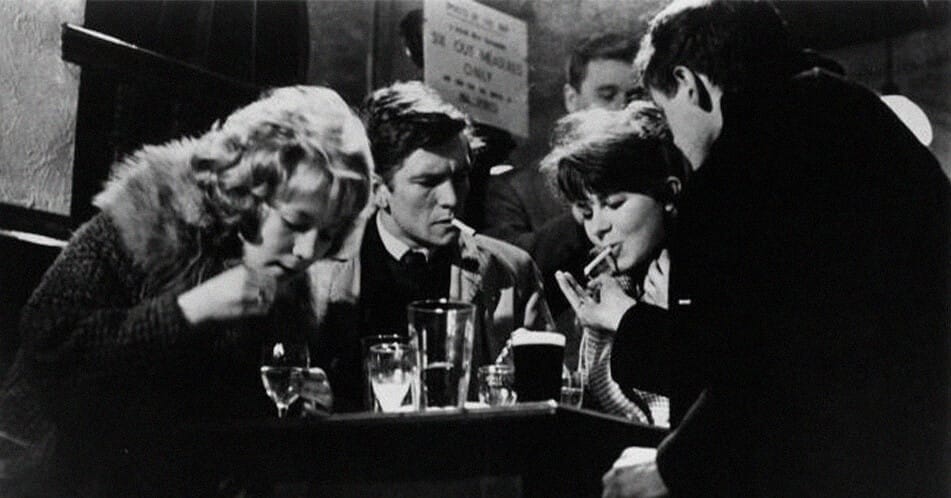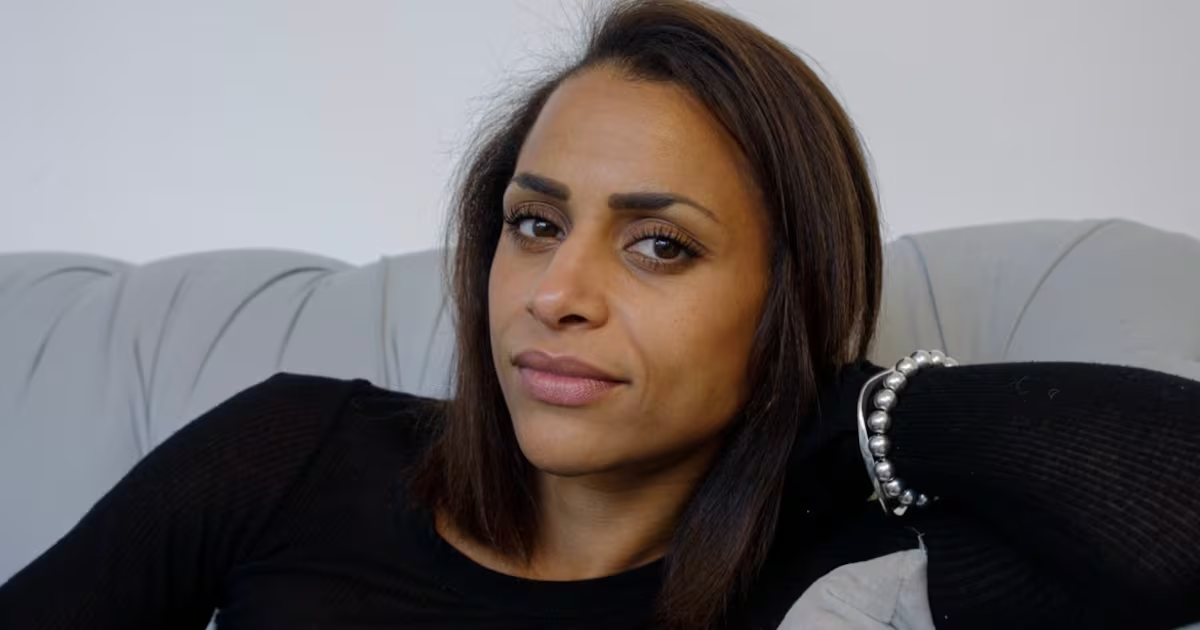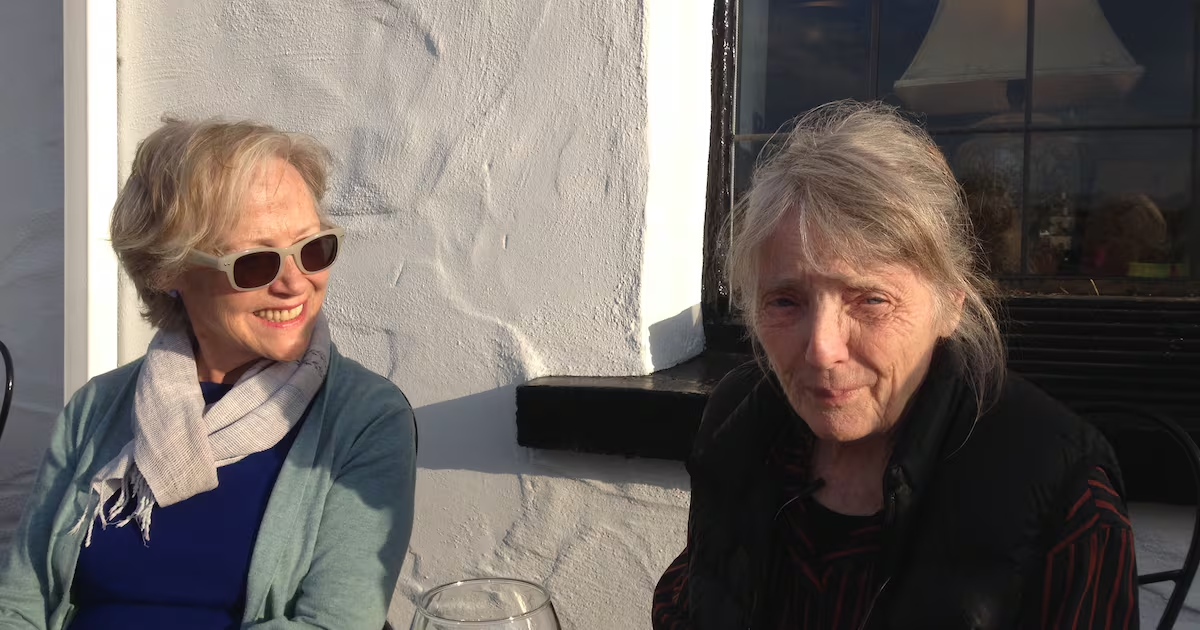
This Poor Book: A Poem Author: Fanny HoweISBN-13: 978-1068439551Publisher: Divided Publishing Guideline Price: £11.99There is an artesian quality to the work of the late Irish-American writer Fanny Howe. Like well water, Howe’s writing, especially in her later phase, seemed to bubble up to the surface with transparency and fluidity: “The Word wrote itself / and continues to write” she observes. Over the course of her life, Howe published 25 books of poetry, 12 novels, three books of essays, two collections of short stories, six works of young adult fiction, and two pulp novels – her “nurse books”, as she called them. She also directed six short films. Poet Eileen Myles, Howe’s old friend and fellow native Bostonian, describes her work as “fairy writing” for its fugitive, un-pin-down-ability. But Howe’s work doesn’t disappear once you’ve clocked the message. You keep returning to it. It has become a source in itself.This Poor Book: A Poem, published this month posthumously by Divided Publishing on this side of the Atlantic and by Graywolf in the US, displays this lucid, unbroken flow as no one but Howe herself could. She composed it by writing, revising and piecing together excerpts from eight books of poetry and one of essays written over the last 30 years of her life. Yet, as she affirms by her inclusion of the “A Poem” in the title, the book is not a fragmentary rattle bag. Instead, in a radical final act, Howe stitches together a work that draws our attention to its seamlessness.Howe’s voice is steady across her oeuvre, though “finding her voice” was hardly her mission. Impersonality was her impetus and her method. Howe dared, in the 20th and 21st centuries, to make the human soul her subject, but her outlook is never pat nor self-satisfied. Her writing is not an inspirational unburdening of her “spiritual journey”. A few months before her death, she told a Paris Review interviewer that she’d like her legacy to be as if, “A free spirit arrived and left. Someone who almost doesn’t have a footprint.” Read a line from Fanny Howe and it feels anonymous, like an aphorism or like the writing of a cloistered scribe from the eighth century. Nearly. But paradox was also deeply ingrained in Fanny Howe. That ethereal voice emanates from a vulnerable, wailing body: “Your soul is just a length of baby,” she writes.“A dirty girl had her own sunbeam that stayed by her side / When she stood on her head / All life long it had been assigned to her.” At the centre of the Fanny Howe cosmos is the essential beauty of the child as she makes her perilous way through a tainted world. In The Paris Review interview, published shortly before her death in July 2025, Howe spoke about her job: “There’s an impulse to preserve something original. It’s almost not possible to live without that. I didn’t know it, but when I looked back, around the age of 60, I could see that was what I was after.”This Poor Book traces the long, late phase of Howe’s poetry, her search for “a god I can swallow”. About her literary and spiritual journey, she told her friend, poet and publisher Bill Corbett, about her encounter with the work of the French Jewish-Catholic mystic Simone Weil: “My reading changed after that. It became more and more clear to me that I was on a new way. I plunged into theology, philosophy, political theory and left fiction far behind. It was Weil’s attraction to paradox and her notebook voice empty of seductive clauses, not written for show, her analysis of impersonality [that] woke me up …”Actors, writers and musicians – Dylan Thomas, Siobhán McKenna, Frank O’Hara, Brendan Behan among them – flowed in and out of the house. She writes tenderly about sitting on the front porch as a teenager beside her first sweetheart, musician Liam ClancyHowe’s poems are fields where her fierce intellect, her deep reading and rereading bloom. “Philosophy should only be written as poetry,” she quotes Wittgenstein as she imagines him in Dublin’s Heuston Station. She slyly tweaks what we now call “predictive text” by performing in language her belief in the power of subversion: “Get on your knees and play”; “Between outside and on”; “In the month of Mary”; “They will be mine”; and the very last line of This Poor Book: “There was no more reason to die.”Howe also subverts the de facto privileging of the rationalist, materialistic outlook of her generation: “Let the academics sneer at the Jesuits, and go on being the hypocritical clerics of the century,” she decries. It was Irish Benedictines in Limerick who gave Fanny Howe sanctuary. At a midlife breaking point, she found solace, balance and space for new directions among the monks and the river Shannon: I have to pass through the estuaryto investigate breakdown as a trail of nerve-endingsat the beginning of everything.Howe’s yearly stay with “her monks” in Glenstal Abbey was both a salutary homecoming and a radical departure from her beginnings. As she once told Joshua Glenn in The Boston Globe, “My parents were ironic and witty about everything – that’s where my troubles began.” In 1940, during a penumbral lunar eclipse, Fanny Quincy Howe was born in Buffalo, New York, the middle of three daughters of Irish writer/director Mary Manning (1906-1999) and Mark de Wolfe Howe, who became a Harvard law professor and civil rights activist (1906-1967). (Her older sister Susan Howe is also an esteemed poet, her younger sister Helen Howe Braider a sculptor.) Fanny Howe as a child In 1950, Mary Manning founded the Poets’ Theater in Cambridge, Massachusetts, a cutting-edge theatre of dramatic verse. As Howe told The White Review: “Fortunately, my mother was very Irish and very full of poetry, so it was in the house.” Actors, writers and musicians – Dylan Thomas, Siobhán McKenna, Frank O’Hara, Brendan Behan among them – flowed in and out of the house where Fanny grew up. There were rehearsals, costume-making sessions and parties galore. Howe writes tenderly about sitting on their front porch as a teenager beside her first sweetheart, musician Liam Clancy. Mary Manning was a force. In her twenties, before she left Ireland, she had a fruitful career in Dublin as a playwright, editor and critic, mostly associated with the Gate Theatre. Micheál Mac Liammóir, who appeared in Manning’s first play, Youth’s the Season…? (1931, restaged at the Abbey in 2025), observed that “her brain, nimble and observant as it was, could not yet keep pace with a tongue so caustic that even her native city was a little in awe of her”. By virtue of her early emigration, Manning fell into the Atlantic crack between Ireland and the US, and her brilliance is only now being properly assessed here. But as Howe’s great friend, the writer Linda Norton, observes, Howe was her father’s daughter. Mark deWolfe Howe’s legal scholarship and activism on racism in the US was formative for young Fanny. As a teen she accompanied him to a lecture by Malcolm X that shaped her life. Her father’s sudden, early death by heart attack in 1967 was a bitter loss.Fanny Howe’s early adulthood was entangled with the politically turbulent 1960s. She pinballed between Boston, New York and California where she dropped out of Stanford. There was a passionate, fraught marriage to Carl Senna, a Black American/Latino writer from Boston. After their divorce in 1974, Howe single-mothered three nonwhite children during the savage years of Boston’s fight against the racial integration of its schools. Howe’s daughter, acclaimed novelist Danzy Senna, says that in those years her mother had an epiphany: “As the mother of nonwhite children, she was no longer comfortable in the blind spot of the white world. She became a race traitor and a keen analyst of whiteness, in all its complacency and complicity.”From her early books to her last, Howe writes incisively about the disfigurement of American democratic ideals by racism, classism and capitalism. She was cross-genre, multidisciplinary, experimental (a term she rejected) before these hyphenated creative identities became ubiquitous.But Howe’s reflex toward self-effacement and her sly impersonation of an ordinary woman (as James Merrill said of Elizabeth Bishop) belie the scale of her accomplishment. Her audience has been small and dedicated, but her readership, especially among younger people, grows steadily. Her purchase in Ireland, though, is tenuous. But she is truly of Ireland. When I spent a year at Harvard’s Radcliffe Institute in 2015, our mutual friend Linda Norton introduced me to Howe. I think part of our connection was that I had chosen to leave the US for Ireland, something Howe dreamed of doing. She once told me that being in Ireland was like standing on her mother’s body. In subsequent years, when passing through Cambridge, I’d stay on the daybed in the greenish, terrarium light of her garden apartment. Her door was always left ajar when she was expecting me. When she was in Ireland, we’d try to meet up, often with Limerick poet Jo Slade, a long-time friend of Howe’s.Last April, frail and in failing health, through sheer force of will and the aid of a kind friend, Howe hauled herself to Dublin’s Abbey Theatre to see Youth’s the Season…? in its first production since its premiere at the Gate in 1931. According to Abbey artistic director Caitríona McLaughlin and director Sarah Jane Scaife, Mary Manning’s incisive, fresh comedy of manners echoes the frustrations and ennui of young Dubliners today. On that trip Howe also made one last visit to her beloved monks in Limerick. Three months later, age 84, she died as a dramatic electrical storm strobed the skies over Boston, a phenomenal send-off to a phenomenon of a writer. She is buried in the woods below Glenstal Abbey, in earshot of running water, at home in Ireland at last.Alice Lyons is the author of Oona (Lilliput Press). She lives in Sligo.
This Poor Book: A Poem by Fanny Howe – a radical final act by an extraordinary Irish-American
Daughter of Dublin playwright Mary Manning was a ‘free spirit’ who dared to make the human soul her subject
1,653 words~8 min read