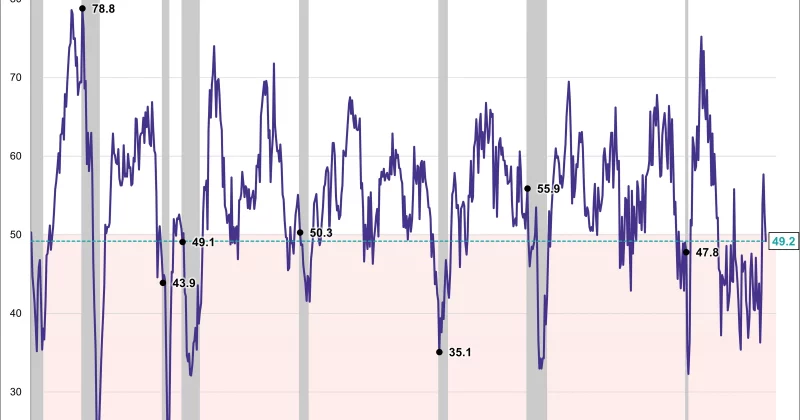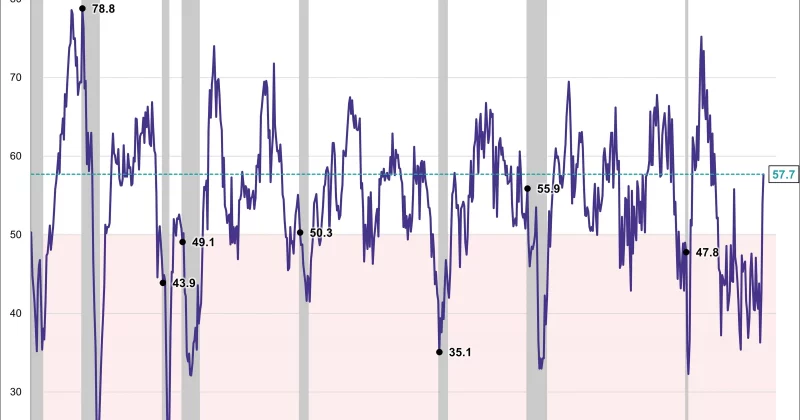
The Chicago Business Barometer, better known as the Chicago PMI, came in at 62.7 for May 2026. Economists had expected something around 50.3 to 50.6. That’s not a small miss. That’s the kind of gap that makes forecasters quietly close their spreadsheets and stare out the window.
For context, any reading above 50 signals expansion. A reading of 62.7 doesn’t just signal expansion. It signals expansion doing a victory lap.
The data, released on May 29, represents a dramatic reversal from April’s reading of 49.2, which had marked the first contraction of 2026. In the span of one month, the index swung more than 13 points to the upside, a move that qualifies as one of the strongest monthly gains the series has recorded in recent history.
What the Chicago PMI actually measures
Think of the Chicago PMI as a health check for business activity in the Chicago region. It’s a composite index that rolls together five key metrics: new orders, production, employment, order backlogs, and supplier deliveries. Each of those components contributes to a single number that tells you whether the manufacturing economy is expanding or contracting.