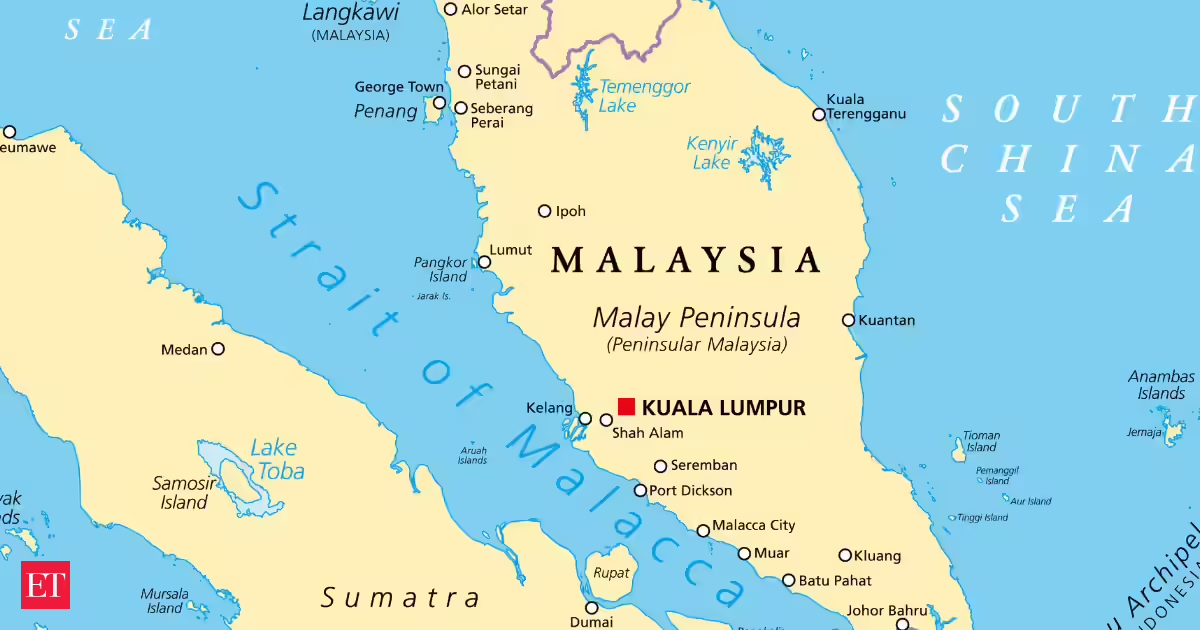
Singapore: China's maritime vulnerability begins at the Strait of Hormuz rather than the Strait of Malacca, creating a new arena of strategic competition in the Indian Ocean among Beijing, India, France and the US, according to a report by the London-based International Institute of Strategic Studies. Released ahead of the three-day Shangri-La Dialogue security summit that opened in Singapore on Friday, the report says the Indian Ocean Region is re-emerging as a key strategic theatre after decades of relative calm following the end of the Cold War. The report, titled "Asia Pacific Regional Security Assessment", argues that China's dependence on energy supplies moving through the Indian Ocean has made the region increasingly important to Beijing's security calculations, while also exposing vulnerabilities that rival powers could seek to exploit during a conflict. The study examines strategic competition around major maritime choke points linking the Middle East and Asia, with particular focus on the Strait of Hormuz and the Straits of Malacca and Singapore (SOMS), also known as the Malacca Strait, which carries a substantial share of global energy shipments. According to the report, recent developments around Hormuz have highlighted the growing strategic importance of these sea lanes. It cited Iran's participation in the Maritime Security Belt 2026 exercise with China and Russia, including naval drills conducted in the Strait of Hormuz earlier this year. The drills took place shortly before the outbreak of conflict involving Iran, the US, and Israel, which disrupted shipping and energy flows through the Strait of Hormuz. The report challenges the widely discussed notion of China's "Malacca Dilemma", which focuses on the vulnerability of Chinese trade and energy flows through the Malacca Strait. While the narrow waterway remains critical, the report argues that China's actual vulnerability begins much further west because a significant portion of its imported energy passes through the Strait of Hormuz before entering the Indian Ocean and reaching East Asia. Any disruption along these routes would affect not only China but also other major Asian economies, including Japan, which relies heavily on energy imports transported through the Indian Ocean. The report says China faces greater strategic challenges in the Indian Ocean than in waters closer to its coastline because it must operate alongside established regional actors such as India, France and the US -- all of which maintain significant military capabilities and partnerships across the region. While the People's Liberation Army Navy has expanded considerably over the past two decades and continues to develop capabilities to protect Chinese shipping routes, Beijing's reach near Hormuz remains comparatively limited, according to the study. To address those vulnerabilities, China has steadily increased defence engagement with Indian Ocean littoral states through military exercises, security cooperation, arms exports and broader political and economic partnerships. While Beijing is unlikely in the foreseeable future to prevent India, France or the US from operating through key Indian Ocean choke points, it is gradually building operational experience, military partnerships and a more sustained presence aimed at protecting its interests and reducing its dependence on routes vulnerable to disruption, the report says. Whether Beijing can eventually sustain a military presence comparable to those maintained by India, France and the US remains uncertain, it adds. France continues to be a major player in the western Indian Ocean through its military presence in Africa and on Reunion Island, while India views the broader Indian Ocean as a primary area of strategic responsibility and has sought to position itself as a leading regional security partner. The report notes that New Delhi has expanded naval exercises, defence cooperation and security partnerships across the region in recent years, while the US has maintained a long-standing military presence centred on the Diego Garcia base and increased engagement with several Indian Ocean states. Taken together, the military presence and partnerships of India, France and the US provide them with significant ability to conduct surveillance, project power and coordinate maritime security activities across key Indian Ocean choke points, the report says. At the same time, it notes that the three countries do not always share identical threat perceptions or strategic priorities, limiting the scope for deeper coordination. For Washington, which remains locked in strategic competition with Beijing in the western Pacific and is also engaged in conflict with Iran in the western Indian Ocean, China's growing military capabilities in the region could become an additional source of geopolitical friction, the report says. A growing defence market, expanding infrastructure investments, energy dependencies and deeper political relationships are likely to ensure that China's engagement in the Indian Ocean continues to increase, according to the study. As its economic and security interests in the Indian Ocean continue to expand, China is likely to deepen its military presence across the region, with aircraft carriers expected to play a growing role in protecting critical sea lanes stretching from the Strait of Hormuz to East Asia, the report said.
Hormuz exposes China's Indian Ocean vulnerability, new report
A new report suggests China's maritime vulnerability begins at the Strait of Hormuz, not the Strait of Malacca, creating a strategic competition arena in the Indian Ocean. This region is re-emerging as a key theatre, with China's energy dependence exposing vulnerabilities to rivals like India, France, and the US.
811 words~4 min read