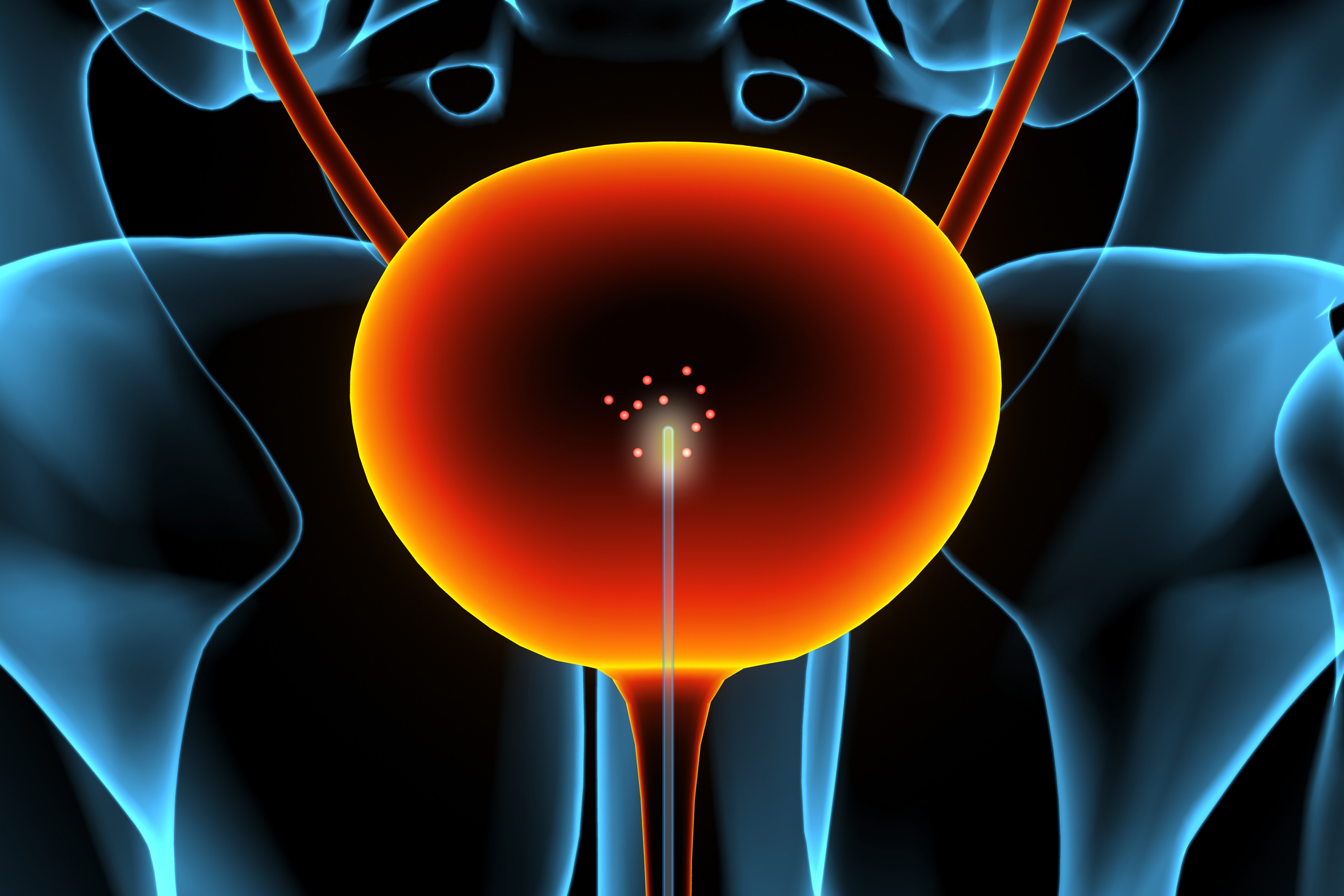
Every year, about 85,000 Americans are diagnosed with bladder cancer. While treatment is often successful, bladder cancer has one of the highest rates of recurrence of any cancer: Following treatment, about 50 percent of patients develop tumors again within the next five years. This makes it one of the most expensive cancers for society to treat.MIT researchers have now developed a new way to regularly monitor those patients, which could enable regrowing tumors to be detected much earlier. Using a catheter coated with specialized nanosensors, the team showed that they could detect very low levels of a protein produced by bladder cancer cells and image their location in tissue.The researchers calculate that this sensing approach is nearly 50,000 times more sensitive than urinalysis, an approach that has been used to monitor bladder cancer in patients. In an animal study, they showed that fluorescent signals produced by the sensors can be used to pinpoint the location of the tumor within the lining of the bladder, providing a chemical image.“It’s like a camera for molecules instead of light,” says Michael Strano, the Carbon P. Dubbs Professor of Chemical Engineering at MIT. “If you have a billion nanosensors in an array, you can use them to make a chemical image that helps you locate their source.” Strano is the senior author of the study, which appears today in the journal Nature Nanotechnology. Wonjun Yim, a Schmidt Science postdoc, and Hohyung Kang, an MIT postdoc, are the lead authors of the paper. Other authors include MIT graduate student Marco Machado, undergraduate student Maeve McGinnis, and postdoc Byungha Kang.“Chemical images”
A new sensor could enable earlier detection of bladder cancer
Using catheters coated with carbon nanotubes, MIT researchers developed a new way to monitor bladder cancer patients for tumor recurrence.
1,097 words~5 min read