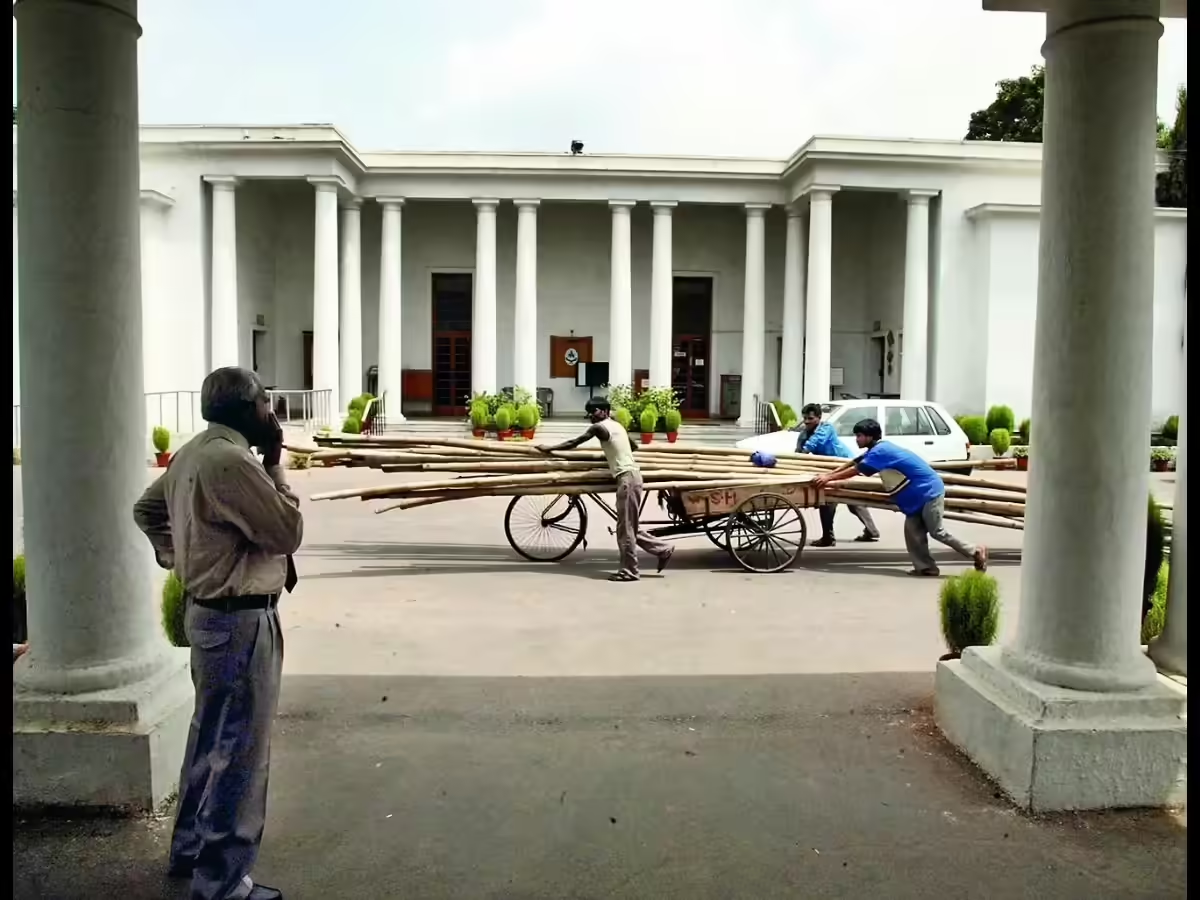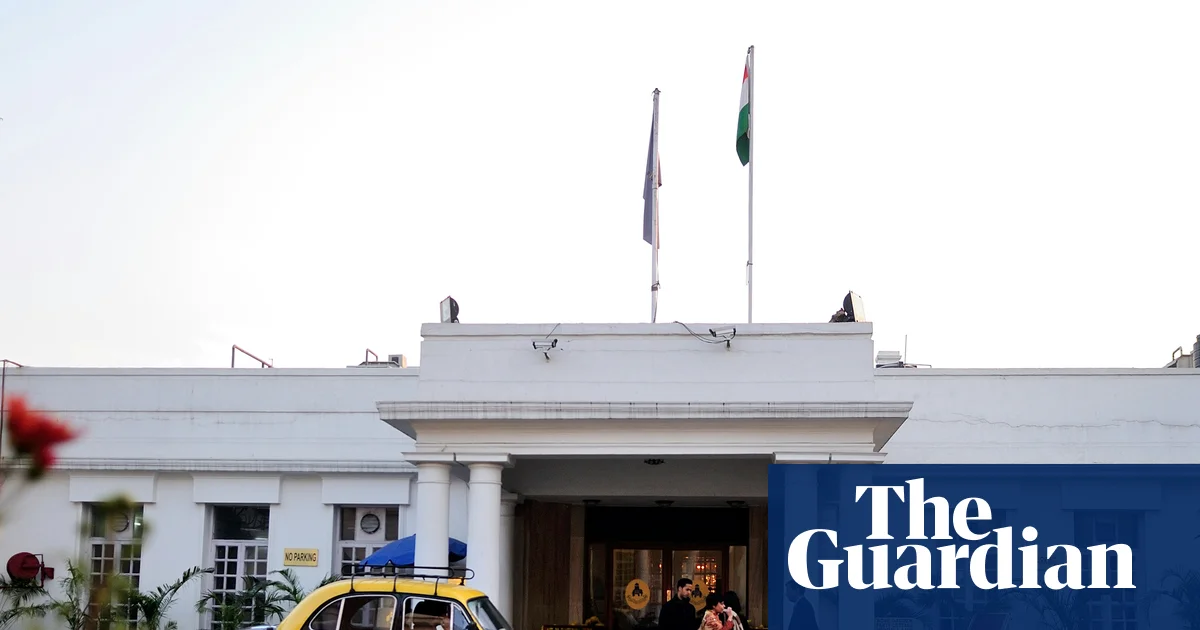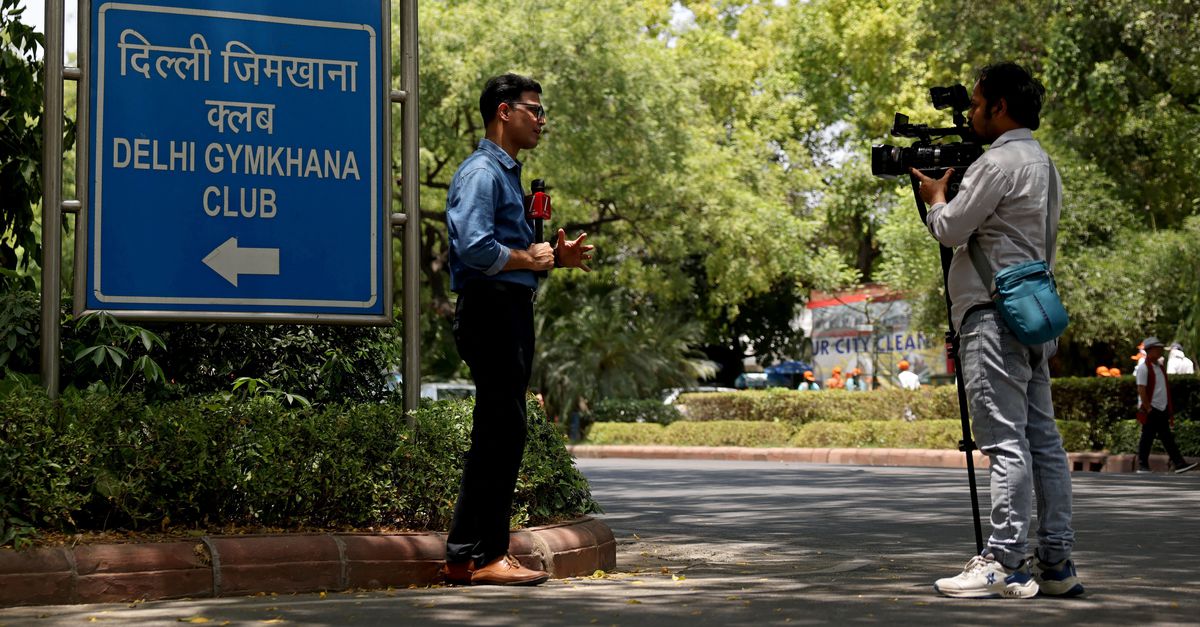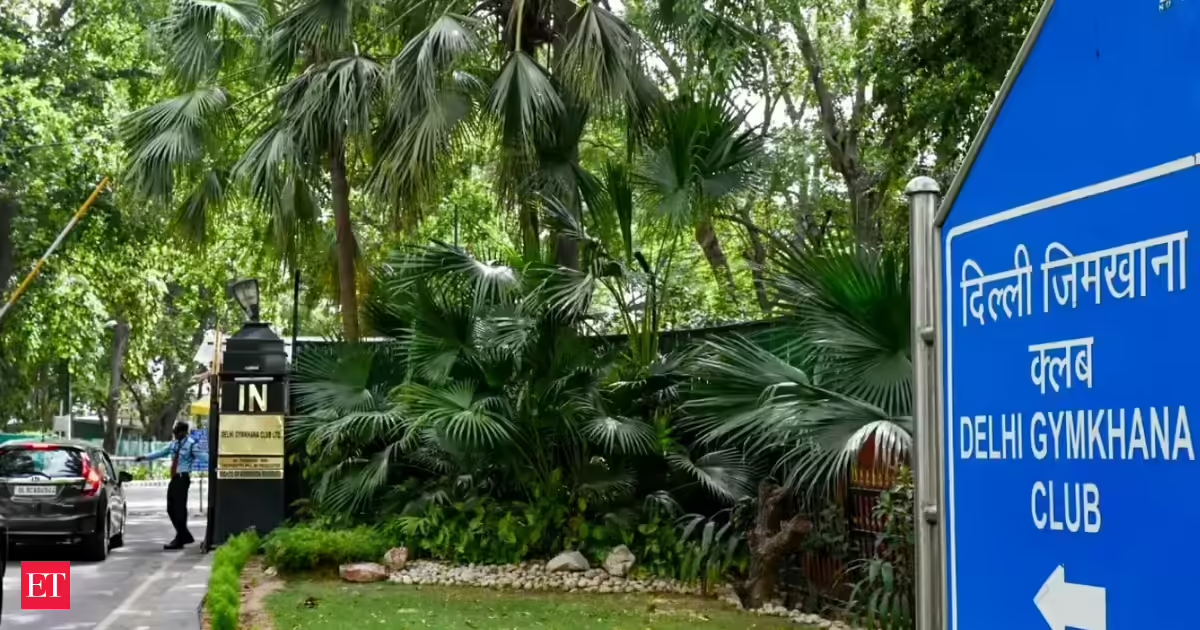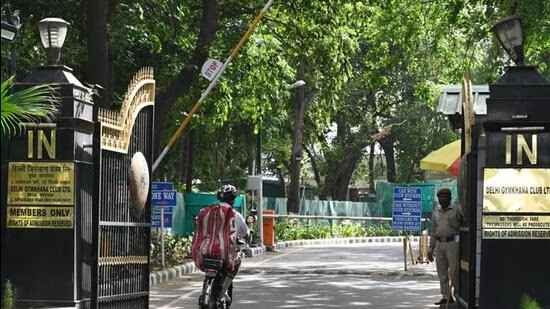
If one were asked to describe the current state of the Bharatiya Janata Party (BJP) and its top leadership in one sentence, it would have to be Charles Dickens’s opening lines from A Tale of Two Cities, “It was the best of times, it was the worst of times”.The attention has shifted to looking for privileged parasites rather than structural holes in India’s economic story. (Delhi Gymkhana Club website)The BJP has buried the ghosts of its 2024 Lok Sabha scare when it failed to secure a majority of its own after back-to-back successes in 2014 and 2019. It has won decisive victories against both its enemies (West Bengal) and friends (Maharashtra and Bihar) in important state elections held since 2024. The Opposition is defeated. Even better, it is disorganised.And yet, there is not much to celebrate and a lot to worry about. The reason lies outside politics. A multi-generational technological disruption in AI threatens the longevity and strength of one of India’s most important post-reform economic stories, namely, IT. Without it, the country will struggle to earn foreign exchange and generate mass white-collar employment. Foreign capital, both speculative and productive, has become cold vis-à-vis India in the recent past. The reasons are partly endogenous (such as lack of AI play) and partly exogenous (such as higher interest rates in advanced countries) to the domestic economy. Weakness on the capital account has come at a time when the current account is under strain due to the biggest ever energy shock in the history of capitalism, thanks to the ongoing war in West Asia.It is too early to declare Mayday for the economy, but things are definitely concerning. Inflation, the rupee's depreciation, and supply-side shortages are posing bumps on the economic road, even though we are not yet facing a full-blown external account crisis. Having spent 12 years in power, it is difficult for the BJP to blame anyone else for the problem.Economists see the problem as a reflection of India’s structural weakness: a lingering current account deficit that can mutate into a crisis in a perfect storm of a terms of trade shock and weak capital flows. For the average person on the street, survival is a bigger challenge than economic arguments. Every mitigation effort by the government is adding to their pain. And things will become worse before they begin to get better.There are spin masters masquerading as subject-matter experts on both sides of the political divide who attribute India’s structural economic vulnerability to either just the current political leadership or anybody but the political leadership. This column has argued on multiple occasions that the reasons for India’s economic vulnerabilities are structurally embedded in the political economy of the democratic dialectic. A domestic capitalist base that is more interested in pursuing what hawkish Marxists would term quasi-comprador behaviour means the focus is on profit-seeking through trade rather than adding to the production base of the economy. This tendency of capital has its insurance in its provision of political finance to the political class. Elections are fought promising paltry palliatives to the poor, but electoral spending dwarfs even the richest countries in the world. On the other side is a huge mass of economically precarious people who are willing to be swayed by economic palliatives. When deployed intelligently along with a potent social strategy – the two must be used as complements rather than substitutes – this is enough to retain power in normal times.But these are not normal times. The economic crisis is threatening to undo the goodwill of even economic palliatives. The poor, many of whom were given the gift of clean cooking fuel under the subsidised LPG scheme, have suffered the most in the aftermath of the war in West Asia. Even the non-poor are being told to exercise moderation and are facing intermittent supply shortages.Where does this leave a government which has been proclaiming India’s economic resilience for the past decade? Not looking good is the short answer. The irony is that steps which can really help contain the situation will strike at the comfort zone of the BJP’s core base: the economically well-off who think it is their birthright to be residents of a trade-deficit country but completely wish away foreign-exchange scarcity. That the prime minister himself denied a speculative report about foreign exchange restrictions is testimony to this fact.To say all this is not to suggest that the government is doing nothing or that there are silver bullets that can make the problem disappear immediately. But in politics, perseverance alone cannot be a strategy. Definitely not in a country with major state elections every year. What politics needs more than anything else is a narrative disproportionate to reality. A narrative which can instil pride and achievement if needed, a narrative which can generate anxiety, even hatred, if required, and, when nothing else seems to be working, a narrative which can evoke schadenfreude by striking at expendable targets.Now, imagine for a second that you are a normal white-collar employee in the country, who pays his taxes and is more worried about mutual fund investments and job security against AI rather than about having to pay ten rupees more at the petrol pump.Who do you blame for the larger structural problems? The powers that be, is the abstract answer. But who is the actual target here? Big corporations that have refused to invest in R&D and investment that could have boosted India’s manufacturing prowess? The political class (across the spectrum)? Such a line of thought will disrupt the existing political economy dialectics. As the dominant political force, the BJP stands to lose the most.How about a political narrative which suggests a strike inside the den of the corrosive elite enjoying feudal decadence? What happens when this privileged bunch starts having a meltdown at the sudden withdrawal of this privilege at a time when the economy faces a much larger challenge? This is exactly what has dominated the news cycle this week: the central government announced it was taking away the heavily subsidised land parcel from the national capital’s most elite club next to the Prime Minister’s residence. Everybody is now engaged and engrossed in debating whether the act is radically egalitarian or motivated by pure vendetta.The attention has shifted to looking for privileged parasites rather than structural holes in India’s economic story. A decoy is sometimes more effective than fighting a war head-on. The politically astute BJP likely knows the value of such decoy-based schadenfreude. The not-so-astute (based on the results) Opposition is having two of its best lawyer-politicians defend this elite privilege in the courts. This author would like to put his neck on the line and argue that this is exactly what the BJP would have hoped for. You would soon see their top leadership exploit this in polemics, where it is easier to draw tenuous connections between the current economic difficulties and the allegedly poisoned tree of the privileged Indian elite, which is still wedded to the political opposition.A little bit of history is useful to end the column.Almost 60 years ago, the Congress party was meeting in a special session after its shocking performance in the 1967 elections. Indira Gandhi had as big a battle on her hands within her party as she had outside. She found the so-called “Young Turks” advocating a radical economic programme useful to rabble rouse against the old-guard of the party, which wanted to get rid of Gandhi. Historian Srinath Raghavan describes this economic programme as amounting to “little more than milk-and-water socialism mingled with a fair dose of vitriol of the (Congress) old guard” in his book Indira Gandhi and years that transformed India. One of the points in the programme was the abolition of privy purses for erstwhile kings. This, along with bank nationalisation (a far more consequential decision for economic policy than abolition of privy purses) became the bedrock of Indira Gandhi’s economic populism which she exploited to destroy not just her opponents within the Congress but also the political opposition in the 1971.To be sure, India’s structural economic problems remained what they were despite Gandhi's radical decisions. The judiciary initially found both decisions unconstitutional, but Gandhi eventually had her way on both issues.The Congress and other opposition parties keep saying that India’s guardrail institutions are becoming subservient to the executive. The claim does have some truth to it. But the Opposition’s bigger problem is the emaciation of its political instincts rather than India’s institutions. They could learn some of it from Indira Gandhi, among the best when it came to fighting a political war where she started as the underdog. Politics, as Niccolò Machiavelli told us in The Prince requires the cunning of the fox and courage of the lion. On repeated occasions, India’s Opposition is found lacking vis-à-vis both these traits.(Roshan Kishore, HT’s Data and Political Economy Editor, writes a weekly column on the state of the country’s economy and its political fall out, and vice-versa)
Terms of Trade: A colonial club and the art of political schadenfreude
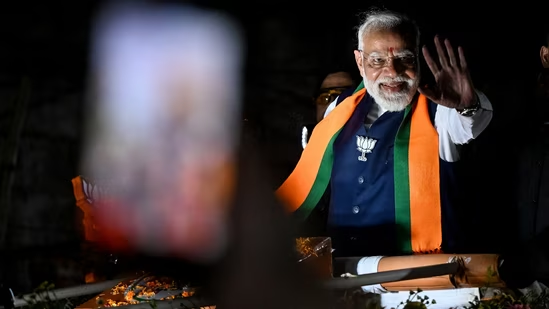
The politically astute BJP likely knows the value of such decoy-based schadenfreude.
1,493 words~7 min read