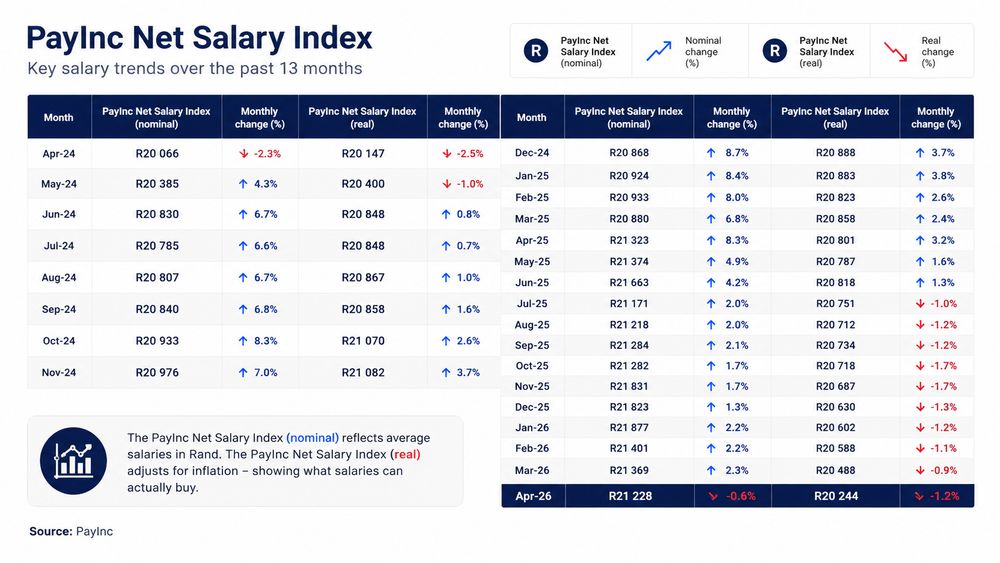
South African salaries declined in both nominal and real terms in April, after two years of relatively strong earnings growth, as the sharp deterioration in the economic outlook for 2026 weighed on the labour market.In the coming months, the value of wages will be further eroded by rising inflation driven by higher fuel costs as global oil supply remains erratic due to the war raging between the US and Iran.National payments utility PayInc’s April index, which tracks about 2.1-million people earning between R5,000 and R100,000 a month on a net basis, showed that the average nominal net salary declined to R21,228 in April, a 0.6% decrease from March and a 0.5% decline from a year ago.In inflation-adjusted terms, the index fell 1.2% month on month and by 2.7% compared with April 2025, reaching R20,244, the lowest real salary level recorded in two years.“The sharp deterioration in the economic outlook following the Middle East war outbreak is already filtering through to the labour market,” independent economist Elize Kruger said.“Companies are facing heightened uncertainty around profitability, costs and planning, and this is beginning to place pressure on earnings growth and employment prospects.”After a promising start to the year, when inflation eased steadily to reach 3% in February, the level now targeted by the South African Reserve Bank (SARB), the price gauge spiked to 4% in April, in direct response to a hefty fuel price increase which was the highest monthly adjustment on record despite the government trying to soften the blow by slashing the general fuel levy that is built into the cost.Petrol and diesel prices jumped further in May, and consumers are bracing for further leaps in coming months, particularly after the government terminates the general fuel levy reprieve, which has cost it R17bn in lost revenue.With inflation expected to accelerate further for the rest of the year, the central bank is expected to hike its main policy rate when it concludes its third policy meeting of the year on Thursday, particularly if it sees second-round effects emerging from fuel costs.“The anticipated worsening inflation scenario will hit salary earners on multiple fronts. First, fuel and increasingly other items are becoming more expensive (on top of administered prices and medical insurance escalations) as the purchasing power of salary earners is dwindling. This is reflected in declining real salaries,” PayInc said.“Second, the SARB may react to the worsening inflation outlook by hiking the interest rates, pushing up the cost of credit and further impacting the disposable income of salary earners. And third, companies are likely to retract to conservative mode in the light of the economic pressures, postponing investment plans and pausing their workforce expansion.”In the latest sign of the stress that companies are under, Statistics South Africa on Wednesday said the total number of liquidations increased by 17.1% to 233 in April compared with the same month last year.The number of liquidations increased by 8.8% to 732 in the three months ended April.South Africa’s labour market is already in dire straits, with the latest quarterly labour force survey showing that unemployment surged to 32.7% in the first quarter of 2026 from 31.4% in the final quarter of last year and was even higher at 45.8% among young people aged 15 to 34.The economy is expanding far below the 3% or more needed to create jobs, with growth this year likely to be even less than the tepid 1.1% registered last year.The PayInc report coincided with one from debt counselling company DebtBusters, which said income growth is not keeping pace with rising costs.Consumers’ debt burdens remained elevated in the first quarter of 2026, with those who applied for debt counselling needing 64% of their take-home pay to service what they owed, DebtBusters executive head Benay Sager said.While the top earners’ debt has grown by 42% since 2021, lower-income earners have seen total debt decline by up to 25%, but this is due to less access to credit rather than improved financial health.“Unsecured loans are being granted to a smaller group of consumers, highlighting that risk is being concentrated in an even smaller group,” said Sager.
Take-home salaries shrink to two-year low as inflation and war bite
Debt burdens grow heavier as real salaries hit lowest point in two years
682 words~3 min read