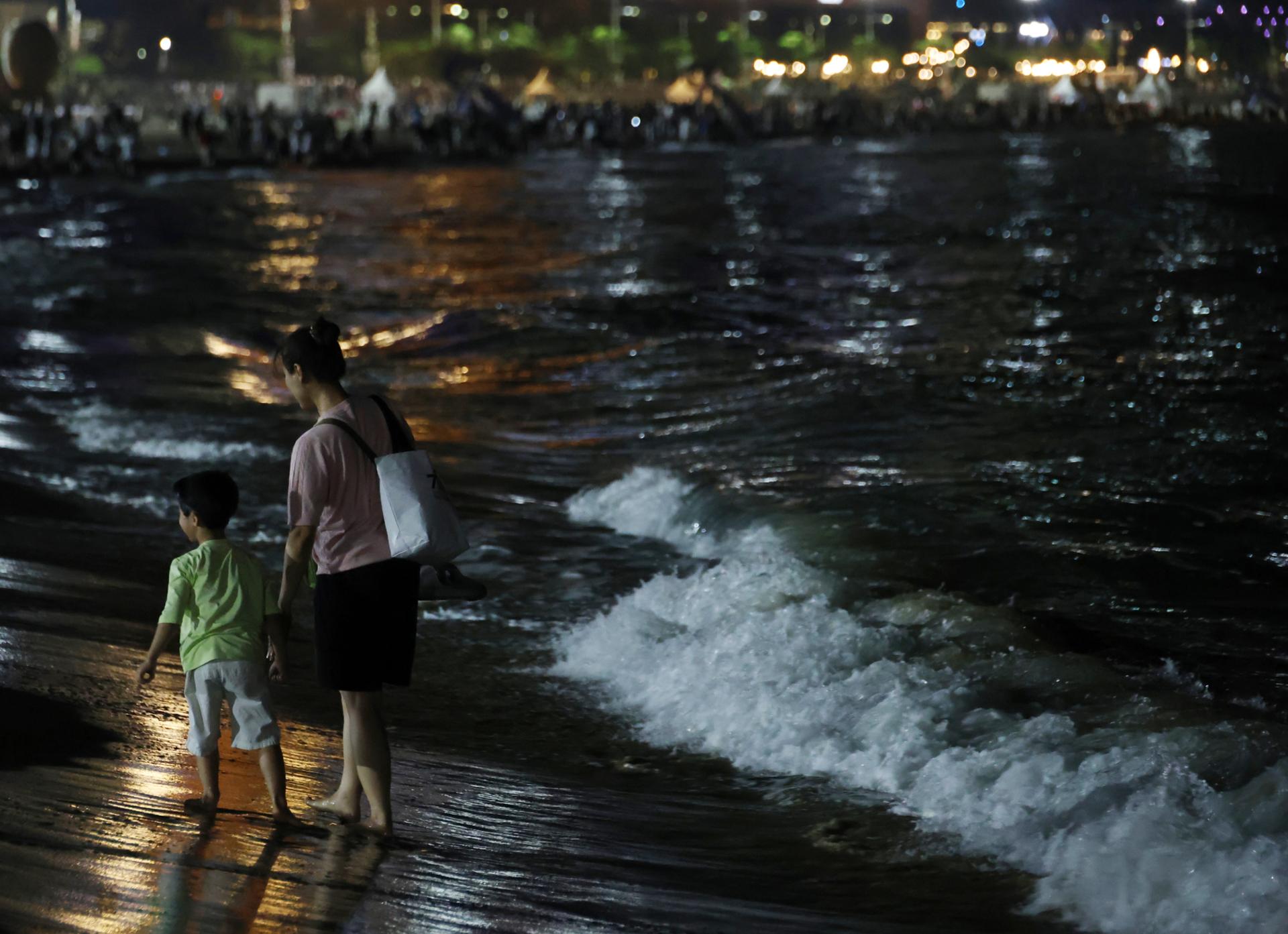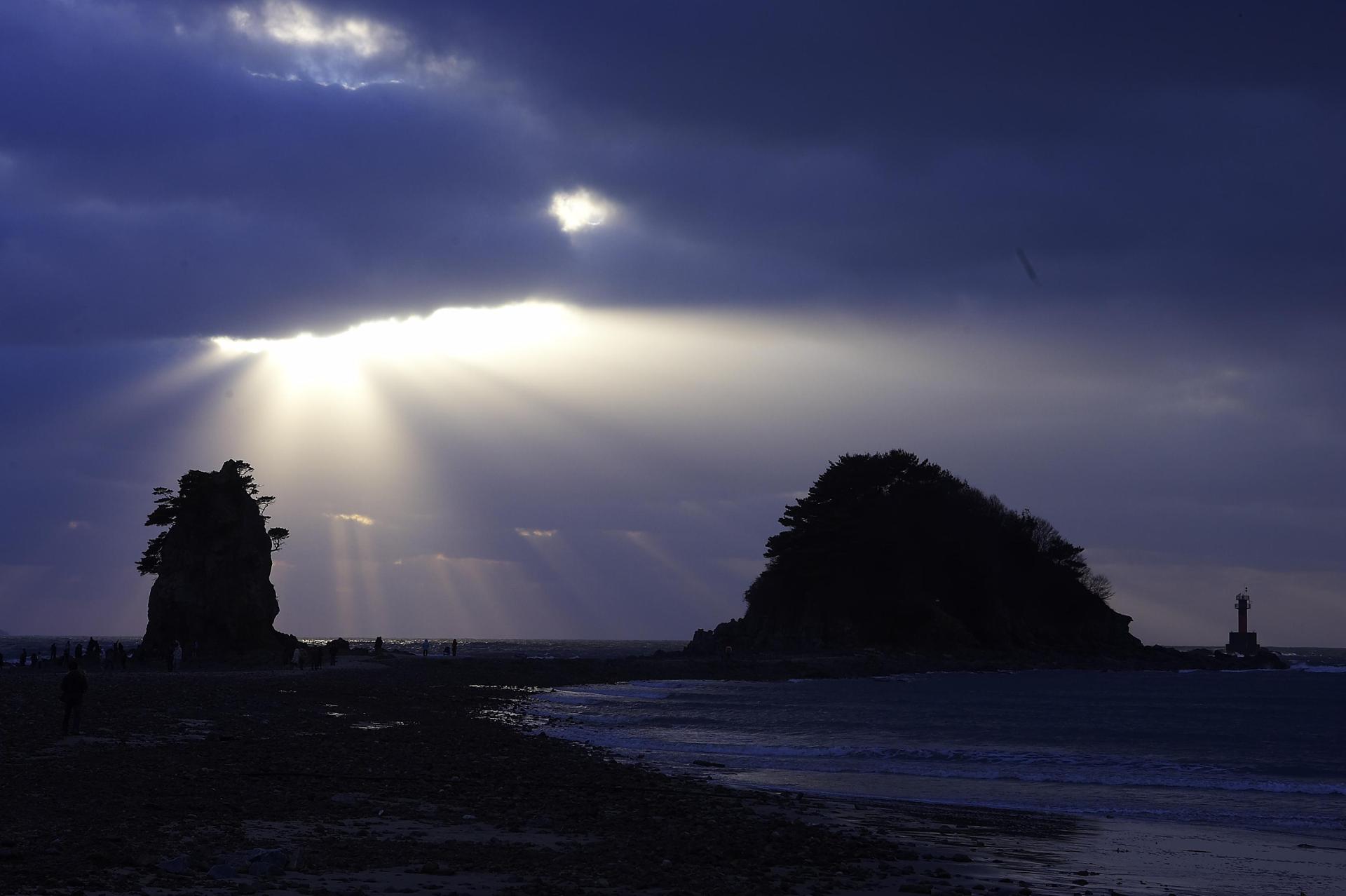
Halmi and Harabi Rocks stand in the shallows at Kkotji Beach on Anmyeon Island, South Chungcheong Province. gettyimagesbankKorea is a country bordered by sea on three sides, each coastline carrying its own charms. The East Sea draws visitors with its crystalline waters and dramatic cliffs. The southern coast enchants with its labyrinth of islands. The West Sea, flatter and quieter and governed by tides rather than waves, has long played second fiddle.Yet the stretch of shoreline running through South Chungcheong Province makes a compelling case for a slower, less-glamorized kind of travel.Taean and Seosan, two towns situated roughly 150 kilometers southwest of Seoul and reachable by car in about two hours, sit at the heart of this coastline. The region rewards visitors eager for more texture than spectacle: tidal flats and sunset skies, fermented crab stew and octopus broth, cattle grazing against mountain ridgelines, and centuries of history folded into fortress walls. None of it announces itself, but all of it lingers.Kkot Bridge spans the waters between Kkotji Beach and Bangpo Harbor on Anmyeon Island in Taean, South Chungcheong Province. NewsisTides, sunset and 'haerujil'Kkotji Beach on Taean's Anmyeon Island is perhaps the most iconic destination in the area, and its appeal lies not in any single fixed feature but in the way the landscape reshapes itself with the tides.At low tide, the sea retreats to reveal wide mud flats, where visitors and locals alike practice something called "haerujil," the traditional method of digging for clams and shellfish. The activity, simple and calming, reflects something essential about the Chungcheong way of life — there is always something to wait for, and always something to find when you do.The beach is flanked by two sea stacks, known as Halmi (Grandmother) Rock and Harabi (Grandfather) Rock, which stand side by side in the shallows as natural landmarks. A small but graceful pedestrian bridge, Kkot Bridge, arcs across the water connecting the beach to the neighboring Bangpo Harbor fishing village.In the evenings, the beach earns its reputation as one of the most celebrated sunset spots on the West Sea. The sun descends in a slow arc toward the horizon, turning the water copper and orange and casting the sea stacks in silhouette. Exhibits and installations stand ready at the venue of the 2026 Taean International Horticultural Healing Expo on April 22, three days before the event's opening. The expo ran from April 25 to May 24 across the Kkotji Beach area in Taean, South Chungcheong Province. YonhapThe area around Kkotji Beach has also served as the venue for Taean's annual spring flower events, and 2026 was no exception. The Taean International Horticultural Healing Expo, which ran from April 25 to May 24, brought together majestic floral installations, nature-themed walking paths and wellness programming alongside exhibitor booths from companies in the health, horticulture and food sectors. The result was a companion to the better-known Taean World Tulip Flower Expo, itself an internationally recognized event. Having been designated one of the world's five great tulip festivals in both 2015 and 2017 by an international conference representing 14 countries, this year's edition moved to a larger site near Mageompo to accommodate its expanded scale. The new venue, at the Korea Flower Park, hosted the largest installation in the expo's history. Both events are held annually each spring and are worth planning around for future visits.Gegukji, a fermented kimchi stew unique to the South Chungcheong area, traces its roots to the brine left over from making gejang, or soy-marinated crab. The version served today features whole flower crabs simmered in a spiced broth. Courtesy of Songjong Kkotge HouseEating the regionNo visit to the Chungcheong region is complete without engaging with the local food culture, which is rooted in the rhythms of the sea and farmland."Gegukji" is the dish that most defines the region. A fermented kimchi stew made with crab brine, it traces its origins to the practical ingenuity of Chungcheong's coastal kitchens — the liquid left over after preparing "gejang," or soy-marinated crab, was traditionally used to ferment cabbage and radish, producing a deeply savory, pungent kimchi that could be simmered throughout the winter. What now appears in most restaurants, blue crabs simmered whole in a spiced broth, is a more crowd-pleasing modern evolution. Older locals, with wry affection, sometimes note that the dish has drifted far from its roots. Both versions, however, carry the same briny depth that sets the regional table apart. In the area, Songjong Kkotge Jip and Ttanttuk Tongnamujip Sikdang are well-regarded spots to try it."Baksok nakjitang" is the other essential. A whole "nakji," the small, long-armed octopus native to Korean coastal waters, is simmered together with the white flesh of a bottle gourd, producing a broth that touches the soul. Lore holds that nakji is potent enough to revive cattle felled by the summer heat — an old country claim, but one the broth almost makes believable.The gourd tempers the brininess of the octopus, and the octopus gives body to what might otherwise be a plain, clear vegetable soup. The combination sounds unlikely, but the result is surprisingly addictive. Baksok nakjitang pairs whole octopus with the white flesh of a bottle gourd, producing a broth that is clean and restorative. gettyimagesbankAn unexpected pastoralInland from the coast, Seosan Hanwoo Ranch, designated the eighth of Seosan's Nine Scenic Wonders, offers a view of Korea that most visitors do not expect to find. Rolling pasture unfolds beneath curved mountain ridgelines, well-tended and wide open in a way that is rare even in the Korean countryside. The ranch has been colloquially nicknamed "Korea's Alps," a poetic comparison given the unusual openness of the terrain. A 2.1-kilometer walking trail winds through the venue, linking elevated viewpoints and offering sustained views of the grazing landscape. On clear days, "hanwoo," the prized Korean cattle breed known for its large, tawny build, can be spotted moving across the distant hillside in loose herds.For visitors from Seoul, where open land is a distant memory, the effect can be disorienting in the best way. The open pasture at Seosan Hanwoo Ranch is designated the eighth of Seosan's Nine Scenic Wonders. The ranch's 2.1-kilometer walking trail offers views of a pastoral landscape rarely found in Korea. Korea Times file Centuries in wood, stoneSet on the slopes of Mount Sangwang in Seosan, Gaesim Temple was founded in 654 during the Baekje period (18 B.C.-A.D. 660) and ranks among South Chungcheong Province's four great Buddhist temples. It's the fourth entry in Seosan's Nine Scenic Wonders.Each spring, the temple draws visitors for a botanical curiosity found nowhere else in Korea — cherry blossoms with soft, yellowish-green petals rather than the usual pink. The blossoms arrive in mid-to-late April, weeks after ordinary cherry blossoms have already fallen elsewhere, and bloom alongside deep pink double-petal cherry blossoms. The two varieties together make for an unusually vivid spring display.The temple's name, "gaesim," means to "open the heart," and the approach does something to earn the name. A 15-minute forest path climbs from the parking area alongside a small stream, the sounds of running water and birdsong accompanying the ascent. Gaesim Temple in Seosan, South Chungcheong Province / Korea Times photo by Pyo Kyung-minHaemi Eupseong, a stone-walled fortress in Seosan, has also stood since the early 15th century during the Joseon Dynasty (1392-1910) and carries more layers of history than any one visit can fully absorb.Designated National Historic Site No. 116 and the first of Seosan's Nine Scenic Wonders, it was built to defend the western coast against external threats and served for centuries as the headquarters of the Chungcheong provincial garrison.Among the garrison's early postings was the young Admiral Yi Sun-sin (1545-98), who served at the fortress in 1579, several years before his legendary naval campaigns against the Japanese would make him Korea's most celebrated military hero.Haemi Eupseong's history took a darker turn in the 19th century, when it became the site of some of the most brutal Catholic martyrdoms of the Joseon era. During the repeated waves of Catholic persecution, thousands of believers were imprisoned, tortured and executed here. The zelkova tree used to torture detainees still stands inside the walls.That history drew Pope Francis to Haemi Eupseong in August 2014, when he visited Korea for Asian Youth Day and prayed for the martyrs. In 2020, the Vatican formally designated the fortress an international holy site, the first such designation in Korea.The weight of that history now coexists with the present that is calm and openly welcoming. The fortress interior, where wide grass lawns are flanked by restored historic buildings, is well-maintained and pleasant to walk. A flight of 108 steps leads up to Cheongheo Pavilion, where a backdrop of pine and bamboo trees creates one of the most beautiful views in the region.Haemi Eupseong, a stone fortress in Seosan, South Chungcheong Province, that has stood since the early 15th century, holds layers of military, religious and royal history within its walls. Korea Times fileThe Chungcheong region has a reputation among Koreans for its particularly slow, calm and somewhat understated temperament, a unique characteristic that some may interpret as a little plain.It describes the food, the landscape and, perhaps, the sensibility of the people who have lived along this coast for generations.But plain does not mean empty. Taean and Seosan offer, in the space of a long weekend, a tidal beach and one of Korea's most celebrated sunsets, a nationally recognized flower festival, food rooted in centuries of coastal ingenuity, an improbable pastoral hillside of grazing cattle, a temple path that eases the mind, and a fortress whose 600 years of accumulated history — military, spiritual, bloody and quietly sanctified — are preserved and open to exploration.It is a kind of travel that does not insist on claiming the spotlight, or being posted on countless dopamine-inducing platforms. That, for some visitors, will be precisely the point.
West Sea towns of Taean, Seosan reward slow travelers - The Korea Times
Korea is a country bordered by sea on three sides, each coastline carrying its own charms. The East Sea draws visitors with its crystalline waters...
1,638 words~7 min read