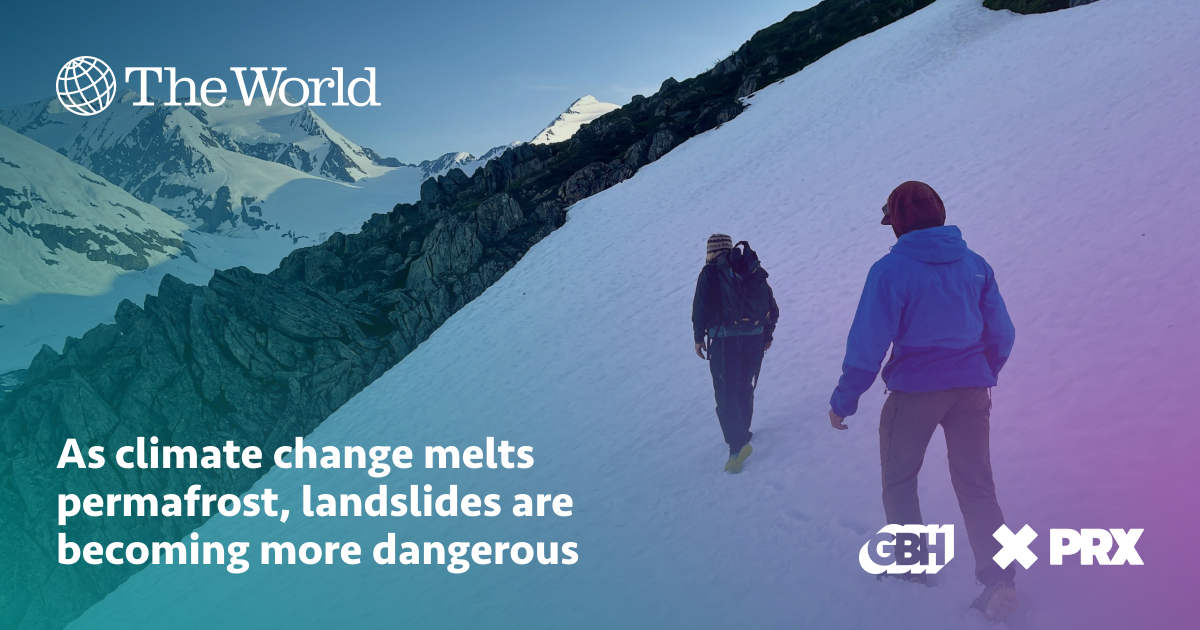
Public radio’s longest-running daily global news program.AboutContactDonateMeet the TeamPrivacyTerms of use©2026 The World from PRXPRX is a 501(c)(3) organization recognized by the IRS: #263347402.As climate change melts permafrost, landslides are becoming more dangerous In northern latitudes and high altitudes, permafrost stays frozen year-round, holding mountain summits together. As global temperatures rise, much of it thaws, loosening soil and increasing landslide risk. National Geographic Explorer Paul Salopek is in Alaska, observing a man developing an early warning system for landslides to help communities prepare.7:23Just another day at the office: Bretwood “Hig” Higman and Krishna Divakarla head up the rim of Portage Glacier, near Anchorage, Alaska, to monitor a massive landslide risk.Scrambling up the side of a mountain, tracing the path of a receding glacier, is not a part of most people’s average day at the office. But for National Geographic Explorer Paul Salopek, walking across much of the world, it is all in a day’s work.Salopek recently huffed and puffed his way up a mountain in Alaska to learn about how the permafrost melting under his feet and the glacier receding alongside him will eventually trigger a massive landslide.He shared more with The World’s Host Carolyn Beeler.Paul Salopek: Yeah, it was something new to me. It’s something called a geohazard. Mountains, you know, tear themselves down all the time through millions of years of erosion. But apparently, what’s happening is that with the climate crisis — the human-made climate crisis — accelerating around the world, these colder parts of the world, where there are vertical slopes, you know, mountains in the Arctic and in very high altitudes where there’re glaciers, the glaciers are starting to melt, the permafrost is starting to fall. And then you add in increased rains — instead of snowing, it’s raining — so it creates more runoff. And then seismicity, right? Earthquakes … all is leading to an increase in landslides across the world, anywhere where these are these conditions. Student Krishna Divakarla, geologist Bretwood “Hig” Higman, and guide Phil Norris take in the receding terminus of Portage Glacier, near Anchorage, Alaska. The glacier has receded about four kilometers since the early 1900s, largely because of global warming.Paul Salopek/National Geographic, Out of Eden WalkPaul Salopek/National Geographic, Out of Eden WalkBasically, the way it was explained to me is that you can see tremors increase. Their frequency starts to increase. And that doesn’t tell you exactly when it may happen. And Higman, he was very plain, he said, “Paul, some of these things have been hanging in a kind of suspended animation for centuries, and others kind of surprise us. They happen behind our backs, and we don’t have it down yet. The science of predicting it is complicated.” Another way, other than motion sensors, is subsonic sound, which is kind of cool. Some scientists have implanted listening devices into the sides of mountains, which emit sounds that the human ear can’t hear, increasing in frequency up until slightly before the mountain collapses. Then it goes kind of dead silent for this ominous period before the mountain slides down. So, they’re trying different technologies to give human beings a little warning that a catastrophe is about to happen.Geologist Bretwood Higman displays a predictive computer model of the likely consequences of a landslide into Portage Lake, near Anchorage, Alaska. The shockwave from a collapsing mountainside would send a tsunami of water across the glacial lake, engulfing a visitors’ center, a highway, and the undersea cabling that carries about half of the state’s internet capacity.Paul Salopek/National Geographic, Out of Eden WalkParts of this interview have been lightly edited for length and clarity.Writer and National Geographic Explorer Paul Salopek has embarked on a 24,000-mile storytelling trek across the world called the “Out of Eden Walk.” The National Geographic Society, committed to illuminating and protecting the wonders of our world, has funded Salopek’s project since 2013. Explore the project here. Follow the journey on X at @PaulSalopek, @outofedenwalk.
As climate change melts permafrost, landslides are becoming more dangerous - The World from PRX
In northern latitudes and high altitudes, permafrost stays frozen year-round, holding mountain summits together. As global temperatures rise, much of it thaws, loosening soil and increasing landslide risk. National Geographic Explorer Paul Salopek is in Alaska, observing a man developing an early warning system for landslides to help communities prepare.
656 words~3 min read