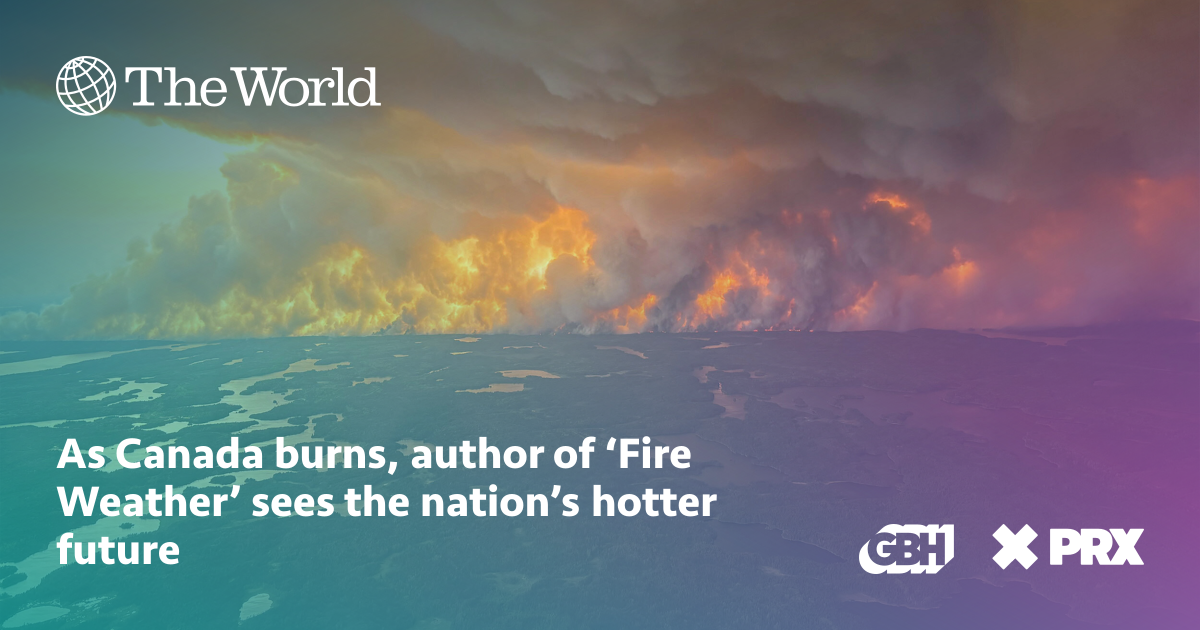
Public radio’s longest-running daily global news program.AboutContactDonateMeet the TeamPrivacyTerms of use©2026 The World from PRXPRX is a 501(c)(3) organization recognized by the IRS: #263347402.As Canada burns, author of ‘Fire Weather’ sees the nation’s hotter futureMore than 30,000 people in Canada have been evacuated due to wildfires, and millions of acres have burned — and it’s only the start of the fire season. John Vaillant, author of “Fire Weather: A True Story from a Hotter World,” said climate change is making conditions ideal for stronger, more frequent fires.12:19Wildfires in Sherridon, Manitoba, Canada on Tuesday, May 27, 2025.Wildfires are continuing to burn across central and western Canada, with no signs of letting up. Two people have died, and more than 30,000 people have now been evacuated across Manitoba, Saskatchewan and Alberta. Many of these people are from remote First Nations communities — with limited escape routes. Smoke from the fires has caused air quality alerts in the United States and hazy skies that reached as far as Europe. “Right now, 2025 is on pace to match that terrible fire season of 2023,” which was the worst fire season in the country’s recorded history, said John Vaillant, author of “Fire Weather: A True Story from a Hotter World.” Millions of acres of land have burned — and it is only the beginning of the fire season.According to Vaillant, an area the size of Florida burned in 2023, and set a planetary record for pyrocumulonimbus fire systems, which are fire clouds that puncture the stratosphere and generate their own lightning.“What we’re getting now is bigger fires, faster moving fires, more destructive fires and also a faster return rate for those fires,” said Vaillant. “So instead of burning through once every 50 or 200 years, they’re coming through every five years, every 10 years.”There are so many downsides to climate change, but as the atmosphere warms, it actually generates more lightning. My understanding is with every degree of warming, you get about 12% more lightning. So, you can have very remote areas in Alaska or the far north of Canada where there are simply no human beings whatsoever, and many fires can be started there by lightning. But most fires, especially around settled [or] inhabited areas, about 80% of those fires are human caused, which means a carelessly managed campfire, a hot muffler, a spark coming off a chain … you know … hanging off a bumper on the road and flying into the dry grass. We are a flamboyant species and we have a lot of fire around us all the time and they get out of control.Almost all fires start small and it really depends on the weather conditions. Boreal forests, the northern forests of Canada and Alaska, are really the wettest biome on earth. In spite of that, the weather conditions for Fort McMurray, Alberta on May 2016, the relative humidity was 11%. You have to go to Death Valley in the month of July to find a comparable relative humidity. So, [you] find desertic dryness in the northern boreal after two years of drought. And then you break the temperature record for that day and put it up into the 90s. And then, you set it on fire. Even with water bombers on it, almost immediately burned out of control. And once the heat starts billowing out of that fire, it starts generating its own wind and it starts throwing the embers. But [then] you have radiant heat, which is the invisible heat that tells you not to touch the candle; it moves at the speed of light. And the radiant heat coming out of this wall of flame sweeping into Fort McMurray was about 900 Fahrenheit. So that’s hotter than the planet Venus. And what that does is not only does it generate more wind, it desiccates everything in front of it for many hundreds of yards. So every tree, every house, everything is bone dry and then heated up past combustive temperatures. So, the moment an ember lands on it, again, it doesn’t just sizzle, it explodes into flame. There’s a cumulative effect to climate change. We had the hottest year in recorded history in 2024 … 2023 was almost as hot as that. And as you raise the temperature of anything, you’re going to have more evaporation.So, we’ve got four, or potentially five more months, of fire season for Canada. We’re really just getting started and we’re also just heating up. And we haven’t had proper snow pack in years. Rivers, bogs are all evaporating much more quickly than they normally would, and so all kinds of water levels are at record lows across western Canada. And, again, that just exacerbates the situation. You have this compound effect. And here’s quite an interesting detail … Maybe you’ve heard of zombie fires, also known as holdover fires.One of the really heartening byproducts of these fires is this incredible community response. When Fort McMurray was evacuated, almost 90,000 people were run out of there in an afternoon. It was the biggest, most rapid evacuation due to fire in modern times. And the rest of Canada opened their arms to those people. But when it keeps happening, it’s very taxing to the finances, to the social capital, to just the toothpaste supplies in local stores, when thousands of new people suddenly descend on a community. And while people are generous and helpful, there are limits. [High Level, Alberta] has officially announced that they won’t be taking in fire refugees this season because they’ve done it for the past couple of seasons and it’s a small community, they don’t have a lot of margin. They’re basically saying we can’t handle it anymore. And it’s not because they’re selfish or don’t love their neighbors. It’s simply because their resources are exhausted. It’s also physically exhausting, looking after hundreds if not thousands of new people who might be traumatized, are certainly disoriented and need everything, because they’ve left everything behind.This is another terrible test that climate change is imposing on us. We can handle disasters most of the time. But what we don’t do so well is serial disasters. They’re a terrible drain on every kind of resource. And they’re so demanding and so violent. And then there’s the trauma … that needs to be counted in terms of when we tally the costs of these events.This interview has been lightly edited and condensed for clarity.AP contributed to this report.As Canada burns, author of 'Fire Weather' sees the nation's hotter future - The World from PRX
As Canada burns, author of 'Fire Weather' sees the nation's hotter future - The World from PRX
More than 30,000 people in Canada have been evacuated due to wildfires, and millions of acres have burned — and it's only the start of the fire season. John Vaillant, author of "Fire Weather: A True Story from a Hotter World," said climate change is making conditions ideal for stronger, more frequent fires.
1,092 words~5 min read