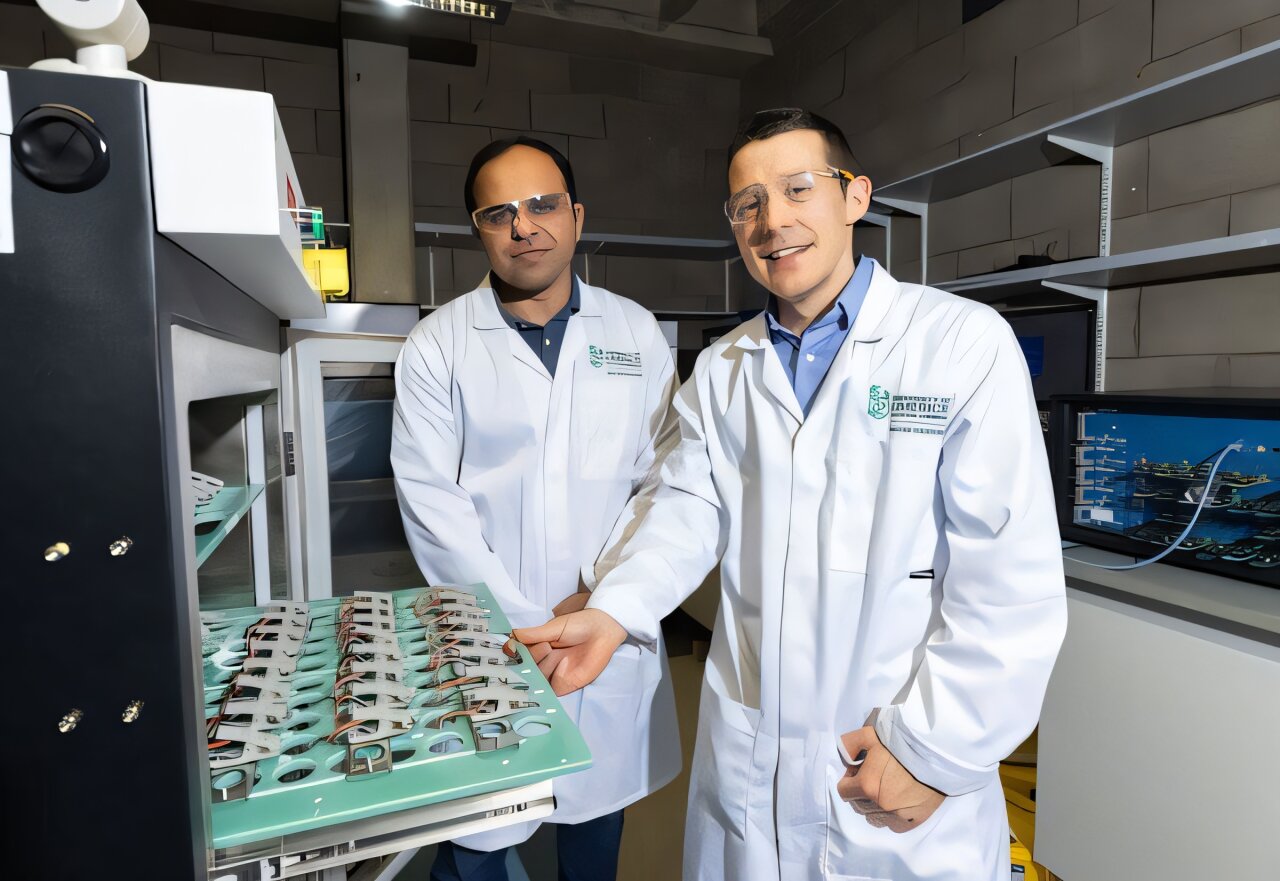
Syed Abdul Ahad (L) and Hugh Geaney are shown with the experimental set-up. Credit: University of Limerick
The world we live in today runs on batteries. But the lithium ion batteries that dominate the market are expensive and environmentally demanding to extract. The raw materials for lithium ion batteries are scarce and concentrated in a few geographical regions. This places continued pressure on supply chains.
Sodium-ion batteries are a promising alternative because they use abundant materials. But sodium has shortcomings that have blocked it from being used as a replacement for lithium.
In work carried out at the University of Limerick's Bernal Institute, my team has now produced a battery that combines the strengths of sodium and lithium. This could lead to more sustainable batteries that reduce the supply chain pressures associated with lithium. The results have been published in the journal Nano Energy.
Sodium-ion batteries lag behind lithium ones in their energy density. Energy density is the amount of energy stored in a battery relative to its weight or size. Lower battery energy densities have an impact on the devices and machines they power.