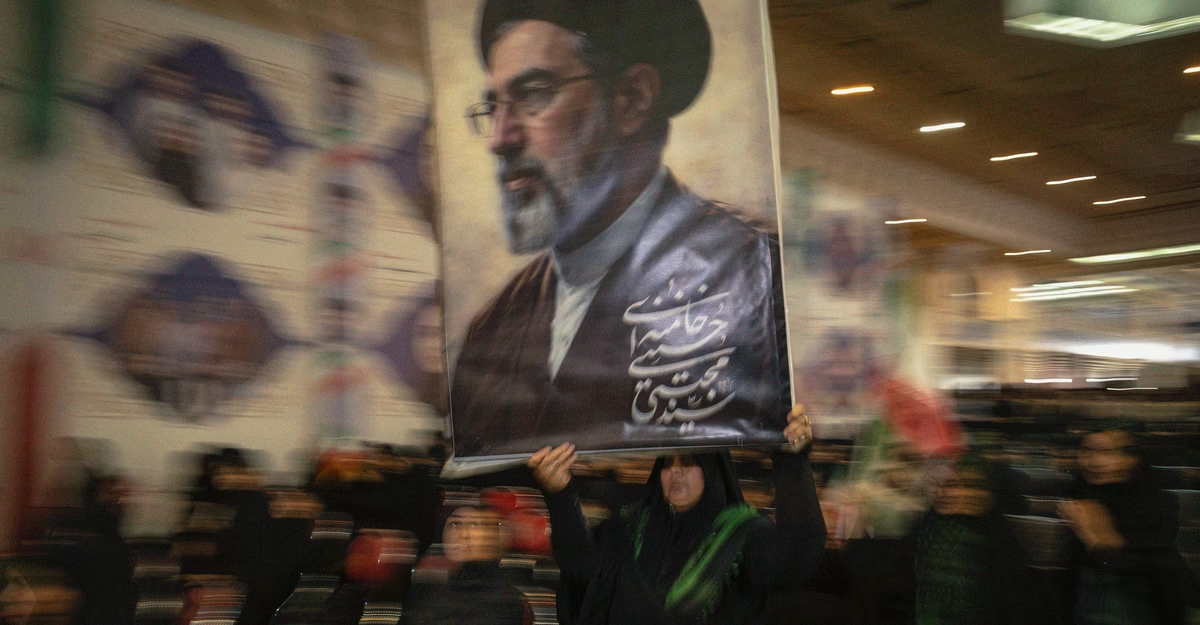
There’s an old line, sometimes attributed to President Dwight D. Eisenhower, that the best way to solve a difficult problem is to make it bigger. That might be the most generous interpretation of how the Trump administration is approaching its ongoing peace talks with Iran.Over the weekend, the news around the talks followed what has now become a familiar pattern. On Saturday, the two sides were reportedly close to a deal to reopen the Strait of Hormuz, and lift the US blockade on Iran. Then on Sunday, President Donald Trump said he had told his negotiators “not to rush” into a deal. On Monday, the United States launched a new round of what it called “self-defense strikes” in southern Iran. The current message from the White House is that they’re giving talks another few days, and continue to believe believe a deal is likely, but haven’t taken a return to full-scale war off the table.Then in a rambling Truth Social post on Monday morning, Trump enlarged the problem by saying that it “should be mandatory” that as part of any peace deal, Egypt, Jordan, Pakistan, Qatar, Saudi Arabia, and Turkey sign on to the Abraham Accords, normalizing relations with Israel. This is unlikely: Saudi-Israeli cooperation against Iran has been the worst kept secret in the Middle East for years, but the international outcry over the war in Gaza has made it politically untenable for these countries to publicly embrace Israel. It’s unclear just how seriously Trump will press for this, but the fact that at this phase in negotiations he’s bringing up new demands sure to irritate his own allies, suggests he’s not exactly desperate to wrap these talks up.The fact that a deal still hasn’t been signed — despite the fact that the underlying dynamics of the conflict haven’t changed much since Iran and the United States signed the current ceasefire agreement in early April — as well as the fact that Trump seems to be expanding rather than narrowing his demands suggests two things that turn the recent weeks of negotiation reports on their head: First, Trump does not believe that he is losing this war. Second, he is still hoping to reach a mega-deal to reset the politics of the entire region.Trump doesn’t think he’s losingBefore the war began, Trump told a concerned Tucker Carlson that despite predictions warning that attacking Iran could destroy his presidency, he was confident everything would be okay “because it always is.” The war certainly hasn’t gone as easily as expected, but it’s very possible Trump still believes he has the upper hand and that everything will work out.Fears of an America First revolt by Trump’s MAGA base also seem to have been overblown.In his defense, the most dire predictions of economic turmoil made when the Strait of Hormuz was closed have not come to pass. Oil prices have been hovering around $100 a barrel and Americans are feeling the impact at the pump, but it’s worth recalling that many energy experts were predicting $200 per barrel oil by now if the strait were not opened. (There are a few explanations for this, but the main ones seem to be that the US and other non-Gulf producers have been able to export more oil than many anticipated, while China has slashed its imports, relying on its substantial reserves. For all the reports of Chinese assistance to Iran’s war effort, in this respect, Beijing may be doing more to help the United States.)The crunch may still hit: There are global concerns about jet fuel supplies ahead of summer travel season, and the impact of the global fertilizer shortage on this planting season won’t be felt for months. But for now, the US economy is not in full-blown crisis mode, and Trump may feel he’s proved the “panicans” wrong.The war is broadly unpopular and a large majority of Americans say it has raised their cost of living, but according to a recent poll by the Eurasia Group’s Institute for Global Affairs, 73 percent of Republicans still approve of Trump’s handling of the situation. Fears of an America First revolt by Trump’s MAGA base also seem to have been overblown.As long as US troops aren’t being killed — and none have been since the ceasefire began — and the economic turmoil stays manageable, Trump may continue to believe that time is on his side. On the other hand, Iran’s current leaders, who believe they can absorb more pain than the Americans and are even less sensitive to public opinion, probably believe that too. This is a recipe for stalemate.War to end all warsIn some respects, Trump has narrowed his goals for the war in Iran. Rather than pushing for caps on Iran’s ballistic missile program or its support for regional proxies like Hamas and Hezbollah as he did in talks prior to the war, Trump now says the “one thing” he thinks about is preventing Iran from acquiring a nuclear weapon.But it would be difficult enough at this point just to get a deal over Iran’s nuclear program that satisfies what appears to be Trump’s main condition: that it be tougher than the deal Barack Obama negotiated in 2015. Though the Iranians have reportedly agreed in principle to dilute or dispose of their stockpile of highly enriched uranium, the White House is continuing to insist that the stockpile itself be turned over to the United States. “No dust, no deal,” one official told Fox News, referring to Trump’s description of the stockpile as “nuclear dust.” That became a harder circle to square last week when Supreme Leader Mojtaba Khamenei issued a directive saying the uranium should remain on Iranian soil.The deal under discussion, according to most reports, simply starts a process of nuclear negotiations over a 60-day period — which would at least lower the temperature, though it leaves the main sticking point unresolved and it’s not hard to imagine the situation deteriorating again during that period.However, his comments linking the Abraham Accords to the resolution of the Iran war suggest that Trump, who is reportedly “bored” by Iran at this point, is thinking bigger. Trump has always expressed confidence that he alone can bring peace to the Middle East as a region, not just solve individual conflicts. Recall that when he announced his plan for ending the war in Gaza last September, he described it as a great day in the “history of civilization” that could bring “eternal peace to the Middle East.” In reality, it didn’t even bring eternal peace to Gaza, but he may be hoping to finish the job now.For the moment, we may be in a dynamic where the costs to Trump aren’t high enough that he feels compelled to end the war quickly, but they’re just high enough that he feels he needs a big win to justify them — whether that’s a deal that demonstrably exceeds Obama or achieves his alleged dream of “eternal peace.”
Trump still thinks he’s winning in Iran
Despite everything, the president is holding out for more before he ends the war.
1,157 words~5 min read