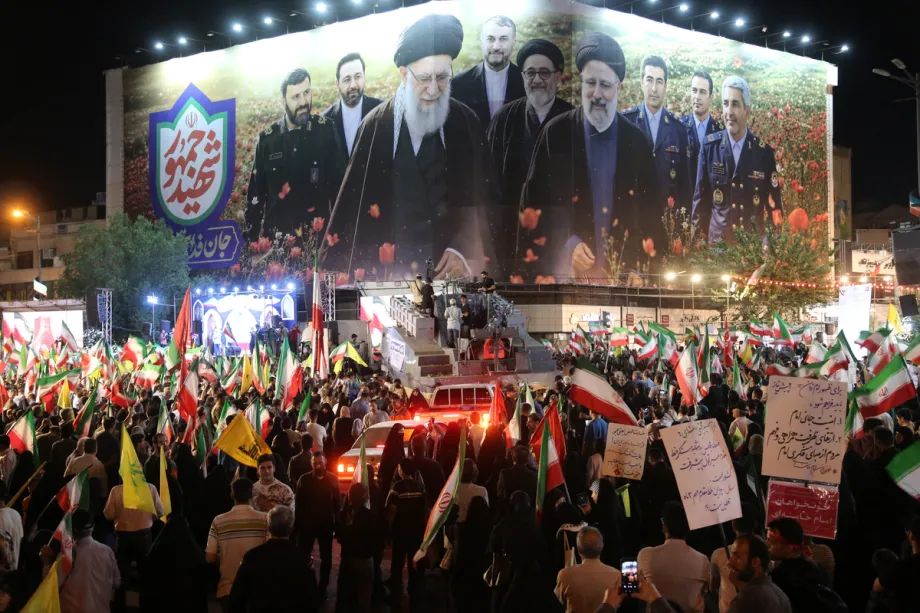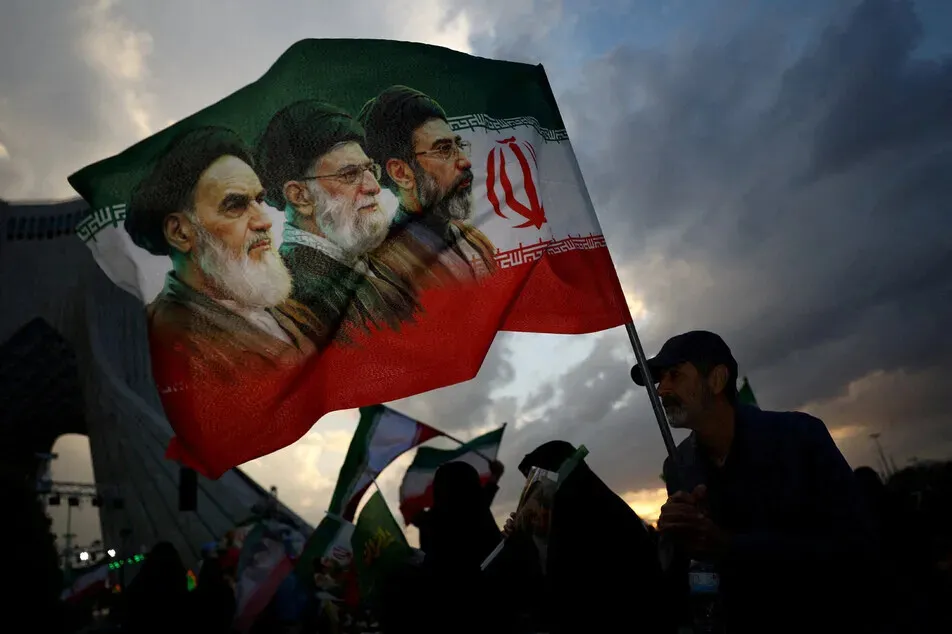
A person holds an Iranian flag depicting the country’s supreme leaders over the years — Ayatollah Ruhollah Khomeini, Ali Khamenei, and Mojtaba Khamenei — during a protest in Tehran on April 29, 2026. (WANA/Reuters/Yonhap)
The US and Iran continue to wrangle for the upper hand in negotiations that seek to end a war that has lasted for over 80 days now.The two sides sharply disagree about whether to include language about Iran’s nuclear program in a proposed memorandum of understanding that would end the war. That program would be a main topic of the negotiations that are supposed to last for 30-60 days after the MOU is signed.A subject of keen interest for the global community is whether two wars have prompted Iran to change its nuclear strategy or whether — as the US and Israel suspect — Iran still harbors ambitions of developing nuclear weapons.The first issue to be considered is how Iran came to acquire 440 kilograms of 60% enriched uranium, which the US and Israel describe as the main justification for their attack.The 2015 Joint Comprehensive Plan of Action, often called the Iran nuclear deal, had limited Iran to 3.67% uranium enrichment. But after US President Donald Trump pulled out of the agreement in 2018, Iran raised its enrichment level to 20% starting in 2020. Then, after Israel launched a cyber operation against Iran’s Natanz nuclear facility in 2021, Iran bumped up its enrichment level once again to 60%Since there are no civilian uses for 60% enriched uranium, that level of enrichment is feared to be a step on the way to uranium enriched to 90% purity, which would be suitable for making nuclear weapons.If the Iran nuclear deal had been left in place, Iran’s nuclear program could have been managed to a certain extent under strict monitoring by the International Atomic Energy Agency (through ratification of the Additional Protocol of the Treaty on the Non-Proliferation of Nuclear Weapons).So in effect, it was Trump and Israel that provided Iran with the pretext for ramping up its enrichment of uranium.Iran’s strategy of not making nuclear weapons but developing nuclear capabilities is dubbed “nuclear latency” by international society. This nuclear threshold state enables countries to, in the event of threats and aggression from foreign entities, make nuclear weapons in a matter of weeks and months, as they possess all the technology and infrastructure to develop nuclear weapons. The Joe Biden administration (2021-2024) engaged in negotiations with Iran in an attempt to get it to adhere to commitments made in the 2015 nuclear deal, but ultimately failed. These attempts to restart nuclear negotiations with Iran were succeeded by Trump, who began his second stint in office in 2025. However, Trump joined forces with Israeli Prime Minister Benjamin Netanyahu to launch devastating strikes on Iran during nuclear negotiations in June 2025 and in February 2026. Around that time, concerns began to emerge that Iran might be on the verge of taking the next step toward developing nuclear weapons.