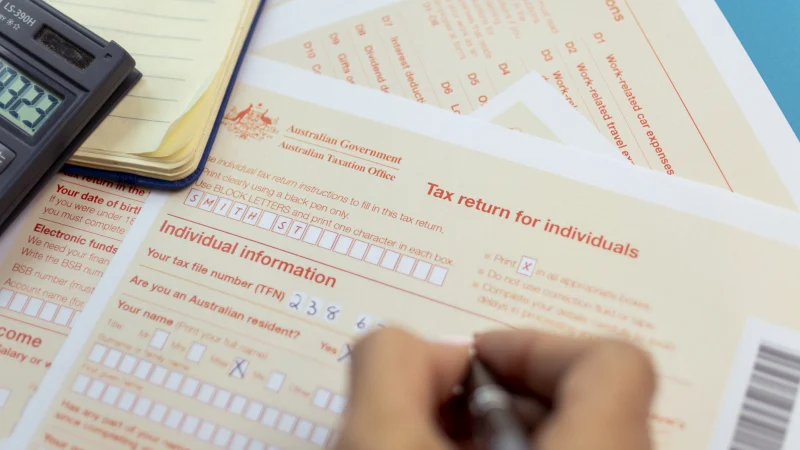
May 26, 2026 — 3:51pmAustralians could be left deciding whether to pay to wash their own work clothes or risk the government taking a deeper look at their annual tax return under Labor’s plan to simplify the tax system.The introduction of a standard $1000 tax deduction on work expenses, which is expected to deliver $205 a year to people and save hours collecting receipts and sitting down with an accountant, is likely to add to the paperwork of people with legitimate but large deductions.The new standard deduction will make life simpler for millions of people. But it could come at a cost to those with a big laundry bill.Dominic LorrimerOn Thursday, the government will introduce the deduction into the parliament as part of its broader suite of tax changes, including its contentious overhaul of negative gearing and capital gains tax. The Coalition is supporting the shift to the standard deduction.The government estimates 6.2 million people, or 42 per cent of taxpayers, will benefit from the change, with an average tax saving of $205. That’s reflected in the cost to the budget of the deduction, which is estimated at $1.2 billion in its first year of operation.The tax office believes it will also save ordinary taxpayers $380 million a year in compliance costs.But as part of the standard deduction, the government is proposing to repeal several commonly used concessions.This includes the laundry concession, which enables people to claim up to $150 in laundry expenses on cleaning a work uniform without fully keeping receipts, and the $300 work expenses exception.Tax experts Lizzie Morton from Curtin University and Lisa Greig from the University of Melbourne said while there were advantages to a standard deduction, the repeal of existing concessions meant the government was creating a “two-tier” system.“In effect, taxpayers who have historically complied and relied on legislated concessions are disadvantaged relative to taxpayers who incur little or no deductible expenditure,” they wrote for the Tax and Transfer Policy Institute.“This raises questions of horizontal equity, as compliant taxpayers with real outlays may be worse off. Firstly, in terms of the compliance burden, and, secondly, if they opt to swap to the standard deduction due to the compliance burden, they may also be financially disadvantaged.”This week, Prime Minister Anthony Albanese talked up the advantages of the deduction to those who depend on work for their income.“They’ll get $1000 automatically without having to put in receipts, etc, and that will be a big benefit, particularly for many low-income earners,” he said.People will still be able to claim other deductions over and above the standard $1000. These include interest, gifts, charitable donations and the cost of managing tax affairs, income protection insurance and fees for membership of unions, business and professional associations.In 2022-23, the most recent available data, more than 10 million people made work-related expense claims worth $28.2 billion. The second most common claim was for managing tax affairs, with 6.1 million people making claims worth $2.3 billion.Laundry and clothing expenses have been a long-standing concern for the ATO. In the late 2010s, it reported a 20 per cent surge in people seeking to reduce their taxable income by making large claims, including a celebrated instance of a car detailer who unsuccessfully claimed $20,000 in laundry expenses in two years.But Morton said people could easily accrue genuine work-related expenses above $1000 that included laundry costs, travel between workplaces and minor work equipment.As their expenses were above $1000, they would be unable to access the standard deduction. This meant they would have to fully substantiate their claims while facing a higher audit and compliance burden than under existing law.Morton said the proposal risked rewarding people who are disengaged from the tax system while penalising those with real work-related costs. Compliance and complexity was being redistributed across taxpayers rather than being reduced for all.“My concern is that no one is really aware that these changes are coming to the tax system,” she said.“For many people, it’s going to be easier. But it’s not going to make things better for those who have genuine expenses like laundry or tools for tradies.”Cut through the noise of federal politics with news, views and expert analysis. Subscribers can sign up to our weekly Inside Politics newsletter.From our partners
The $1000 tax deduction promises less paperwork. Experts warn there’s a catch
Australians will soon join most of the world in having a standard deduction on their tax return. But it could come at a cost to those with dirty clothes.
706 words~3 min read