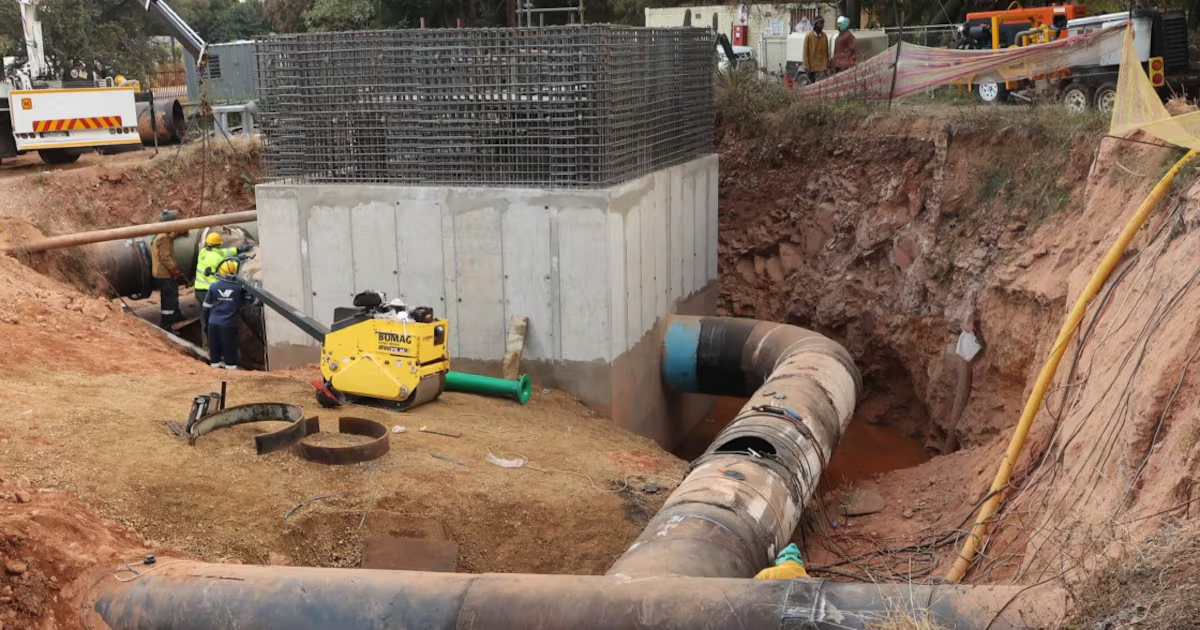
Despite a pickup in recent years, South Africa’s pace of infrastructure investment is still not enough to encourage the level of business activity needed to boost economic growth, now wallowing around 1%, and create employment.This verdict from economists comes as a new report by global professional services group PwC shows the country’s annual infrastructure spending is forecast to grow 39% from $19bn in 2024 to $26bn by 2050.Transport, resources and power are expected to lead, together accounting for 63% of total infrastructure spending in South Africa over the next 25 years, according to PwC’s “Global Infrastructure Outlook 2025-50″.In its budget review in February, the Treasury laid out plans to spend R1.07-trillion over the next three years on infrastructure, acknowledging that the economy continues to face structural constraints, including elevated unemployment, transport bottlenecks and infrastructure backlogs.“South Africa’s infrastructure deficit limits productivity and raises the cost of doing business, particularly through transport bottlenecks, water insecurity and uneven municipal service delivery. Accelerating investment, while improving project execution and maintenance, is critical to crowd in private capital and expand productive capacity,” it said.The government has received plaudits for Operation Vulindlela — an initiative to accelerate the implementation of structural reforms and support economic recovery by modernising network industries such as electricity, water, transport and digital communications. But while the government has ramped up its focus on infrastructure investment after years of neglect, there is still not enough visibility on the ground, Stanlib chief economist Kevin Lings contended.“Infrastructure has deteriorated for probably 15 to 20 years and it’s very clear that if South Africa wants to lift the overall GDP growth rate, take it up to 3% or higher, then you’ve got to develop the infrastructure, because you’re just not going to get businesses investing unless the infrastructure is appropriate,” he told Business Day.“There has been progress, but it’s been limited and slow, and it is not yet visible to the vast majority of the population, and so you don’t get the confidence boost.”He recalled how the hive of infrastructure activity as the country prepared to host the 2010 World Cup boosted sentiment and the economy.Infrastructure has deteriorated for probably 15 to 20 years and it’s very clear that if South Africa wants to lift the overall GDP growth rate, take it up to 3% or higher, then you’ve got to develop the infrastructure, because you’re just not going to get businesses investing unless the infrastructure is appropriate.— Kevin Lings, Stanlib chief economist “It was visible. Every time you drove past a stadium, past the airport, you could see activity and it did a phenomenal job of boosting confidence and belief that the country is on a better growth path,” Lings said.“We don’t have that in this instance, because a lot of this progress is in the background. There’s still no real progress at municipalities, even though there’s work going on. It’s too slow. It needs a higher sense of urgency.”Key to upping the pace of the infrastructure drive will be getting the private sector involved, particularly in upgrading the country’s broken water infrastructure, said Gina Schoeman, an economist at investment bank Citi South Africa.She cited how private sector participation was vital to getting the country out of its years-long energy crunch and improving the performance of Transnet’s port and rail system.“The government has to make an attractive investment opportunity for the private sector to attract them in. They did that with Eskom, they did that with rail and that’s why it’s been successful,” Schoeman said, stressing the need for legislation and regulation that would encourage investment.“Right now they’re trying to ring-fence the water revenue in the municipalities to only be used for water infrastructure because, in the past, so much of it was used for other things, especially wages.“They still have to get that legislation done… They can invite the private sector in right now, but the private sector is unlikely to want to move into this space because there isn’t the legislation or regulation to protect the return on their investment.”The private sector has lobbied for an independent water regulator instead of leaving this power strictly inside the department of water & sanitation. Private investors looking to finance public water and sanitation projects have also struggled to find bankable projects.The scale of investment needed in South Africa over the next 25 years has the potential to take infrastructure “beyond just an assemblage of roads, railway lines, pipes, power lines and concrete structures to a fundamentally transformed ecosystem”, PwC said in its outlook.“This won’t be automatic. It will take ingenuity, smart prioritisation of resources, exceptional public and private sector collaboration and acceleration of the institutional reforms in progress,” infrastructure leader at PwC South Africa Jarendra Reddy said.
Infrastructure investment ‘must gather pace’ to meet 2050 target
Economists say private sector involvement is vital but bankable projects are needed
783 words~4 min read