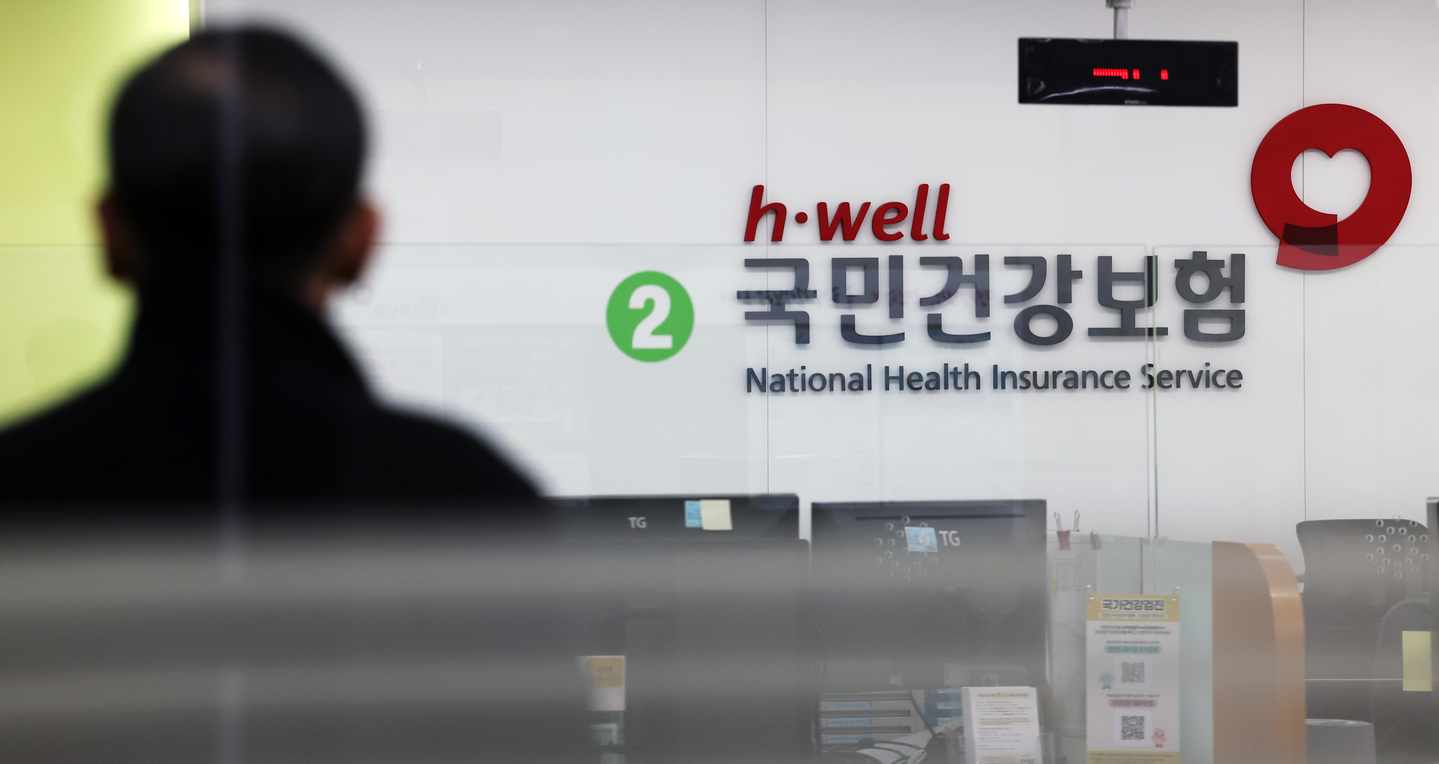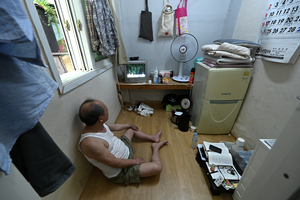
Without legal recognition, chosen families remain vulnerable to poverty and caregiving risks A resident watches television in a small single-room unit in a jjokbang village in Dongja-dong, Yongsan-gu, central Seoul, where many low-income single-person households are concentrated. (Im Se-jun/The Korea Herald) In South Korea, recognition as "family" can determine who is allowed to visit a hospital room, take care leave, remain in a shared home or make decisions in an emergency.For decades, this has largely been limited to spouses and blood relatives. But as more Koreans live alone or build households outside marriage and kinship, that definition is coming under renewed pressure.The debate, long driven by calls from the LGBTQ+ community for legal recognition of same-sex partners, is increasingly expanding into the broader question of care. How should society protect those who rely on unmarried partners, friends or housemates as family?As Korea ages rapidly and single-person households continue to grow, policymakers have begun to consider limited welfare and caregiving benefits for people who share livelihoods outside traditional family structures. But activists and experts say the country is still far from establishing a comprehensive legal framework to protect such relationships.Beyond romance, toward careFor Seoul resident Lee Sun-min, the issue became personal while working on a rescue team and repeatedly encountering cases of lonely deaths.“They must have once lived within society, surrounded by family or friends, judging from the photographs left at the scene,” Lee, who is in his 30s, told The Korea Herald. “The shock of discovering bodies long after death turned a vague fear into something real. I realized it could one day be me.”The number of lonely deaths in South Korea rose 7.2 percent on-year to 3,924 in 2024, highlighting the growing number of socially isolated single-person households across the country.At the same time, more Koreans are forming households outside marriage or blood ties. The number of non-relative households with five or fewer members rose 36 percent over the past five years to 580,000 in 2024.Such arrangements are not limited to romantic partners.Platonic shared living between both opposite-sex and same-sex housemates has also become more common, while residents of such households are aging. The share of people aged 50 or older in non-relative households rose from 15.7 percent in 2010 to 23.9 percent in 2020.A 2024 survey by the Korean Women’s Development Institute found that many non-relative households cited safety and support as key reasons for living together. Among two-male households, 86 percent pointed to help during illness and a sense of security as major forms of dependence.Legal protection outside marriageActivists and experts say one possible solution is a civil partnership system, which would allow unmarried partners, same-sex couples or other designated companions to gain some rights now reserved for spouses or blood relatives.But they say Korea remains far from establishing a comprehensive framework for such relationships.Initially introduced in many countries to protect same-sex couples, civil partnerships offer some marriage-like protections with simpler procedures for formation and dissolution. They are now also used by heterosexual couples seeking alternatives to marriage and, in some cases, by non-romantic partners who share living or caregiving responsibilities.In April, the National Assembly’s research body presented civil partnerships as a possible way to support older adults living alone.“Welfare programs for older adults living alone fall short of meeting all demands and have limits in addressing diverse needs,” the report said. “Civil partnerships could serve as a basic legal framework for voluntary mutual care, as seen in many advanced countries that experienced aging societies earlier than Korea.”The report cited France as an example, noting that rights and responsibilities between partners, including succession of housing leases after a partner’s death and obligations to provide support during illness or poverty, helped reduce separation, social isolation and depression while increasing life expectancy.In Korea, it can be difficult for people outside legally recognized family relationships to remain involved in each other’s lives and provide support during medical or other emergencies. Rights linked to assets, housing or livelihoods built together are also limited.The lack of access to housing, financial and welfare benefits afforded to married couples can also weaken the stability of such communities, leaving many who cannot or do not marry exposed to poverty and caregiving risks.“Welfare systems still largely recognize family as the basic unit, meaning people living outside traditional family structures are often left outside institutional protection,” said Moon You-jin, head of the Welfare State Youth Network.“We have also interviewed people who experienced emergency surgery being delayed because friends they lived with, despite knowing the patient’s condition better, were not recognized as caregivers.”Limited progressMany advanced countries, including several European nations and some Japanese prefectures, now grant designated partners at least some rights previously limited to family members, regardless of gender.In Korea, however, parliamentary efforts to establish civil partnerships have made little progress. Bills proposed by liberal parties over the past decades were scrapped before reaching a final vote, while another remains pending in the National Assembly.The legislative deadlock contrasts with a separate KWDI survey showing that 65.8 percent of 6,177 Korean respondents supported expanding the legal concept of family.One major obstacle has been opposition from Catholic and Protestant groups, two of the country’s largest religious communities. Opponents argue that civil partnerships could eventually lead to the legalization of same-sex marriage, as seen in many Western countries, while weakening what they describe as the traditional concept of marriage and child-rearing.As a result, efforts to adapt welfare systems to changing family structures have remained limited and fragmented.Recent changes include a 2024 court recognition of same-sex partners as eligible dependents under the National Health Insurance system and an ongoing Labor Ministry review to expand family care leave beyond blood relatives.Experts say Korea needs a broader roadmap to incorporate non-traditional family structures into welfare systems before the country’s aging population and growing number of single-person households further deepen care blind spots.“Korea may not be able to adopt systems identical to those overseas immediately, but it needs to gradually recognize more diverse forms of family beginning with what society can accept,” said Seol Dong-hoon, a sociology professor at Jeonbuk National University.
Blood, marriage and those left outside Korea’s family system
In South Korea, recognition as "family" can determine who is allowed to visit a hospital room, take care leave, remain in a shared home or make decisions in an
1,009 words~5 min read