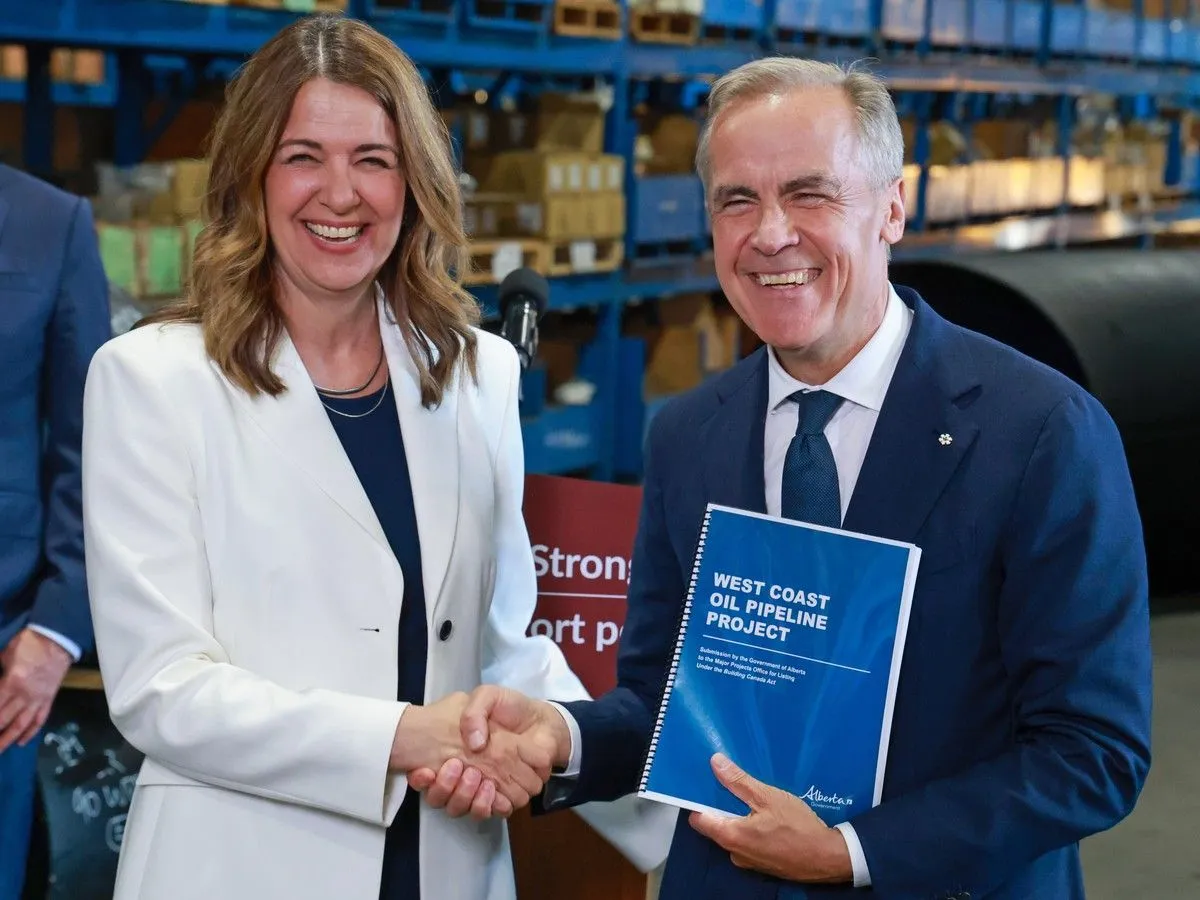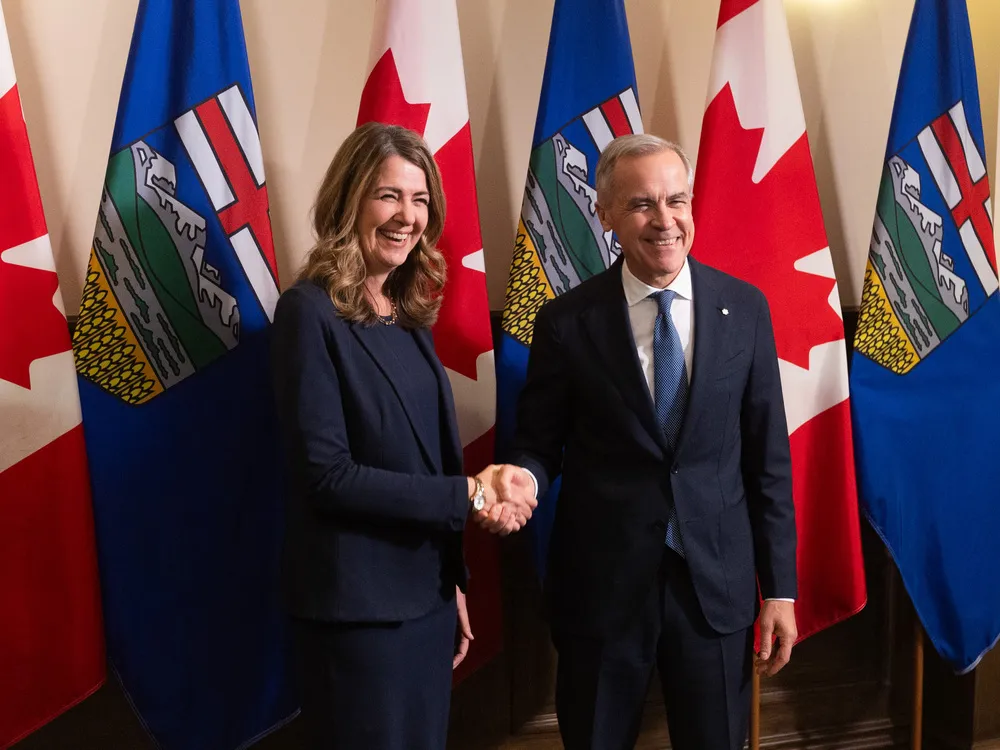
Skip to Content News Archives Economy Energy Oil & Gas Renewables Electric Vehicles Mining Commodities Agriculture Real Estate Mortgages Mortgage Rates Finance Banking Insurance Fintech Cryptocurrency Work Wealth Smart Money Wealth Management Investor Personal Finance Family Finance Retirement Taxes High Net Worth FP Comment Executive Women Puzzmo Newsletters Financial Times Business Essentials More Innovation Information Technology FP500 Podcasts Small Business Lives Told Tails Told Shopping Financial Post Store Obituaries Place a Notice Advertising Advertising With Us Advertising Solutions Postmedia Ad Manager Sponsorship Requests Classifieds Place a Classifieds ad Working Profile Settings My Subscriptions Saved Articles My Offers Newsletters Customer Service FAQ News Economy Energy Mining Real Estate Finance Work Wealth Investor FP Comment Executive Women Puzzmo Newsletters Financial Times Business Essentials HomeEnergyAlberta premier 'open to conversations' on potential incentives to stimulate investment into new oilsands projectsChris Varcoe: If this was a poker game, the stakes are large and the next few hands will be essential in the coming weeksLast updated 3 days ago You can save this article by registering for free here. Or sign-in if you have an account.Alberta Premier Danielle Smith speaks during a panel discussion at the Canada Strong and Free Network conference in Ottawa on Friday, May 8, 2026. Hyungcheol Park/PostmediaIt was almost 30 years ago when Jean Chretien’s federal government reached a historic understanding with Ralph Klein’s Alberta government and the Canadian energy industry to ignite a wave of investment in the oilsands.Subscribe now to read the latest news in your city and across Canada.Exclusive articles from Barbara Shecter, Joe O'Connor, Gabriel Friedman, and others.Daily content from Financial Times, the world's leading global business publication.Unlimited online access to read articles from Financial Post, National Post and 15 news sites across Canada with one account.National Post ePaper, an electronic replica of the print edition to view on any device, share and comment on.Daily puzzles, including the New York Times Crossword.Subscribe now to read the latest news in your city and across Canada.Exclusive articles from Barbara Shecter, Joe O'Connor, Gabriel Friedman and others.Daily content from Financial Times, the world's leading global business publication.Unlimited online access to read articles from Financial Post, National Post and 15 news sites across Canada with one account.National Post ePaper, an electronic replica of the print edition to view on any device, share and comment on.Daily puzzles, including the New York Times Crossword.Create an account or sign in to continue with your reading experience.Access articles from across Canada with one account.Share your thoughts and join the conversation in the comments.Enjoy additional articles per month.Get email updates from your favourite authors.Create an account or sign in to continue with your reading experience.Access articles from across Canada with one accountShare your thoughts and join the conversation in the commentsEnjoy additional articles per monthGet email updates from your favourite authorsSign In or Create an AccountorWill history repeat itself in 2026?In the wake of last week’s energy agreement between the provincial and federal governments on increasing Alberta’s industrial carbon price, Premier Danielle Smith indicated Thursday she’s willing to talk with industry about finding ways to stimulate investment in new oilsands developments — projects that could help fill a new bitumen pipeline to the British Columbia coast.The Oil Sands Alliance, a group of five large producers, would like to see an improved “fiscal framework” as the companies contemplate moving ahead with a large carbon capture project. The Pathways development is directly tied to Ottawa approving a new oil pipeline to the West Coast.Get the latest headlines, breaking news and columns.By signing up you consent to receive the above newsletter from Postmedia Network Inc.A welcome email is on its way. If you don't see it, please check your junk folder.The next issue of Top Stories will soon be in your inbox.We encountered an issue signing you up. Please try again“In this province, we have always had a preferential royalty regime for greenfield (oilsands) development,” Smith told a crowd Thursday at a Calgary Chamber of Commerce breakfast.“We’re open to having those types of conversations, that if there is some way that we have to stimulate greenfield investment, those are the kind of conversations we are going to be able to have.”If this was a poker game, the stakes are large and the next few hands will be essential in the coming weeks.People in the industry have hearkened back to the deal reached in Fort McMurray on June 3, 1996, when Ottawa and Alberta signed Canada’s Declaration of Opportunity for the oilsands.It established a new uniform royalty rate by the Alberta government to spur new oilsands projects, while the federal government made tax changes.These initiatives — Alberta’s generic royalty regime and an accelerated federal writeoff of capital costs — helped offset the large amounts of capital needed to kick-start new projects and higher production.Today, Alberta is proposing a one million barrel per day (bpd) pipeline to move oil to the West Coast for export to customers in Asia. It also wants to see oil production double to eight million bpd by 2035. A tanker sits in dock at the Trans Mountain Pipeline expansion Westridge Marine Terminal in Burnaby, B.C. Photo by Trans Mountain Corp.The Pathways carbon capture network will cost billions of dollars to build, although Alberta is willing to provide a 12 per cent grant to the project and Ottawa is offering a federal investment credit worth up to 50 per cent.But in last week’s agreement, industry pushed back against an increase in Alberta’s industrial carbon price to an effective rate of $130 per tonne by 2040, saying it makes the sector less competitive to attract capital.The premier said economic modelling done for the Alberta government indicates the additional costs from the higher industrial carbon price would add between 80 cents to $1.10 per barrel.Building a new pipeline to the B.C. Coast that can access Asia and obtain higher international prices could help reduce the oil price differential on Western Canadian Select heavy oil — relative to benchmark U.S. crude — by $2 to $3 a barrel, she noted.During an energy panel discussion after the premier’s speech, ConocoPhillips Canada president Nick McKenna said the new energy MOU is an improvement from the previous regulatory landscape. Yet, he also pointed out greenfield projects can require multibillion-dollar investments.“It’s still a challenging competitive landscape,” he added. Kendall Dilling, president of the Pathways Alliance, speaks at a panel during the Oil Sands Trade Show at MacDonald Island Park in Fort McMurray on Sept. 10, 2025. Vincent McDermott/Fort McMurray Today/Postmedia fileOil Sands Alliance president Kendall Dilling noted the 1996 national oilsands task force and subsequent energy accord was a landmark co-operation agreement that created the conditions that “that spawned the oilsands industry as we know it today.”But it also took place during a period when the world was concerned about running out of oil and multinationals soon flocked to the country’s massive resource base. Today, to add about one or two million barrels per day of production growth will require a lot of capital, “well north of $100 billion,” Dilling said.The issue of governments providing production incentives will likely come up in the three-way negotiation on the Pathways project between Ottawa, Alberta and the sector in the coming weeks. Federal Natural Resources Minister Tim Hodgson told the Herald last week that with the MOU and carbon price framework, there is “more than enough incentive for the producers to bring forward their production plans.”Regulatory certainty provided by the Alberta-Canada memorandum of understanding will help companies increase production, but it’s clear that the amount of upfront capital needed for new projects is a big hurdle, said Charles St-Arnaud, chief economist with Servus Credit Union. For the Alberta government, more production would mean more royalties, he added.“How do you get public acceptability?” St-Arnaud said of any possible incentives. “In the long run, it probably makes sense, but we need to be careful how much we give. It’s a balance.”And the idea of providing incentives to companies to increase production, particularly during a period of high energy prices, will face opposition.“Taxpayers should not be subsidizing oil companies making massive profits,” said Keith Stewart, Greenpeace Canada’s senior energy strategist. An information booth for the Pathways Alliance at the Oil Sands Trade Show in Fort McMurray on Sept. 10, 2025. Vincent McDermott/Postmedia NetworkAny tinkering with Alberta’s royalty system would also prove complex, say experts.Richard Masson, who worked as Alberta’s director of oilsands policy at the time of the 1996 task force, said some elements of the current system could be improved.However, he believes the province needs to be cautious with any changes, as the generic royalty regime was intended to get away from one-off negotiations for projects.“The last thing we want to start doing is customized deals, that was the whole point of the generic royalty in the first place,” said Masson, who later became CEO of the Alberta Petroleum Marketing Commission.“If producers are saying the royalty system as it sits won’t allow for investment, it’s probably better to look at it on a generic basis, as opposed to trying to customize incentives for individual projects.”Chris Varcoe is a Calgary Herald columnist. Join the Conversation This website uses cookies to personalize your content (including ads), and allows us to analyze our traffic. Read more about cookies here. By continuing to use our site, you agree to our Terms of Use and Privacy Policy.
Alberta premier 'open to conversations' on potential incentives to stimulate investment into new oilsands projects
Premier Danielle Smith indicated she's willing to talk with industry about finding ways to stimulate investment in new oilsands developments
1,552 words~7 min read