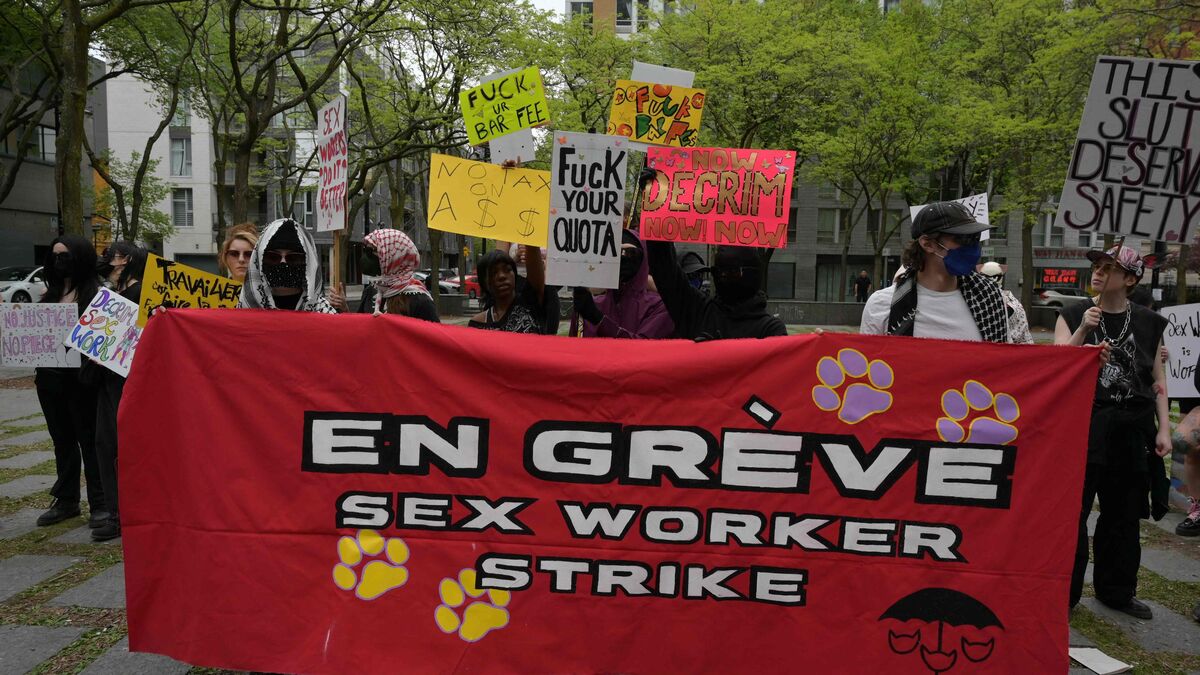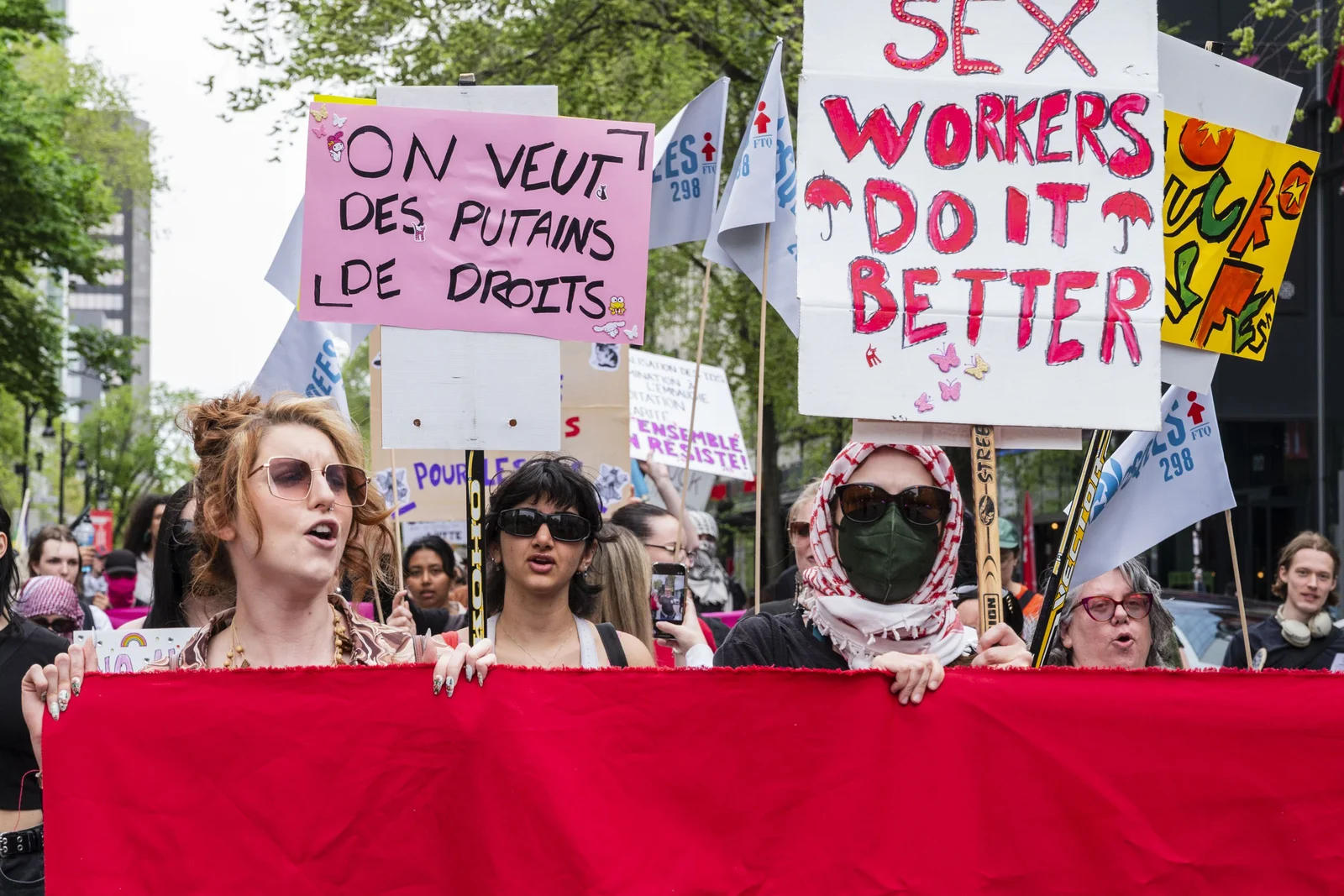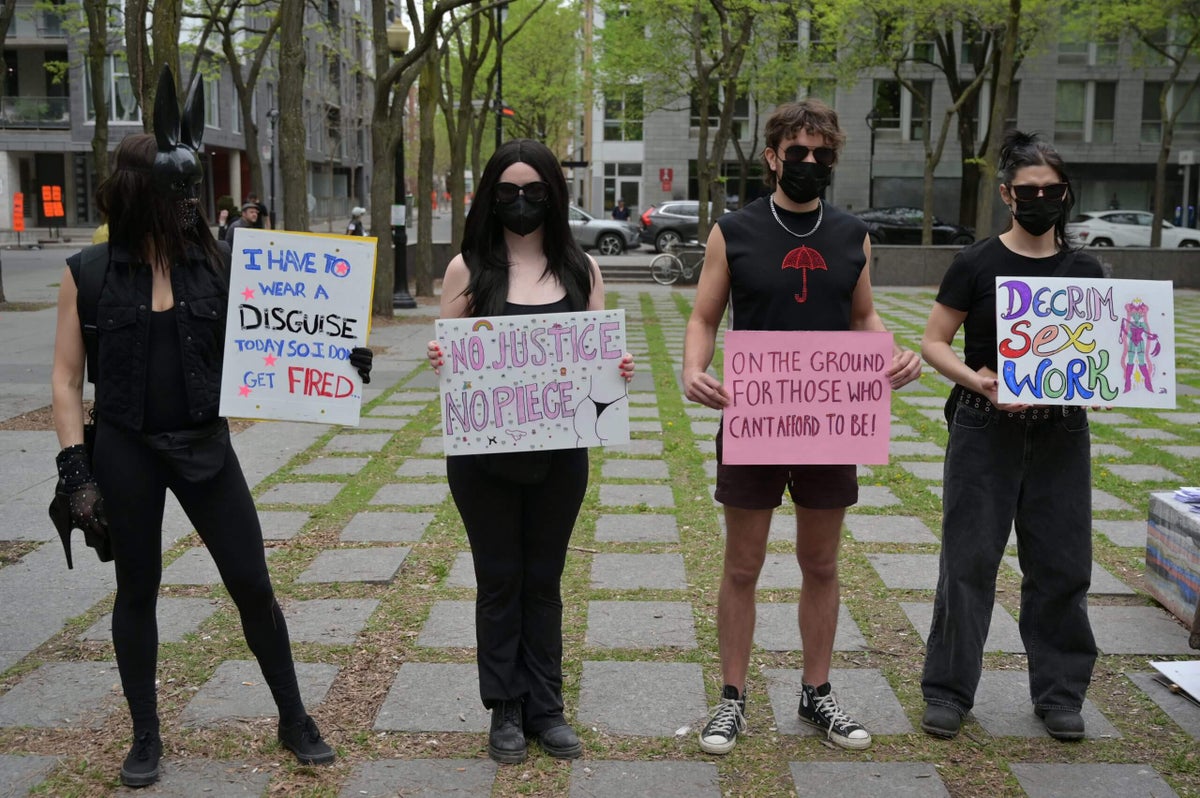
MONTREAL — As Canadian Grand Prix qualifying took place at Circuit Gilles-Villeneuve on Saturday, a different kind of rally took place in Montreal’s downtown core.Sex workers announced they’d be going on strike during one of Montreal’s busiest weekends of the year. Over one hundred sex workers and allies walked the streets and protested in the name of improved wages and working conditions.“Grand Prix was a good opportunity because our employers make a lot of money,” said Adore Goldman, co-founder of the Sex Work Autonomous Committee (SWAC), established in 2019. “But…often we don’t make that much money because they overbook. They book a lot of girls, and they raise the bar (fees). So, in the end, it’s just a normal night. Sometimes even worse.”The protest comes against a complex legal backdrop. In Canada, selling sexual services is legal, but purchasing them is a criminal offense under Bill C-36, the Protection of Communities and Exploited Persons Act, passed in 2014. This means sex workers themselves operate legally, while their clients do not. That leaves workers in a precarious position, unable to fully access labor protections or report workplace incidents without exposing their clients to prosecution.Protesters are calling for the abolition of bar fees, which sex workers have to pay before working shifts in clubs. Through speaking with numerous workers, The Athletic learned bar fees could range from $15 to $140.“We don’t want to have to pay to work anymore,” said Goldman.Some protesters gave speeches at the city’s Parc de la Paix, located in Montreal’s former Red Light District, before walking and chanting along the pedestrian portion of Sainte-Catherine Street and onto Boulevard René Levesque, then assembling in the city’s Dorchester Square park.People hold signs and listen to a speaker at the protest on Saturday (Daphné LEMELIN / AFP via Getty Images)“We’re done watching our community fall further into the margins and further into precarity,” said one protester, Kit, in a speech before their march began. “We’re done with the status quo.“We have numbers in this fight. We are your neighbors, friends and family. We’re here to show the sex workers of the world that we deserve rights and we must fight for them.”Many protesters held signs advocating for their cause, with some using broken hockey sticks as shafts. The signs ranged from clever, like ‘F— the patriarchy, but not for free,’ to revealing, like ‘I am a client, I am a criminal’.“I’m really doubting that it’s really profitable for everyone,” fellow SWAC co-founder and escort Melina May said. “I guess if you’re prettier and slimmer and nicer looking, maybe, and you’ve been there for a while. Competition is hard. I feel like it can be really competitive. And I feel like the bar fee, just the model of strip clubs, makes it really inequitable.”Sex workers also want to be protected by labor laws so they can have access to unemployment insurance and workers’ compensation in case they’re injured on the job. Sex workers and escorts are typically self-employed contractors and not salaried, meaning they rely heavily on tips from patrons.“We don’t receive a salary in exchange,” Goldman said. “So, the money we make is from the dances we sell. And sometimes, we can even be in the negative. Because if there’s no customers, we don’t make any money.”The 2026 Canadian GP broke attendance records (Minas Panagiotakis/Getty Images)The Canadian Grand Prix is an annual destination event, attracting tourists and celebrities from around the world. This year, the Canadian GP attracted a record 360,000 fans, up from last year’s Canadian GP record-breaking crowd. But even those not attending the race frequent the city’s downtown area, visiting restaurants, bars and strip clubs. According to the CBC, last year’s event brought $162 million to local businesses.The conditions should make for a lucrative weekend for all parties involved, including sex workers. And potentially more so, with the Montreal Canadiens still playing in this year’s Stanley Cup playoffs and fans regularly spending time downtown attending bars and watch parties for games. However, some, like Kit (who asked to be identified only by her first name, citing the nature of her work), still encounter difficulties thanks to the number of women hired for certain clubs.“I paid $110,” Kit said of working the F1 weekend last year. “The whole night they were bragging about having 50 girls there, and that particular night was the first night, so I think it was a Tuesday. I made $100, and then I didn’t go back.“It was early in the week, so they didn’t have the clients to keep up with how many girls they were hiring. But I felt I was paying far too much to be there in those conditions, and didn’t personally want to deal with the chaos of the weekend that was to come.”Workers like Melina have also had “violent” and physical experiences with clients that go beyond boundaries.“And the bosses, they don’t really do nothing about it,” May said. “So, in a world where we would be recognized as employees, the bosses would really be liable for making sure that the workplace is safer and hygienic.”According to Melina, workers in as many as 10 strip clubs and massage parlors were either striking or mobilizing colleagues to strike this weekend. But not all sex workers can afford to take time off.People hold a banner reading “sex worker strike” as sex workers demand better work conditions during a demonstration in downtown Montreal, Canada, on May 23, 2026. (Photo by Daphné LEMELIN / AFP via Getty Images)“I think it’s a moment to show our strength,” May said. “I think striking is a good way of showing how threatening it is. We’ve had rumors of clubs threatening their workers not to go on strike, otherwise they’ll be fired. So, they’re stressed. It shows that it has an impact on them.”But even if conditions are not always perfect for sex workers, many still feel suited to the work. As Ada, a transgender female dancer who also wished to be identified only by their first name, citing the nature of their work, explained, it’s a job that many can make a living from if they have some interpersonal skills. But for others, it may be their only way to get by or even “survive.”“There are people who are more suited to not work from 9-to-5,” Ada said. “Some people have chronic diseases or are neurodivergent. You could say the same thing for people who work rough jobs in construction. Their working conditions could always be better. That’s what makes it rough, but it doesn’t mean it has to stay the same.”And performers want to use events like Saturday’s strike as an example that they can fend for themselves.“We also want to show that sex workers are able to organize and make sure that we are (safe) by ourselves,” Goldman said. “We don’t need the police to come in our workplace to save us, because usually that doesn’t really work.“I think we want to highlight that it’s from the labor laws that we’re going to get better working conditions. It’s not from criminalization.”
Why Montreal sex workers chose F1’s Canadian GP to strike: ‘We don’t want to pay to work anymore’
The protest occured during the weekend of the Canadian Grand Prix in Montreal, which had over 360,000 attendees
1,177 words~5 min read