Park Ga-young
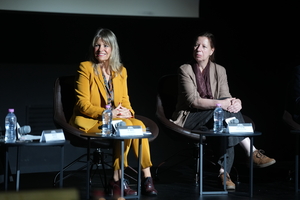
Seoul research suggests art therapy may strengthen self-control, reduce aggression in teens Kim Bung-nyun, a child and adolescent psychiatrist at Seoul National University Hospital, participates in an international symposium, part of the 15th UNESCO Culture and Arts Education Week, held at the National Museum of Modern and Contemporary Art, Korea, on Thursday. (KACES) Kim Bung-nyun has spent more than a decade trying to answer one question: What does art actually do for the brain and body?The child and adolescent psychiatrist at Seoul National University Hospital began his work in 2014, when his team put 600 adolescents referred from the juvenile justice system through a six-month program combining cognitive behavioral therapy with art therapy: emotional literacy exercises, music therapy, and picture book bibliotherapy. About 100 of the participants — perpetrators of school violence whose cases had been suspended on the condition of treatment — underwent brain MRI scans before and after.Kim, by his own account, expected nothing. "I was quite skeptical. I thought the MRI data would clearly be a negative finding," he told the symposium. The results, he said, surprised him.The outer layer of the brain, where neural connections form, measurably thickened in regions that govern impulse control, aggression and empathy. The wiring connecting those regions also strengthened. Both findings survived rigorous statistical testing, the kind that usually erases apparent effects in small psychiatric studies.More importantly, the brain changes tracked with behavioral ones: the more a child's brain changed, the more their aggression and impulsivity dropped. The study, published in 2018, suggested that six months of art therapy and CBT — without medication — had physically reshaped adolescent brains.Kim’s study is part of a broader effort by Korean scientists to better understand how art education affects the human brain, particularly in children.With the 2005 Support for Arts and Culture Education Act, Korea became the only country to establish a dedicated national agency for arts education. In 2011, it successfully proposed UNESCO's International Arts and Culture Education Week, which has been observed each May since. Since then, KACES has cycled through successive waves of methodology: beginning with satisfaction surveys to justify the policy, moving to mixed quantitative and qualitative studies, then developing a framework of 12 official effect indicators now embedded in government policy metrics, covering creativity, self-esteem, empathy and communication, among others.In recent years, the agency has folded physiological and neurological measurement — cortisol testing and brain imaging — into its research, partnering with medical researchers to track what arts education does within the body. The goal, said Kim Joo-ly, head of cultural workforce development at KACES, is "to understand more scientifically how arts experiences affect our brains and our bodies." From left: Anne Bamford of the University of Sydney and Susanne Keuchel of Germany's Genshagen Foundation participate in an international symposium, part of the 15th UNESCO Culture and Arts Education Week, held at the National Museum of Modern and Contemporary Art, Korea, on Thursday. (KACES) Korea is leading the world in arts education, according to Anne Bamford, a University of Sydney researcher whose survey of arts and culture education spans 220 countries. She has watched Korea's progress over seven visits across two decades, roughly the same period in which KACES has worked to expand the country's arts education programs.The author of "The Wow Factor," a 2006 UNESCO-commissioned study widely credited as the first global analysis of arts education, noted that Korean was the first language into which the book was translated."When I say Korea is doing a wonderful job, you can really, in your heart, believe that that is true," she told an international symposium at the National Museum of Modern and Contemporary Art, Korea. But Bamford's praise came with a warning that framed the day's entire program: only 50 of those 220 countries now offer arts education she would call good. Seventeen essentially offer none.The symposium, hosted by KACES on Thursday, brought together global researchers whose work converges on a single, increasingly urgent point: Arts education's impact is real, but proving it remains the field's central challenge.That challenge is harder than it sounds. Bamford's global survey identified more than 1,600 different aims countries set for arts education — even when grouped into 16 distinct categories — making any single yardstick of "impact" almost impossible to construct.The very disciplines treated as standard worldwide — music, visual art, drama, dance — reflect a largely Western European tradition that fits awkwardly in many other contexts. Data is scarce: most countries do not systematically track what happens in their arts classrooms, let alone in the after-school programs, community centers and home settings where much of arts learning actually occurs. And what one country calls successful arts education, another may not recognize as arts education at all.Still, the symposium's two researchers argued that international comparison matters — not to rank countries, but to spread what works. Bamford likened her two decades of country visits to a bee carrying pollen between flowers. Susanne Keuchel of Germany's Genshagen Foundation called it "positive competition" — every country wanting to be "not the better one, a good one."In a closing panel, Bamford pointed to a structural irony that runs through arts education. "Globally, arts and culture as a ministry, as a policy area, always gets the least money, but they are always asked the most to justify themselves," she said. "The military gets a lot of money, and they're never asked to justify what good they do for social welfare, for education, for making flourishing."Kim Joo-ly, sitting beside her, made nearly the same point about Korea: within the Ministry of Culture, Sports and Tourism — itself one of the smallest in the government — arts education receives less than other priorities such as K-content and tourism. That funding gap, she said, is precisely why the burden of proof never lifts. Near the discussion's end, Bamford offered her own answer to why the demand for justification never stops. "It's because," she said, "we change things."