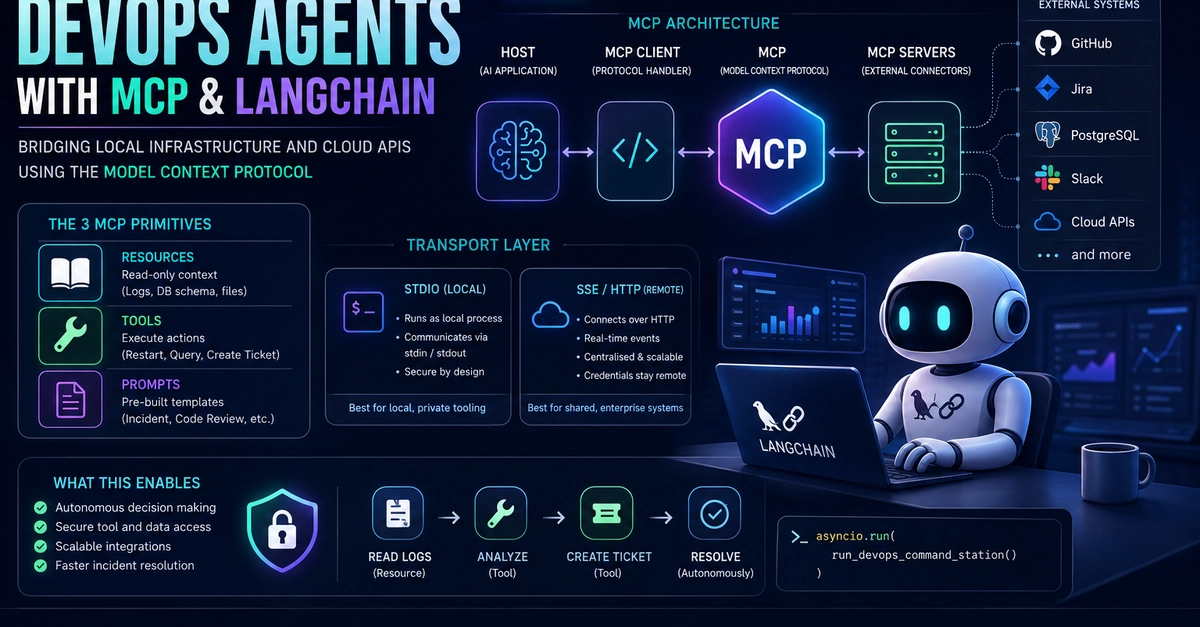
Bridging Local Infrastructure and Cloud APIs Using the Model Context Protocol
How the Model Context Protocol turns a fragile mess of custom connectors into a secure, autonomous DevOps command station.
For years, AI developers faced the dreaded N × M integration problem. Three AI models, five external services — GitHub, Jira, Postgres, local file systems — that's fifteen separate custom API integrations to build, maintain, and debug. Add one new model or one new service, and the number climbs again.
The Model Context Protocol (MCP), open-sourced by Anthropic, changes this paradigm entirely. It acts as the USB-C port for AI: a secure, open standard that allows any model to plug into any external tool or data source using a single universal language.
In this deep dive, we'll break down the MCP architecture using a practical analogy, walk through the transport layer, and build a working Python DevOps agent that reads local crash logs and files production incident tickets — all autonomously.

 aws.amazon.com