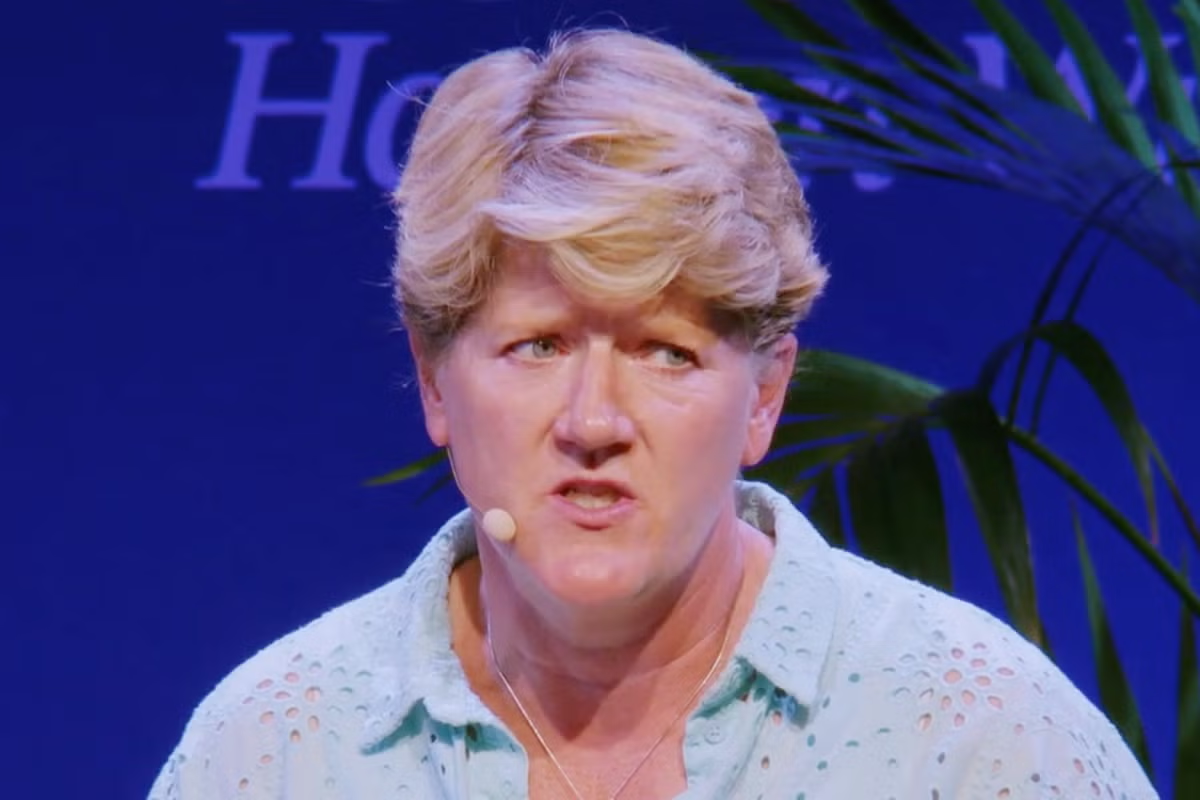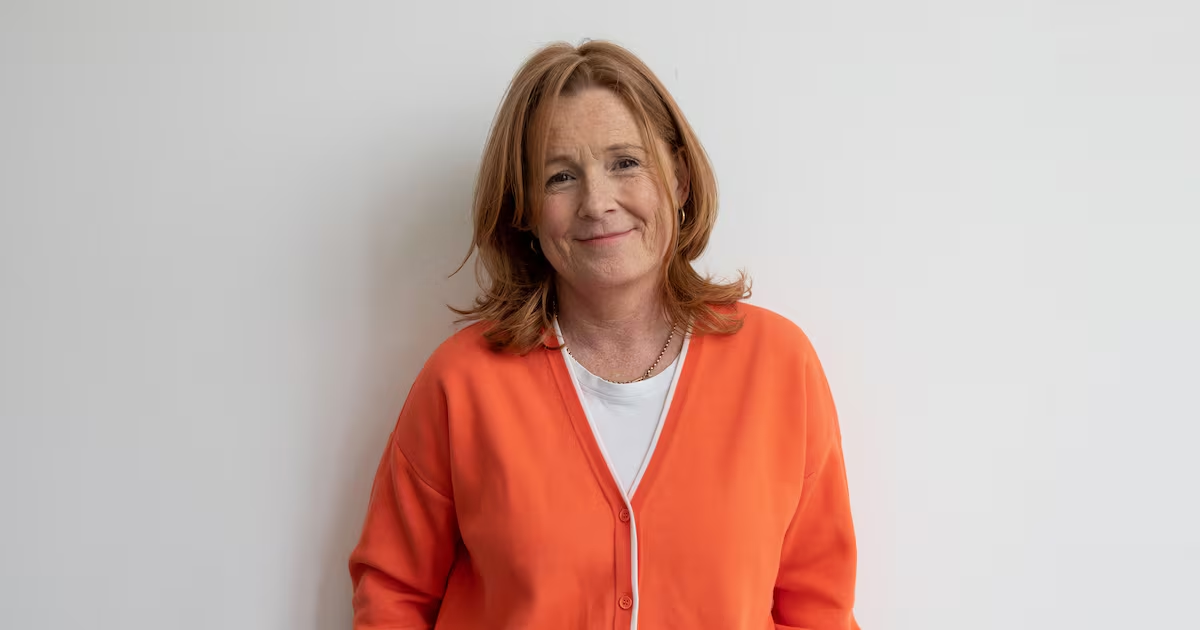
Kirsty Lang always thought she was Irish. The journalist, broadcaster and presenter of BBC Radio 4’s Round Britain Quiz grew up believing she had inherited the personality, temperament and red hair of her Irish grandmother. They were the only two redheads in her family, and “there was this sort of running thing that my mother would say, ‘well, you know, your grandmother had red hair’,” Lang says. “She died when I was five, of breast cancer, and I then got breast cancer at exactly the same age as my grandmother, so clearly I had inherited the red hair and the breast cancer gene.” It took Brexit to begin a search for her grandmother’s birth certificate, so Lang could apply for an Irish passport; then she discovered her grandmother Winifred Warden, née Merry, had been born, not in Ireland, but in the workhouse in Stafford in the north of England. “It was a bitter disappointment, because I felt this connection ... there were so many mixed emotions, and a great deal of sadness. “I couldn’t get an Irish passport, and I was furious, but also, I felt I had this Irish identity taken away from me. “It was my great-grandmother [who was Irish], not my actual grandmother, but it deprived me of being able to become Irish, which I really, really wanted to do.”Lang’s story is the story of many in Ireland and indeed Britain, and of the complex relationship between these two islands. Her understanding now is that her great-grandmother came from “somewhere near Kilkenny” and “was a domestic servant, born in 1911, and whether she was a domestic servant in England, and then got pregnant, or whether she was shipped off from Ireland, we don’t know.“She was just registered as coming to the workhouse pregnant, giving birth, and then leaving the child, my grandmother, presumably because she couldn’t look after her.”The story Lang’s grandmother always told was that “her family were from Ireland, and she was adopted from Ireland, or fostered, by this farming family in Staffordshire, and that they were horrible to her, and she ran away when she was 16”.Lang emphasises the “terrible sadness” when she discovered the reality: “She must have lived with this terrible shame all her life that she was born in a workhouse.”This, too, is part of the more recent history of Ireland and Britain; how stories such as these, which would once have been kept hidden, have been uncovered, acknowledged and reclaimed. Does Lang think about her family’s place in this history? “Yes, a lot. When you read things like that brilliant book by Claire Keegan, Small Things Like These, absolutely, I always think about my grandmother and my great-grandmother. “I definitely feel a connection to that, and I feel terribly sad about it.”So she does not have an Irish passport, even though her husband, the writer and broadcaster Misha Glenny, did become an Irish citizen thanks to his Newry-born grandfather. “I was so jealous,” she laughs. “He whizzes through the passport queues and I’m in the other one [queue] and I look at his Irish passport with so much envy.” Kirsty Lang, journalist and broadcaster with the BBC. Photograph: BBC Lang is a Londoner; it is where she went to university and where her family had a home, even though her father’s job meant she grew up in different countries around the world. “London, being a big, cosmopolitan city, I was able to identify [with it].”She is about to move back to London permanently after almost four years in Vienna, where Glenny was rector at the Institute for Human Sciences; following in his wife’s footsteps as the custodian of another BBC Radio 4 institution, he replaced Melvyn Bragg as the presenter of In Our Time in January. As a reporter, Lang has been all over the world. Her first overseas posting was to Hungary for the BBC in 1989, just in time to witness the fall of the Iron Curtain. She covered the war in Yugoslavia in the 1990s, was posted to Paris for the BBC and then the Sunday Times, and was Channel 4’s Europe editor before returning to the BBC – first as a news presenter, and later as one of the long-standing presenters of Radio 4’s Front Row. But it all began with a six-month stint in Northern Ireland in the late 1980s. “Pretty much all of us wanted to go to Northern Ireland because it was exciting. Obviously, if you’re a journalist, you want to run towards the flames, don’t you, not away,” she says. On one of her first days in the BBC newsroom in Belfast, a bomb exploded in the city centre. “I threw myself to the ground underneath my desk, and when I appeared again, everybody was laughing. ‘Don’t worry love, it’s miles away.’ That was my starting point.”BBC Broadcasting House in central London. Lang is worried about the ‘undermining of public sector broadcasting’. Photograph: Mike Kemp/In Pictures via Getty Images She recalls “the first time I went to somebody’s house with an open coffin ... it was an incredibly steep learning curve, and it made me realise how incredibly ignorant we were in England of what was happening. “I’ve always hated the word ‘Troubles’ as a kind of euphemism, because it was a war, in my view, and it should have been called a war, and we should have called it a war, and I think those things about language are really important.”She learned about the North by reading novels, something she still does when she goes to other countries, devouring fiction and poetry. “I tried in that way to get under the skin of what it meant to live in a society so riven by sectarianism, and it was incredibly useful training for covering the collapse of Yugoslavia later on. “In eastern Croatia in the summer of 1991 ... it was familiar, to be in this small place where everybody looks the same, speaks the same language, and yet have these divisions. “I understood it in a way I think I wouldn’t have done if I hadn’t had that experience in Northern Ireland.” Yet, as she reflects on her nearly 40-year career, most of it with the BBC, Lang is keen to emphasise how worried she is about the broadcaster’s future, not least given the announcement last month that it would cut almost one in 10 staff in a bid to make savings of £500 million (€575 million). “I do think it [the BBC] faces an existential crisis, and I don’t think that’s too strong to say. “I think we take it for granted, and having lived in a lot of other countries and being aware of what’s on offer there, I realise how incredibly valuable the BBC is.“In an age where we have endless information but very little wisdom, it provides us with wisdom and analysis.“I have Radio 4 on all day, and I would feel absolutely bereft [without it], as would millions of people.” She has seen first-hand the “undermining of public sector broadcasting” under right-wing populist governments and warns of the “systematic attack” under way in Europe and the US. “The fourth estate is a very important part of our democracies, and that’s why I worry about the BBC being salami-sliced to death.” Round Britain Quiz is the longest-running quiz in the world, and celebrates its 80th birthday next year – which comes with its own set of pressures. “It’s like somebody’s handed you a very valuable bit of Radio 4 crystal and you’re thinking ‘oh no, I don’t want to drop it’,” says Lang.[ ‘A wake-up call for every country’: public service broadcasting in crisisOpens in new window ]She took over in 2022, much to her own surprise; as she confessed to the BBC Radio 4 controller who offered her the job: “I’m not very good at quizzes.” “I enjoy them,” she stresses, “even though I can very rarely answer anything. “But I like watching other people do it, and of course it’s sort of aspirational, because when you do manage to get something [right], you feel really clever.” In a world where everything is dumbed down, why shouldn’t we have something super smart?— Kirsty LangRound Britain Quiz is complex and hard to define. “The Everest of quizzes,” says Lang. Teams from England, Scotland, Wales and Northern Ireland tackle “multi-part questions that mix general knowledge with cryptic clues”, with plenty of hints from their host. There was a “Dublin” team in the 1940s and a “Republic of Ireland” team in the late 1970s and 1980s. The current Irish representation comes from this journalist and Paddy Duffy, a broadcaster and film-maker from Lifford, Co Donegal, representing Northern Ireland; former competitors include writer Polly Devlin, political columnist Brian Feeney and magistrate Martin McBirney, who was shot dead by the IRA in 1974. A friend of the poet Michael Longley, he recalled how McBirney would return from recording the latest series and meet them in Belfast’s Crown Bar with the questions so that their group of poets and friends could all have a go. Kirsty Lang's journalism career has taken her all over the world. Photograph: Mike Marsland/Mike Marsland/Wireimage This is the “unique quiz culture” of Britain and Ireland that the show taps into, says Lang. “Other countries have gameshows, but they don’t have quizzes embedded quite so much in the community – be it pubs, schools, working men’s clubs, universities, whatever – it’s a sort of social glue, and it’s actually something really important.”At home, Glenny “makes up quizzes all the time, at every family event, for Christmas, or somebody’s birthday ... we’ve done that with our kids since they were little” and she brought this to Round Britain Quiz.[ When people hear I won University Challenge they want to know what Paxman was really likeOpens in new window ]“My vision was to see it as a kind of parlour game whereby, if you’re at home, you can join in and not feel intimidated if you can’t get something.” Unsurprisingly, it has its own community – many of the questions are sent in by listeners – and an online group plays along with the show as it is broadcast, though some – “men of a certain age”, says Lang – found her triggering. “They wrote in – still do, actually – to complain that I laugh too much and it’s annoying. “It was a little bit upsetting ... I don’t want to say it was a huge amount, but it was quite a few.”She followed her producer’s advice and ignored them. Round Britain Quiz “is joy and a privilege, and I think the fact that it was unexpected – I mean, if you’d said to me when I first started working in news as a reporter that I would end up hosting a quizshow, I would have laughed in your face.” Round Britain Quiz grew out of Transatlantic Quiz, designed to boost Anglo-American relations during the second World War, and subsequently reinvented as Trans-Britain Quiz; in the decades since, it has survived both geopolitical crises and BBC cuts. Lang hopes the celebrations will get listeners even more involved – “I just love the idea of groups of people getting together, or at home, wherever, and playing with us” – while also bringing in younger fans. “In the current series, we had a 17-year-old girl who sent a question in. That warmed my heart, because she’ll be listening to Round Britain Quiz for the rest of her life,” she says.[ University Challenge Irish finalist: ‘There’s always a Shakespeare question, so I read his complete works’Opens in new window ]So will many others. “There’s something gloriously smart and intellectual about Round Britain Quiz, but also very democratic,” says Lang. “There are loads and loads of smart people out there, so let’s appreciate it, let’s keep the bar high.“In a world where everything is dumbed down, why shouldn’t we have something super smart?”This year’s final of Round Britain Quiz is on BBC Radio 4 on Sunday, May 24th, and on podcast platforms
‘I couldn’t get an Irish passport. I felt I had this identity taken away’
The BBC broadcaster on how Brexit sent her searching for her Irish roots, reporting the Troubles in Belfast, and the ‘joy and privilege’ of hosting Round Britain Quiz
2,009 words~9 min read