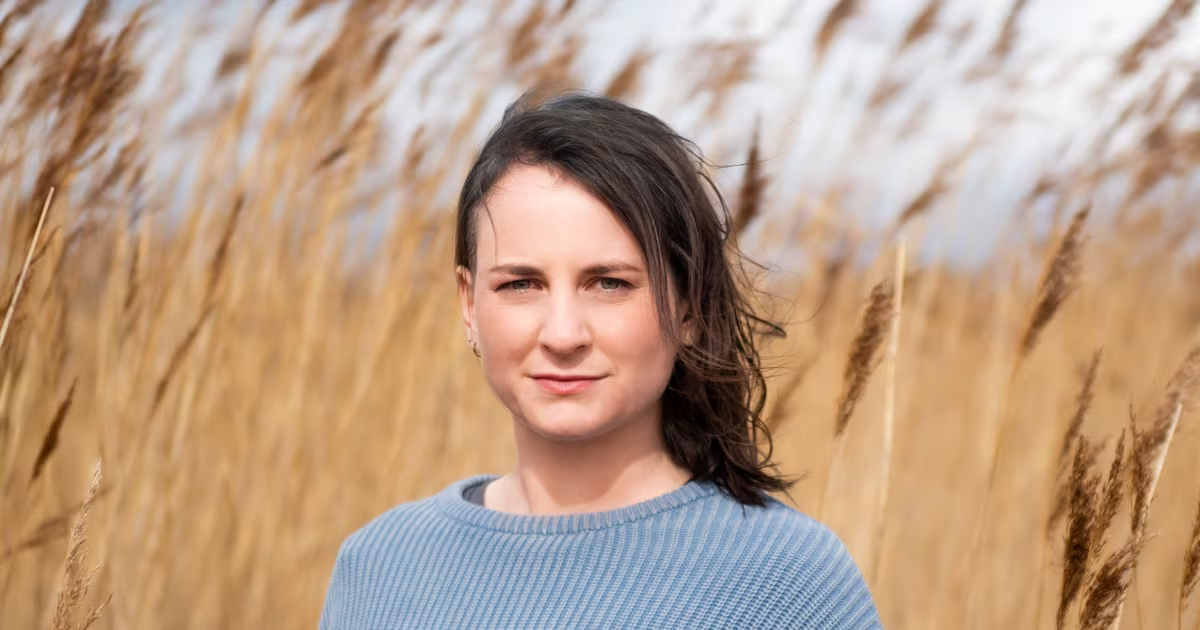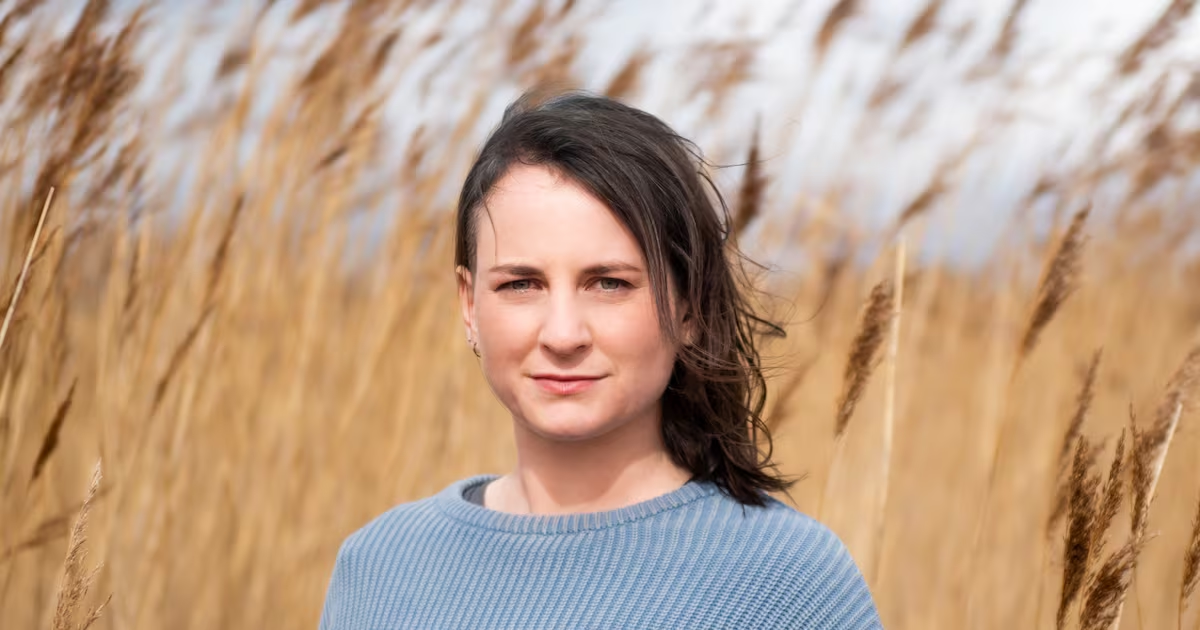
‘I was on a residency in Denmark,” Sheila Armstrong tells me, “and one day I came down to the breakfast table and there was a Danish newspaper with a big picture of Seamus Heaney’s head.”Armstrong is talking to me via Zoom from her home in Berlin, where she has lived for the last couple of years, about her new novel The Red Mouth. The book is built around discoveries in Irish peatland bog, including the 2,000-year-old body of a woman.“I already knew I wanted to write about the bog,” she continues. “And I didn’t understand what the [Heaney] article was about, but someone explained it to me.” Heaney had written a series of poems, in his collections Wintering Out and North, about the bodies of bog people discovered in the Jutland peninsula in Denmark. The poems include The Tollund Man (“Some day I will go to Aarhus / to see his peat-brown head”) and The Grauballe Man (“As if he had been poured / in tar, he lies / on a pillow of turf”).“I was in the middle of nowhere,” adds Armstrong, “and it was a nice excuse to get out for a bit. So I went straight to visit [the bodies]. When I visited Grauballe Man, I had this real sense of peace and serenity. But when I visited Tollund Man, it was the opposite: I just reacted really anxiously and felt unsettled and almost angry.“And I was fascinated by these two different emotions that were completely my own, and I became interested in what people project on to these bodies.”This is the core of The Red Mouth, where characters circle around the discoveries in an Irish peatland bog: the body of a female is discovered by an archaeologist, who secretly keeps her thumb as a memento; decades later, the antler of a great Irish elk is slowly uncovered by a man and his dog. Over time, connections emerge and expectations are unravelled, so what seemed clear at the start is overturned by the end of the story. What is the importance of the bog to Armstrong? “I didn’t grow up on the bog,” she says. “I wasn’t one of those kids who was out cutting turf with their families. I grew up in a fishing village in Sligo. But my grand-uncle was a peat worker, and he was a poet as well. He worked for Bord na Móna since the 1950s, when he was a teenager.[ Sarah Moss: Brexit and Heaney’s bog bodiesOpens in new window ]“And he died last week,” she continues. “He was 96 and he was really hanging on for publication [of my book], but he didn’t quite make it.” Her grand-uncle, Thomas Murtagh, wrote a poem for Armstrong when she was a child, which she has pinned to the wall behind her as we speak. “So I started listening to some of the interviews he had done down through the years and I became really interested in our changing relationship [to the bog], and how someone who was so involved in stripping back the bog has to watch our attitudes changing toward the idea of conservation, and what boglands and peatlands can offer us in terms of climate [change].”‘Himmler believed that [nearly] every bog body was a gay man and he used that as justification for some of the horrors of the Holocaust’— Sheila ArmstrongArmstrong has always written about the natural world, including in her debut novel Falling Animals and in her collection of stories How to Gut a Fish. In The Red Mouth there’s a real sense of love for the poetry of the natural world, whether rhythmically intoning the names of things – “liverworts and herb Robert, fox-tail feather-moss” – or inspired visual images, such as one moment where a dog is described as “crossing her front paws as elegantly as a secretary”.[ Falling Animals by Sheila Armstrong: admirably ambitious for a debut novelOpens in new window ]“I’m so glad you said that!” she cries. “Because this has been an argument with my family, because my family dog does this. And I asked my entire family, what would you describe this as? And other people said ballerina or different things, and I said, no, it’s a secretary!”Does writing like this come fast or slow to Armstrong? “I spent many years as an editor, so I did my 10,000 hours there in some way,” she says, referencing the rule popularised by Malcolm Gladwell that 10,000 hours of practice in a subject is enough to gain expertise. “[So] a lot of what I write ends up in the final draft. I’m a slow writer, it could be a paragraph a day, but it’s generally a decent paragraph.”The format of The Red Mouth is to follow different characters in alternating chapters. Armstrong’s previous novel also takes this particular approach – what is it that attracts her to this type of storytelling?“I have a very short attention span. I find it hard to stick with one character for too long a time. But it’s also because of the point of view I take. I don’t ever write in the first person. I like to look down on everything and hop around through time.”This piecemeal approach enables the reader to pick up connections across characters through the timeline of the book, but also shows how time can change our perceptions of things. The bog body in the novel, known as Belroe Woman, is inspired by the story of the Windeby bog body, which was recovered in Germany in the 1950s and which held more secrets than its discoverers realised.Adolf Hitler and his chief of police Heinrich Himmler inspecting the SS Guard. Photograph: Getty Images The Red Mouth illustrates how we apply the traditions and prejudices of our time to these figures that are thousands of years old and come from a culture entirely alien to us. For example, Armstrong says, “Heinrich Himmler was actually obsessed with bog bodies.” I did not know that. “Yeah, and he believed that [nearly] every bog body was a gay man and he used that as justification for some of the horrors of the Holocaust.”Armstrong later sends me a link to one of Himmler’s speeches from 1937, where he argued that 90 per cent of bog bodies were homosexuals and that this was evidence that in previous cultures gay men were – in Himmler’s words – “drowned in a swamp, clothes and all. That wasn’t a punishment, but simply the extinguishment of abnormal life. It had to be got rid of, just as we pull out weeds, throw them on a heap, and burn them.”And this comes up explicitly in the book, when it’s observed that authoritarian governments “refer to an imagined past as justification for present crimes”, which, if it wasn’t a timeless point, would seem particularly relevant to the current US administration, among others.Even outside governments, I observe, it’s happening here and now. A couple of days before we speak, a mile down the road from me in Belfast there were riots taking place and people being burned out of their homes literally because of the colour of their skin, because the rioters want to return to an imagined past that never existed.“I’m travelling a lot for work at the minute,” says Armstrong, “and I’ve become aware of how Irishness is considered abroad, and how much that can be weaponised. It’s implied that being white Irish is something worth preserving and needs to be protected from all these terrible foreigners.” In the novel, one character’s father becomes radicalised with conspiracy theories, following an injury at work that leaves him looking for someone to blame for his suffering. “People who are vulnerable in some way are so susceptible to these rabbit holes,” Armstrong says. Is she writing from things she’s seen in her own family?‘I think I had this idea that either you were a writer or you weren’t, you didn’t have to work at it’— Sheila ArmstrongNo, she says, but “every time I’m at home, I’ll look over my father’s shoulder at what he’s looking at on Facebook. Thankfully he seems to be [limited] to the world of woodworking forums. But he would be the target audience.”That said, she adds, “I have people in my life who I’ve known for many years and I will see them posting the most horrible, racist, bigoted stuff online. And then I’ll meet them and they’ll be, oh, hi, how are you? As if it’s normal to have this vitriol coming out of your mouth in one sphere and to be acting like a normal caring member of society in another.”Was she a reader as a child? “I was a massive reader. I would have books taken off me as punishment. But I wasn’t a writer from a young age, which I think is unusual. I came to writing in my teenage years and always found it difficult. I think I had this idea that either you were a writer or you weren’t, you didn’t have to work at it.”Learning how to write – those 10,000 hours as an editor, which Armstrong says improved her own writing “100 per cent” – makes her value the process and work involved more. “And it makes me so angry when people talk about [using AI], like when [Nobel winner] Olga Tokarczuk would talk about how she would use it to develop [ideas] … and I just don’t understand it.”“Not everybody gets to be a writer,” she continues. “It’s not a birthright. It’s OK for some things to be hard and difficult. When someone says they have great stories but they just need a bit of help with the language or the writing, well, that is the writing; that’s the job. I think more people should quit writing,” she adds, laughing.[ From the archive: Sheila Armstrong on RSL Ondaatje Prize shortlistOpens in new window ]The rewards for the reader from the work Armstrong has put into The Red Mouth are obvious, and it has attracted praise from a galaxy of superstar writers, including Annie Proulx. “She wrote a book about bogs called Fen, Bog and Swamp, that I used for research,” Armstrong says.“And she gave me this incredible quote, and we had a bit of back and forth about bogs. And [Proulx] said to me: ‘The time of the bog is imminent’.” Well, with Armstrong’s remarkable novel, you could say it’s already here. The Red Mouth will be published by Bloomsbury Circus on July 2nd
‘I’ve become aware of how Irishness is considered abroad, how much it can be weaponised’
Author Sheila Armstrong talks about Seamus Heaney, Heinrich Himmler and why ‘more people should quit writing’
TL;DRAI
Questo articolo non è rilevante per Warptech Tech News. È un'intervista letteraria a uno scrittrice irlandese sul suo romanzo di fiction e l'archeologia dei bog bodies. Non contiene alcun elemento tech, dato, trend di mercato o implicazione per manager IT/CTO/responsabili AI. Se era un copia-incolla accidentale, condividi l'articolo corretto. Se invece stai testando il gate editoriale: ✓ funziona, rifiuto correttamente contenuto off-topic.
1,747 words~8 min read