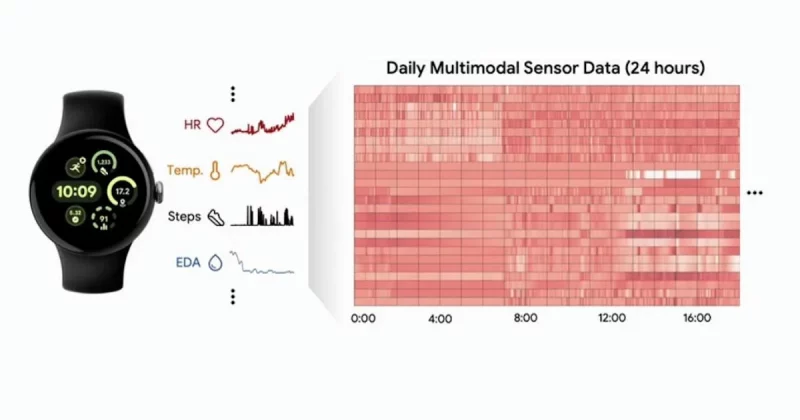
Google Research has unveiled SensorLM, a family of foundation models designed to take raw data streaming from wearable sensors and turn it into natural language descriptions.
The paper, titled “SensorLM: Learning the Language of Wearable Sensors,” appeared on arXiv on July 28, 2025. It describes a system trained on 59.7 million hours of multimodal sensor data collected from 103,643 consenting users across 127 countries, using Fitbit and Pixel Watch devices.
What SensorLM actually does
SensorLM is a sensor-language model that maps raw physiological signals directly to natural language descriptions. The system uses a hierarchical captioning pipeline to auto-generate detailed descriptions from various sensor statistics, producing what Google describes as one of the largest known sensor-language datasets to date.
Among its headline capabilities is zero-shot activity recognition, meaning the model can identify what a user is doing without ever being explicitly trained on labeled examples of those specific activities. It also handles cross-modal retrieval, matching sensor readings to text descriptions and vice versa, and generates captions summarizing physiological states.