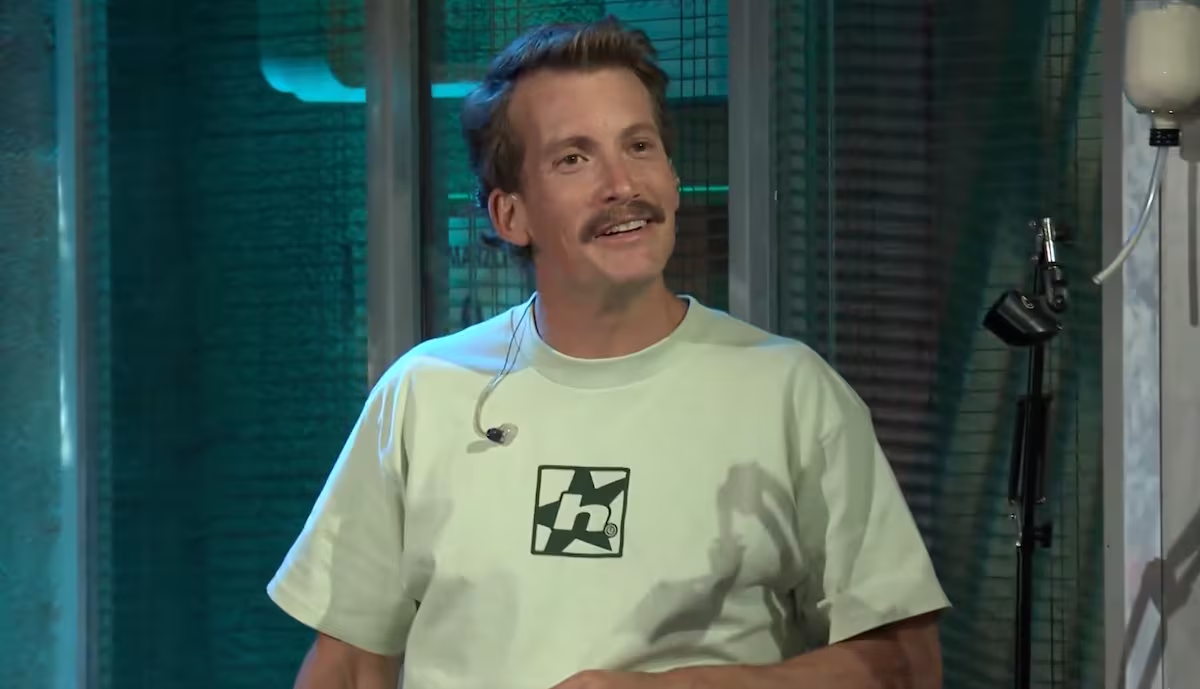
“Jury Duty” had a premise so ambitious it’s hard to believe it worked twice.In the streaming series first season, an unwitting juror thought he was taking part in a documentary, but the case was fake and everyone else in the court was an actor. The second season, “Jury Duty: Company Retreat” moves the action to a resort where fictional hot sauce company Rockin’ Grandmas has gathered with some help from a temp worker, who is made to think everything that unfolds is real.In the first episode we see the patsy, Anthony, hired on by an HR boss named Kevin, whose voice will sound familiar to Marketplace fans: He’s actually Ryan Perez, longtime comedy writer and co-host of our kids podcast “Million Bazillion.” Luckily Anthony doesn’t listen, or the show might have fallen apart before it started.“Jury Duty: Company Retreat” is streaming in full on Amazon and “Million Bazillion” is wrapping up its latest season, so I called up Perez to talk about his experience playing a real-fake boss.“You don't have to be a business expert to enjoy the show,” Perez said. “I think if you've ever worked a day in your life, you can have a good time watching.”Below is an edited transcript of our conversation.How did you prepare to play a corporate human resources guy? I was able to talk to a few real HR people that were related to the production. A few producers had friends and people that worked in HR, and so I got to interview a few real HR professionals to learn about what their daily workload is like. And then I read a few books, one was called “HR From The Outside.” It was like an HR philosophy text. It was, I don't know — I'm sure if you're in the industry, it's a good book. It was a little bit hard to understand. I also read a book of management phrases, all these kinds of like, little manuals that they publish for people who are in positions of leadership. That was just helpful in terms of learning some of the language that you would use when working in HR. But luckily, most of this didn't really come into play because I didn't have to fire anybody or do any of the things that an HR person really has to do on the show.But you did interview Anthony for a job that he of course thought was real, was that when most of this research came to bear?That was interesting, because it was really like doing a job interview, and they [the producers] weren't really interested at all in there being jokes. They said, “Just play that as you would, completely straight, completely normal, like the most boring HR person in the world.” So when you look at that first episode, I'm completely not in character, I'm just talking to him basically as myself. There's nothing funny about it, and it somehow ended up becoming the first scene of the show.It was basically just like an interview that you would get at any job, like, “what are your strengths?” “What are your weaknesses?” Because in the beginning, Anthony 100% needed to believe that this was a real job and a real company. And if you'll notice in the first episode of the show, very little interesting really happens until, honestly, days into the process of him being hired at Rockin’ Grandma's, the hot sauce company.Obviously things go off the rails once you get on the retreat itself, but you're saying you did a couple days of just showing him around the office and stuff?Yeah, that time that we spent in the office probably was about two full work days. It was really just mundane work, the kind of temp job work, sending them around for tasks and laying down a few beats that would be relevant to the story later on.We had a word for it, which is we were “building the reality bank” of the situation. You would have to build this bank of real, mundane, normal office behavior, and then you were allowed to sort of do maybe one strange thing. And then after that strange thing you would have to build the reality bank back up — here's some normal stuff, here's another boring day. Even on the retreat, it sort of worked that way when we knew that there was going to be a really audacious stunt or something that may have really aroused suspicion. You go, “OK, we can do that on one day, but the next day is going to have to be boring.”You have had a long career in entertainment, some of that was in writers rooms, production offices. Did you reach back to that career experience to play Kevin, interviewing Anthony and assigning him all these mundane tasks?Oh yeah, you end up calling on the personality of old colleagues and old bosses that you've had. Very often a character that I play is a combination maybe of some relatives of mine, or some other characters that have existed, but a lot of it is maybe a boss that I worked with for two days, years ago.You're kind of combining all those characters into someone who works in an office, and it's not terribly difficult acting because you have to practically execute everything in the scene. Like, you genuinely have to explain to someone, “Here's what your job is for today.”One of the jobs was stuffing gift bags full of different kinds of combinations of items. The prop department had a very complicated job making the task of stuffing these bags just long enough to where he could barely finish it that day. You're just explaining it in the most real way. And so as an acting challenge, it's a wonderful challenge because you're distracted by the strangeness of the whole endeavor, but you really have to be present in the scene, and being present in the scene is a gift.As an actor, anything that gets you forgetting the cameras are there is always a gift, and in this case, having hidden cameras is a blessing. It's not actually a bad thing for your performance to not have bright cameras and lights in your face all the time, and to just be doing the job of a boss. And yeah, I've worked with plenty of people just like the HR guy that I played.The show’s storyline has Anthony coming on at Rockin’ Grandma’s at a moment of transition, this small family business is being passed on from father to son, and a big company is offering to buy them out. How do you see this show reflecting real business, what would a Marketplace fan get out of it?The show is a very pro-small-business show. And I think it strives to understand the struggles of a small business. Ironically, the retreat portrayed in the show is something more elaborate than most small businesses can afford. But the show at the end of the day is really about the functioning of a small business.Just as the first season of this show strived to have a deeper theme about doing our civic duty of serving on a jury, this season did strive to have a pretty relevant message about the importance of small businesses in America. And about this influence of private equity, which, whether you love it or hate it, is undeniably changing the scope of how a lot of businesses are run, and the clashing sensibilities of how a boss of a small business thinks of their workers versus how the private equity-brained people think about things. It doesn't mean that they're evil people, but it means that they think about employees in a different way. And I think just talking a little bit about that reality is a good thing.We see Anthony form genuinely warm relationships, bonding with the rest of the cast, and you gotta wonder if there's an opportunity for that at a massive corporation’s retreat.Exactly. Like if you work for, you know, Starbucks corporate or something, I'm sure there's probably a lot of nice people that work there, but I would imagine one can get lost in the shuffle of that kind of organization. This is representative of a much smaller kind of thing where there's 10, 12 people that are really running the company.And it's funny what you say about bonding. That's one area where Anthony and I, because of the nature of the tasks that I had to give him, and how I initially met him, I actually didn't form the strongest buddy bond with him, and it's only since finishing the show that I've gotten to know him a little bit better. But it's kind of funny how those bonds cement a little bit, when you're doing them.He bonded very well with a lot of people on the show, but afterward I remember seeing him and still sort of feeling like I was his boss in a way, you know? And it took a minute for that to sort of dissolve. But we know, we had a great time playing Uno the other night, and sort of realized like, “Oh, wait a minute, yeah, that dynamic was fake that we were playing.”It’s like the Stanford Prison Experiment or something. You were play-acting boss and subordinate for so long, it takes a minute to shake that off.Yes, it did take a minute. Meeting him, or talking to him like immediately after we finished shooting. I was like, wait a minute, I'm not — you don't have to listen to me at all. I'm just a guy, you know?
Ryan Perez isn't an HR guy, but he plays one on TV
Perez, who also co-hosts Marketplace’s “Million Bazillion,” told us how he prepared and why he’s still reminding himself he’s not the boss.
1,606 words~7 min read