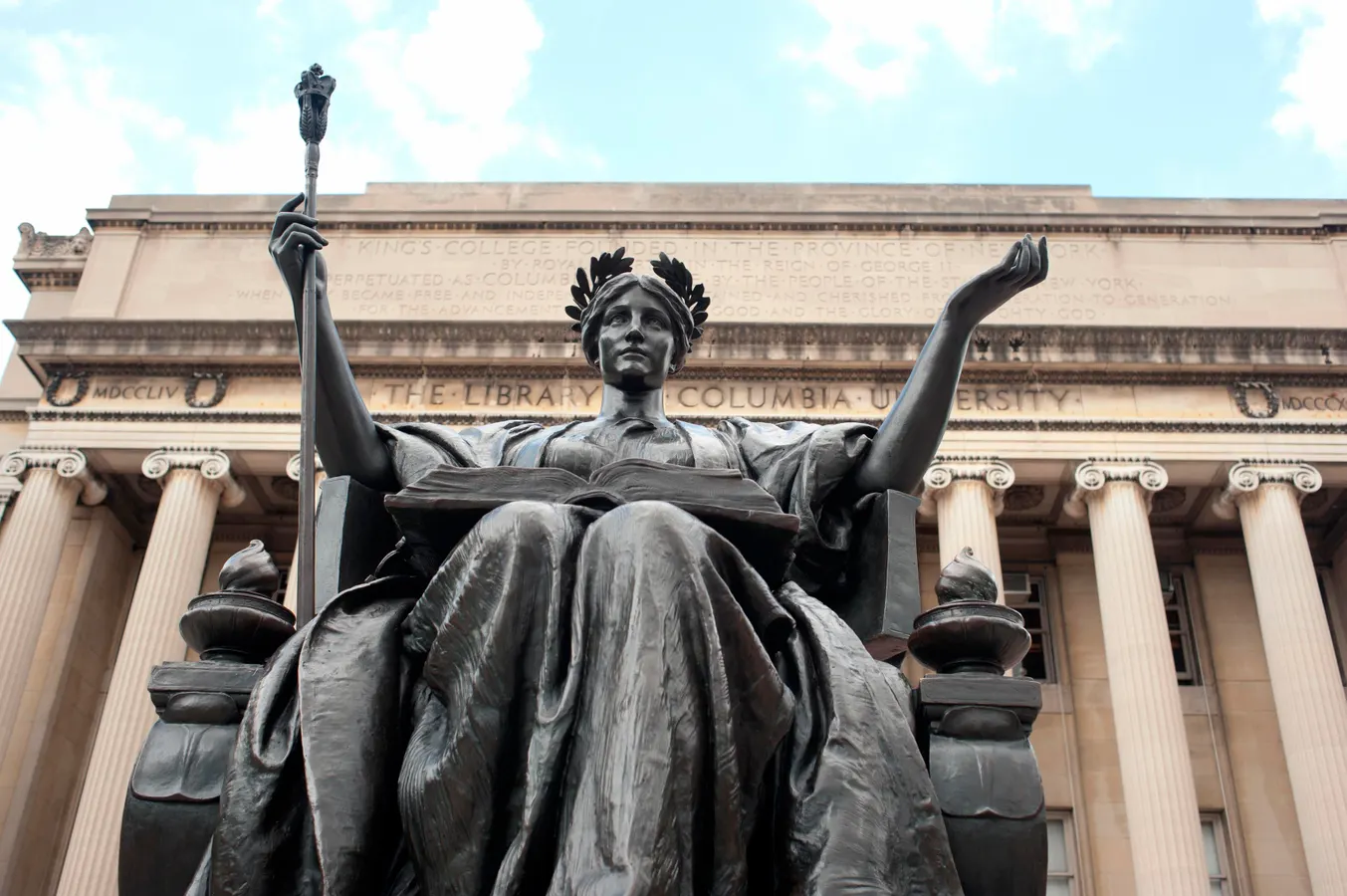
"Alma Mater" sculpture designed by Daniel Chester French in front of the library building on New York City's Columbia University campus grounds.gettyForbes College Financial Grades are designed to assess a private not-for-profit college’s operational soundness and balance sheet health using the following ten measures. Our data is derived from the Department of Education’s National Center For Educational Statistics as well as higher education analytics and consulting firm Perspective Data Science. Only schools with more than 500 full-time students were included and public colleges were not graded. Some colleges fail to provide the government with the financial variables we use for analysis.Endowment Assets Per FTE (15%): This measures schools’ endowment assets at year end per full-time equivalent student and is perhaps the most important determinant in a college’s long term financial health. Institutions with giant endowments can hire the best professors, embark on the most ambitious research projects and tend to have the most impressive facilities. Princeton and Yale, both A+ graded schools, have by far the highest endowments per student of $3.7 million and $2.3 million respectively. Larger Ivy League schools like University of Pennsylvania and Cornell, also A+ graded, have endowments per student of $808,000 and $345,000 respectively. American University (A-) in Washington, DC and Lewis & Clark College in Oregon (B+) have endowments per student of under $100,000. Private colleges generally need more than $150,000 per student to receive full credit in this category.Three Year Average UNAEP to Expenses (15%) - A college’s Unrestricted Net Assets Exclusive of Plant reveals an institution’s financial flexibility and zeroes in on what an institution truly has available in resources to cover its annual expenses. (see story) If a college has perennial operating deficits and negative UNAEP, it is almost always a sign that they are plundering so-called restricted funds, or endowments, to remain open. The measure often provides an early warning for colleges in financial distress. Our ratio, provided by analytics firm Perspective Data Science, looks at a three year average of UNAEP to annual expenses. No credit is given to any college with a negative or zero value, and full credit is given to any school whose unrestricted net assets to expenses ratio is 100% or greater. Top graded Pomona College ( A+) has UNAEP to expenses of over 600% and Grinnell College in Iowa’s ratio surpasses 1,000%. Some well-endowed colleges like Johns Hopkins and Middlebury, which each have endowments per student in excess of $450,000, report 3-year UNAEP to expenses of only 40%. No less than 192 colleges on our list, most graded D, reported negative average Unaeps.MORE FOR YOUPrimary Reserve Ratio (10%): This balance sheet metric, measures how long a college or university could continue operating using its expendable financial reserves relative to its annual expenses. Expendable assets are defined as total unrestricted net assets; plus temporarily restricted net assets; plus debt related to property, plant and equipment; minus property, plant and equipment net of accumulated depreciation; divided by total annual expenses. A school with a primary reserve ratio of one could cover expenses for one year. Both Notre Dame and Williams College have primary ratios in excess of 10, while Harvard’s is 7.4. Syracuse University’s primary reserve ratio is 1.4 and University of Rochester’s is only 0.5. In our grading primary reserve ratios above 2.2 get full credit. Viability Ratio (10%): This metric analyzes a college’s expendable assets divided by its total liabilities, so it hones in on a school's ability to cover its debt.Schools with a ratio of at least 2.57 received full credit, including Brown University and Johnson & Wales in Providence, Muhlenberg and Saint Johns in New York.. Howard University in Washington DC only gets half credit with its viability ratio of 0.79. Nearby Georgetown University scored even worse with its viability ratio of 0.26. Core Operating Margin (10%): This measures whether tuition, donations and investment revenues cover a college’s educational expenses by subtracting its core expenses from its core revenues and dividing the difference by its core revenues. Operating margins above 10% get half credit while margins above 50% receive full credit. College of the Ozarks, Trinity University and Berea in Kentucky all had high operating margins and received full credit, while Boston University with its 10% core operating margin only got half credit.2-Year Enrollment Growth (10%): Increasing enrollment often indicates high demand for a university and likely means growing revenue. We looked at the last two years of enrollment data at each private institution. Certain colleges like Dickinson College in Pennsylvania and Randolph College in Virginia and The Julliard School in NYC, have recently been growing their enrollment at a rate of more than 20%. Any college whose enrollment has increased by more than 5% in the last two fiscal years gets full credit in this category. If a school’s enrollment fell by more than 10% it did at Oberlin College, Kalamazoo College and Caltech, it received no credit.Tuition As A Percentage of Core Revenues (7.5%): While many colleges have become overly dependent on tuition revenues, this measure rewards colleges that have successfully diversified their revenues away from tuition and fees. Schools that derive the lion’s share of their revenue from tuition are more vulnerable to enrollment declines and price competition. The majority of the private colleges on our list are tuition dependent. In order to get full credit in our grading 10% or less of core revenues needs to come from tuition as it does for MIT and Washington University in St. Louis. DePauw University in Indiana got a near perfect score as a only 14% of its revenues come from tuition. Schools like New York City’s New School which derives 74% of its annual revenue from tuition scored very poorly in this category. Return On Assets (7.5%): This metric divides a college’s change in net assets during the year by its assets at the beginning of the year. Perfect scores to any college with a return-on-assets above 7.5%. Half credit was given to any college earning an ROA of about 4%. Texas Christian University, Brigham Young and Pepperdine all received perfect scores in this category. Yale, with its return on net assets of only 0.29%, got less than half credit.Net Tuition Revenue Per Student (7.5%): This metric looks at the actual revenue a college receives from each student it enrolls. It strips away all discounting (often known as merit scholarships) to give credit to schools that have the ability to bring in more revenues per student. For example, while Pennsylvania’s Susquehanna University advertises tuition rate of roughly $60,000 per year, after discounting its net tuition revenue per student is slightly more than $17,000. Susquehanna was awarded roughly half the possible score in this category, while any college with net tuition revenue per student in excess of $30,000 received full credit. Some A+ colleges like Princeton and Yale intentionally have lower net tuition revenue per student because they can afford to offer generous grants to a large number of incoming students. Princeton’s net tuition revenue per student was only about $15,000 while Yale’s was $21,000. In order not to penalize these wealthy and generous schools we automatically awarded perfect scores in this category to any school with an endowment per student in excess of $150,000. The highest net tuition revenue per student was Pitzer College with $59,637. Harvard and Colgate University are also bringing in more than $50,000 per student. Says Perspective Data Science partner Matthew Pearson, “Having pricing power in this environment is a real accomplishment.”Instruction Expenses Per FTE (7.5%): This measures how much schools actually spend on educating each student. A higher amount reflects a college able to invest in its core mission. For the fifth year in a row, Washington University in St. Louis wins top honors with $181,929 spent per student Other elite schools spending north of $100,000 per student include Johns Hopkins, Caltech and Stanford. Harvard spends about $52,000 in instruction expenses per student, while the median for our 900 plus private colleges was roughly $11,000. Full credit is given to any school spending at least $30,000 per student on instruction expenses annually.
Forbes 2026 College Financial Grades: How We Calculate The GPA’s
Forbes 2026 College Financial Grades analyzes the operational soundness and balance sheet strength of private colleges. Here is how we calculate the grades.
1,347 words~6 min read