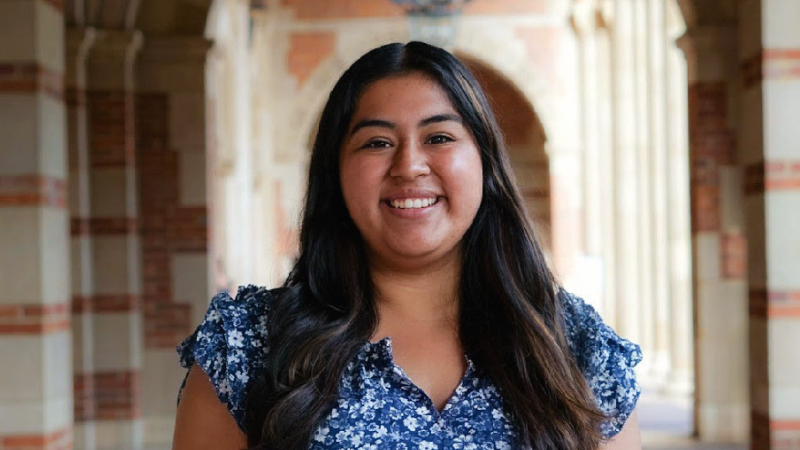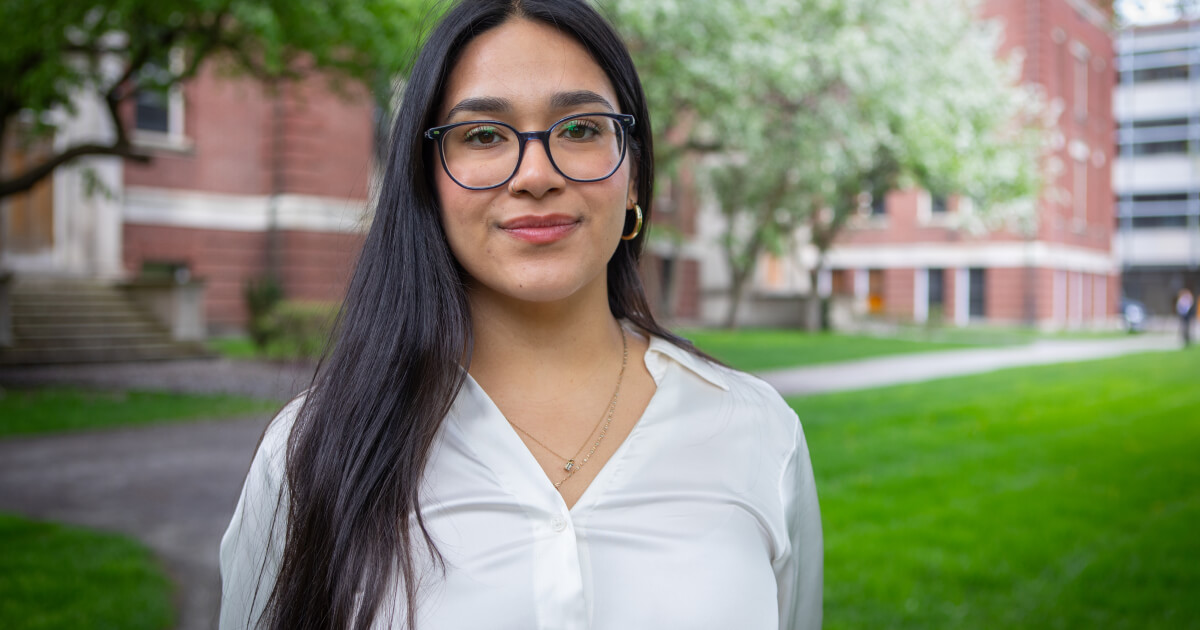
Lizbeth Ibarra, S.B. '26, in environmental science and engineering (Eliza Grinnell/SEAS)
Lizbeth Ibarra grew up next to an oil refinery, and every day she saw its impact on her community of Richmond in the San Francisco Bay Area. Her family and friends suffered from asthma and other respiratory illnesses. School days were sometimes cancelled for “smoke days” because the air quality was so bad. A 2012 fire at the refinery led to thousands of people seeking medical treatment.“There's just a lot of things that I think I was desensitized to because they felt very normal, or they were just things that my family never questioned or talked about,” she said. “I remember every Wednesday in elementary school just hearing this alarm blaring and not knowing what it was, but later learning that it was just a refinery making sure that the alarm works in case some other kind of emergency happened. Those were really big things that I didn't realize until later on were impacting my community, which is predominantly low income and of color, while other communities nearby were not having any kind of experiences like that.”As a high school student, Ibarra joined the climate activist group Youth vs. Apocalypse and became a member of the Path to Clean Air Committee for the Bay Area Air Quality Management District. But while she understood the impacts of climate change on communities, she didn’t know the underlying science. That brought her to Harvard, where she studied environmental science and engineering at the Harvard John A. Paulson School of Engineering and Applied Sciences (SEAS).“Coming to Harvard was an opportunity to be able to bring something back to my community that a lot of people in my community had not had access to,” she said. “I felt like doing environmental science engineering was the right intersection for me.”Now a senior, Ibarra is at the end of a journey that transformed her into a leader. She served as Head of Outreach for the SEAS-affiliated Harvard Society of Professional Engineers (SHPE) and led the Harvard Engineers Without Borders (EWB) project constructing a water distribution system in Los Sanchez, Dominican Republic. After 10 years of work, that project wrapped up last summer, and the club is now in the early stages of a new project in Mirador, Guatemala.“Being able to be the project lead during this time in the project was such an honor and privilege,” she said. “I’d learned so much from everyone who had previously been involved in the project and who had already graduated, and I felt like I was able to honor them in the way that we closed off the project. It was really important for us to do it right and make sure that the community had all of the training that they needed and felt satisfied with the work that we had done.”After graduating, Ibarra will be working for Pullman Services, a structural repair and strengthening company and contractor she interned with last summer. She worked on building restoration projects during her internship, which put her on a team working on the hospital wing at the Alcatraz Island prison. While excited, Ibarra is also thinking farther ahead towards a possible master’s degree, or working for organizations trying to improve air or water quality in her community “I'm really excited to be able to be back in my community again and be back home,” she said. “But I am also interested in going to grad school for my parents who never had access to any kind of education.”