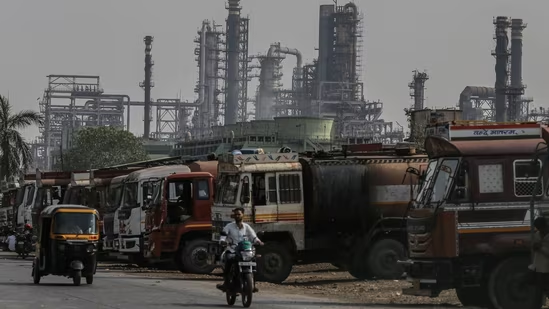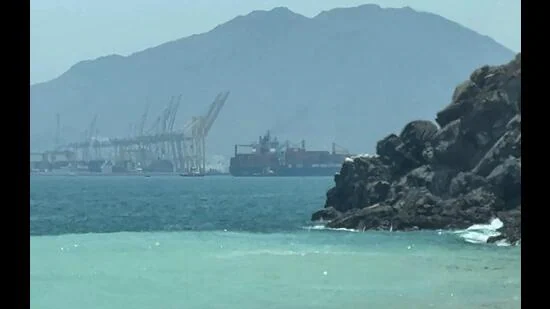
Can the Indian economy, if global supplies do not normalise, maintain this uneasy equilibrium? We will know soon. Next week marks three months since the beginning of the ongoing war in West Asia and the near-halt of maritime traffic through the Strait of Hormuz. Thanks to US President Donald Trump’s jawboning of the petroleum market – he keeps talking about a deal with Iran to end the war – futures prices are still not very high. Many analysts, however, believe that a physical shortage of crude oil and other supplies will start manifesting in coming weeks as almost all pre-war shipments stuck in the Strait of Hormuz have sailed, likely landed and major countries have finished their inventory run-downs. For example, Bloomberg reported on Wednesday that US total crude inventories had their largest weekly fall last week since 1982, the earliest period for which data is available.Marshall Islands-flagged tanker Symi, carrying approx 20,000 tonnes of LPG, arrives at the Kandla Port in Kutch. (DPA Kandla)What does all this entail for India? Anecdotal reports about fuel stations running dry across states seem to be increasing in frequency. To be sure, these are still anecdotal reports and one must wait for May’s consumption data before jumping to conclusions about a big supply-squeeze. But it is useful to look at consumption, import and price data until April to juxtapose where things stand in May.Is the war's energy shock shifting gears in India now?Petroleum imports in April saw among the biggest month-on-month jump by value in dollar terms The Centre for Monitoring Indian Economy (CMIE) database gives the dollar value of India’s petroleum and oil imports until April . Values for February, March and April are revealing: $12.9 billion, $12.2 billion and $18.6 billion respectively. In month-on-month terms, the 52.9% increase between March and April in import value is the third highest since April 1993, the earliest period for which CMIE has data. The first two instances, September 2021 and March 2025, also saw a large increase in import volumes. Data on import volume is only available until March 2026 and it shows a fall from 26.5 to 20.7 million tonnes between February and March 2026.But import volumes are unlikely to have risen in April How likely is a big jump in import volume of petroleum products in April ? Given the sharp disruption in global supplies, it seems less plausible. Wholesale Price Index (WPI) data on prices of crude and natural gas, buttress this prediction. Because of the adverse movement in the rupee-dollar exchange rate – it fell from 92.76 in March to 93.55 in April – some of the import value increase in dollar terms could just be on account of exchange rate rather than higher volumes. The crude oil and natural gas component of the WPI increased from 17% and 14.8% between March 2026 and April 2026. These numbers increased by 49.1% and 7.5% between February and March . A lot of the higher value of imports could be due to price increases rather than India buying significantly more volume. Consumption data until April supports this theory What we lack in import volume data for April, one can get from consumption data for the month. CMIE numbers, sourced from the petroleum ministry, show that consumption fell in April both sequentially (compared to March) and annually. While this is not the first-time consumption has fallen in annual terms, what it does rule out is a large increase in import volumes in April. To be sure, consumption trends are not uniform across different types of petroleum products.Will demand destruction move to sectors outside LPG? This is the most interesting question. So far, the heavy lifting of demand destruction has been done by LPG. Will this have to move to other commodities such as petrol and diesel if the war does not end and supplies do not resume? Are anecdotal reports of petrol pumps running dry signs that some of this is already happening?
Is the war's energy shock shifting gears in India now? | Number Theory
Can the Indian economy, if global supplies do not normalise, maintain this uneasy equilibrium? We will know soon.
798 words~4 min read