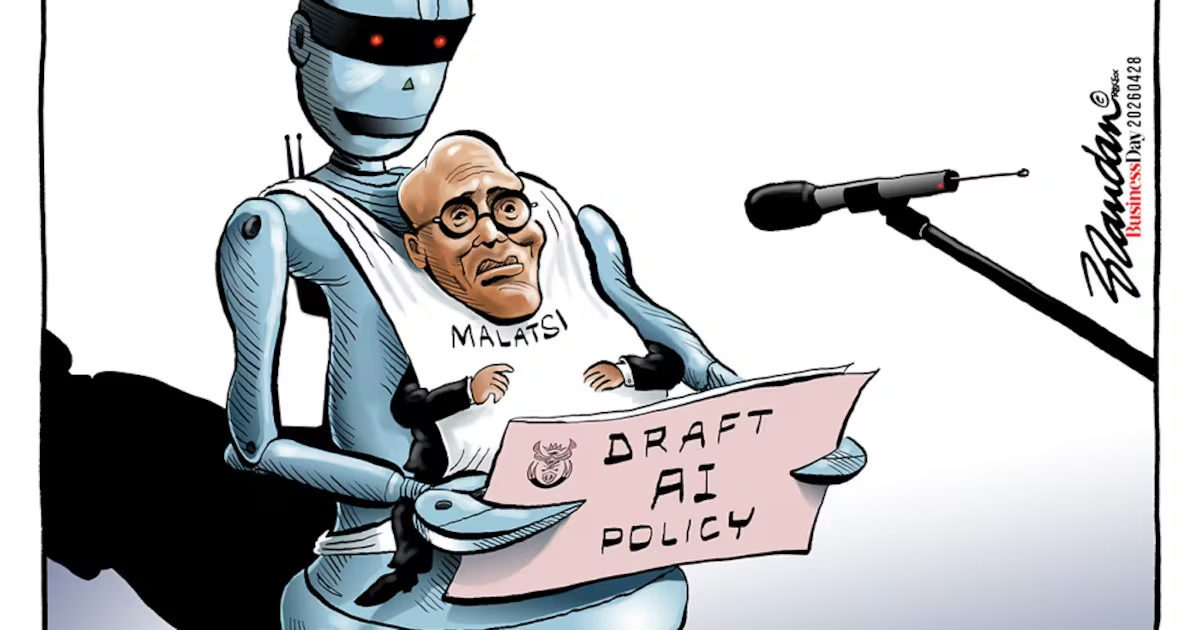
Michael Porter, in The Competitive Advantage of Nations, argued that “national prosperity is created, not inherited. It does not grow out of a country’s natural endowments, its labour pool, its interest rates or its currency’s value, as classical economics insists.” Regarded as the father of strategy, Porter made the point that nations ultimately succeed because their home environment is the most forward-looking, dynamic and challenging. To meet this high bar we have to engage each moment of our changing world without fear of making mistakes in policymaking or of falling short in some way. We have to accept that if policymaking were simply about finding the “correct” answer we would have solved most of our, and the world’s, problems by now.Policymaking is hard precisely because it exists at the intersection of conflicting human values, limited resources and unpredictable outcomes. This understanding matters as we consider the aftermath of the recently withdrawn South African national AI policy. The withdrawal followed the revelation that drafters had used generative AI to help write the policy and that the verification step did not catch the AI-generated sources that turned out to be fabricated. The national policy itself exemplified the shortcomings it had aimed to address, a sobering reminder for everyone working in this space. Understandably, the conversation has turned to questions of competence and accountability, and one government department has already suspended officials. The more useful question, though, may be how we build a drafting process robust enough that no single individual carries the full weight of getting it right.For South Africa the lesson is twofold: engaging with global AI is itself a strategic choice and shaping it on our own terms will require a cross-sectoral approach to policymaking. If accountability is understood narrowly as identifying people to suspend, it risks disincentivising the policymaking boldness we need and stigmatising the work of building national AI capacity. In the present age of policymaking, we must come to terms with the fact that humans are not perfect processors. Policymaking is constrained by bounded rationality — limited time, limited information and cognitive biases. Instead of finding the optimal solution, we settle for the first option that is “good enough”. A recurring theme in public policy analysis is the difficulty central planners face in possessing all the localised information required to make flawless economic or social decisions. That is an important, useful realisation. In his paper “Technology Adoption, Innovation & Inequality in a Global World”, Oxford economist Florian Trouvain reminds us that innovation and adoption are not lesser and greater activities. Rather, they are two halves of the same growth engine. Advanced economies tend to allocate skilled labour towards pushing the technological frontier while emerging markets do the indispensable work of adopting and adapting existing technology. Neither role is a junior partnership; the countries that grow fastest are usually those that take adoption seriously and resource it accordingly. For South Africa the lesson is twofold: engaging with global AI is itself a strategic choice and shaping it on our own terms will require a cross-sectoral approach to policymaking. Policymaking, properly understood, is how governments translate social goals into programmes and actions that deliver real-world change. It is the “how” of governance. At its best, it is about setting the agenda, rather than simply adopting an agenda defined and advanced from elsewhere.This is the opportunity we have with AI. If bounded rationality is the underlying constraint the answer is less about asking drafters to be cleverer and more about giving them more company at the table. AI is a general-purpose technology. Like electricity or the internet, it will not sit inside any single ministry’s mandate. It will reshape diagnosis in our clinics, lesson planning in our classrooms, credit scoring for small businesses, yield forecasting on our farms and case management in our courts. No drafting team can carry that full sectoral picture alone, nor should we expect it to. A wider authorship also offers a more constructive understanding of accountability. Treated narrowly, accountability becomes a question of who to answer for a mistake after it has happened. A multistakeholder drafting process reframes it as a question of who should be in the room beforehand so that errors are surfaced early and corrected cheaply. That is a more honest definition of the word and a more useful one for a country building capacity rather than apportioning blame. To return to Porter’s “National prosperity is created, not inherited”, we have to make serious attempts at creating, rather than inheriting, technological capacity and capability from others. • Dr Payi is an economist and strategist and Mukuna, co-founder of payment platform getsly.ai.
XHANTI PAYI AND SIMUKAYI MUKUNA | AI’s role in drafting multistakeholder documents
Withdrawal of national AI policy puts focus on need for more robust processes
769 words~3 min read