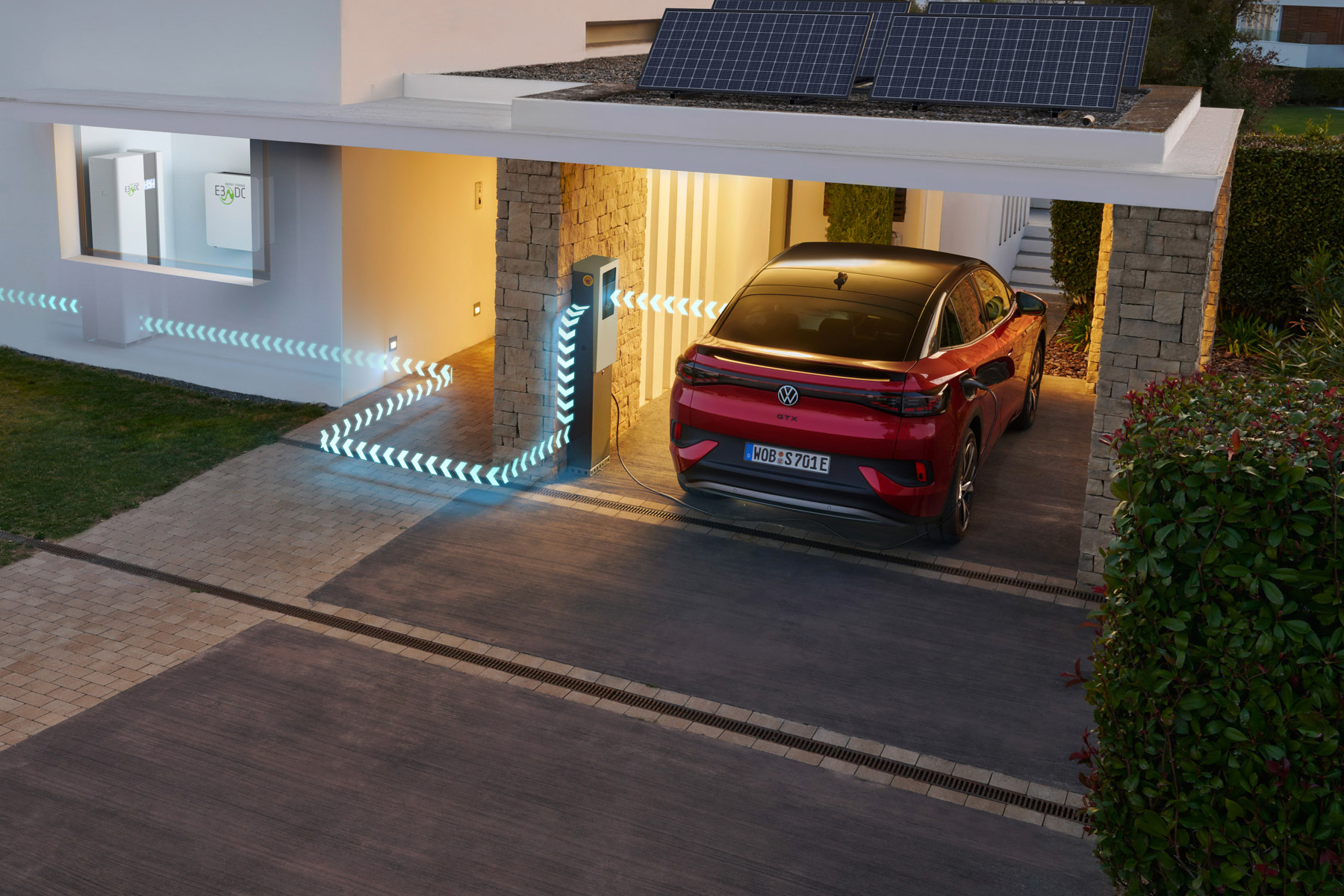
Germany is struggling with getting bidirectional charging capabilities to drivers so they can support the grid. The German Ministry of Economic Affairs recently hosted the third 'European Summit for Bidirectional Charging' where European industry partners presented the progress of cross-country and cross-sector collaboration since the inaugural pan-European summits in 2023 and 2024. Progress from world's largest legacy carmaker is in sight, but hurdles remain before vehicle owners can help stabilize the grid en masse. Image: VolkswagenAn increasing number of vehicle-to-grid (V2G) pilot projects demonstrate that bidirectional charging works technically. Despite Germany’s tardiness compared to other European countries, pilot projects are popping up all over the country, such as the recent bidirectional charging demonstration of a MAN electric truck. An increasing number of passenger cars are now ready for bidirectional charging, including the Renault 5, Ford models Capri and Explorer, several Volkswagen models, the Mercedes GLC, and the BMW iX3. BMW recently launched its first commercial V2G offering in Germany in collaboration with E.ON. Ford will follow this summer with Octopus Energy, while Volkswagen plans to enter the market in Q4 2026 through its subsidiary Elli. Additionally, Renault and Mercedes aim to launch their bidirectional charging offerings in Germany later this year with The Mobility House.However, in Germany, processes that would make vehicle-to-grid bidirectional charging doable for drivers are “prone to delays,” as Munich-based bidirectional charging pioneers at The Mobility House recently noted. The German Federal Ministry for Economic Affairs had already pledged at the two preceding summits—in November 2023 and October 2024, under Green Party minister Robert Habeck—to eliminate technical, legal, and organisational barriers and make bidirectional charging market-ready by 2025, but this goal was not achieved.While the federal German government has taken steps, such as introducing initial tax regulations for bidirectional charging and presenting its roadmap for bidirectional charging via the National Control Centre, and the Bundestag made a key decision at the end of 2025 to address multiple charges on electricity in bidirectional charging (grid fees for intermediate storage will no longer apply in future), the regulatory framework still fails to adequately support bidirectional charging.This was the central message from industry partners at the third ‘Bidi’ Summit, hosted by Habeck’s successor, Katharina Reiche from Germany’s main conservative party, the CDU. The event, officially titled the European Summit for Bidirectional Charging, was attended by “top representatives of the European automotive, energy, and digital industries,” according to a ministry statement. Participants presented progress reports and concrete recommendations for the market and grid integration of bidirectional electric vehicles and home storage systems.The German ministry stated that attendees “have pledged to bring corresponding offerings to the German market in 2026.” However, the obstacle is not the industry’s willingness but the regulatory conditions that politics must create. The ministry further noted a consensus “that European framework conditions for bidirectional charging must be simplified, existing barriers removed, and a European single market for bidirectional charging developed.” The ball is now in Brussels’ court, not Berlin’s—or so the German government’s message implies.For grid integration, industry experts proposed a target concept that includes an EU-wide standardised dynamic grid status signal. This would automatically distribute load and charging flows across all grid levels to prevent overloads before they occur. The German Federal Ministry for Economic Affairs agreed, stating that bidirectional charging technology should be developed within a European single market featuring a unified system architecture.The reality is stark: other European countries are already ahead of Germany, a fact even the ministry under Minister Reiche acknowledges. “Bidirectional charging tariffs are already being offered in other European countries and, increasingly, in Germany,” she noted. However, Germany’s fragmented distribution grid sector and the relatively low adoption of smart meters continue to hinder the rollout of this technology.One of the reports submitted at the summit described Germany’s barriers in detail: “The persistent challenges stem from the pending implementation of MiSpeL and the integration of the grid fee exemption for verified intermediately stored grid electricity, ambiguities and inconsistencies in the area of work-related electricity ancillary costs, the tax treatment of fed-back electricity volumes, and insufficiently coordinated control regimes in the low-voltage grid. Under the current framework, these factors create cost and bureaucratic burdens disproportionate to the potential revenues from bidirectional applications. Furthermore, the timely implementation by Germany’s over 800 grid operators remains uncertain.”The acronym MiSpeL refers to the “determination procedure for the market integration of storage systems and charging points” by the Federal Network Agency. This procedure includes a flat-rate option for households with their own PV systems, electricity storage, and/or charging points, where “the electricity fed into the grid can be classified as ‘eligible for subsidies’ or ‘eligible for netting’ based on certain framework conditions and within certain limits.” This is a crucial step for bidirectional charging. However, MiSpeL is not yet in effect. Additionally, while Germany has decided to exempt grid fees for intermediate storage, the integration of this change is still ongoing.In addition to the report from the sub-working group WG 3a (legal and sub-legal framework for Germany), other groups within the European Coalition of the Willing for Bidirectional Charging submitted their reports. These are available via the link provided below (in English, although the initial report is in German). One report, compiled by the industry coalition and expert working groups of the EU Commission’s ‘Data for Energy’ and ‘Sustainable Transport Forum,’ proposes creating a common European data space within a single market for bidirectional charging. A key focus is the harmonisation of grid connection conditions across the EU.Another concern highlighted in the reports is that linking bidirectional charging with local energy generation, intermediate storage, and the redistribution of locally produced energy could be particularly lucrative. Such “energy sharing” models could be applied in workplace charging or multi-family residential buildings, providing significantly cheaper electricity and serving as backup and emergency power systems during crises.According to the Federal Ministry for Economic Affairs, the reports will now be submitted to the European Commission to advance the development of the regulatory framework in Europe.bundeswirtschaftsministerium.de, linkedin.com (in German, attached links in English)
"Europe must close ranks on bidirectional charging" as Germany dawdles - electrive.com
Germany is struggling with getting bidirectional charging capabilities to drivers so they can support the grid. The German Ministry of Economic Affairs
999 words~5 min read