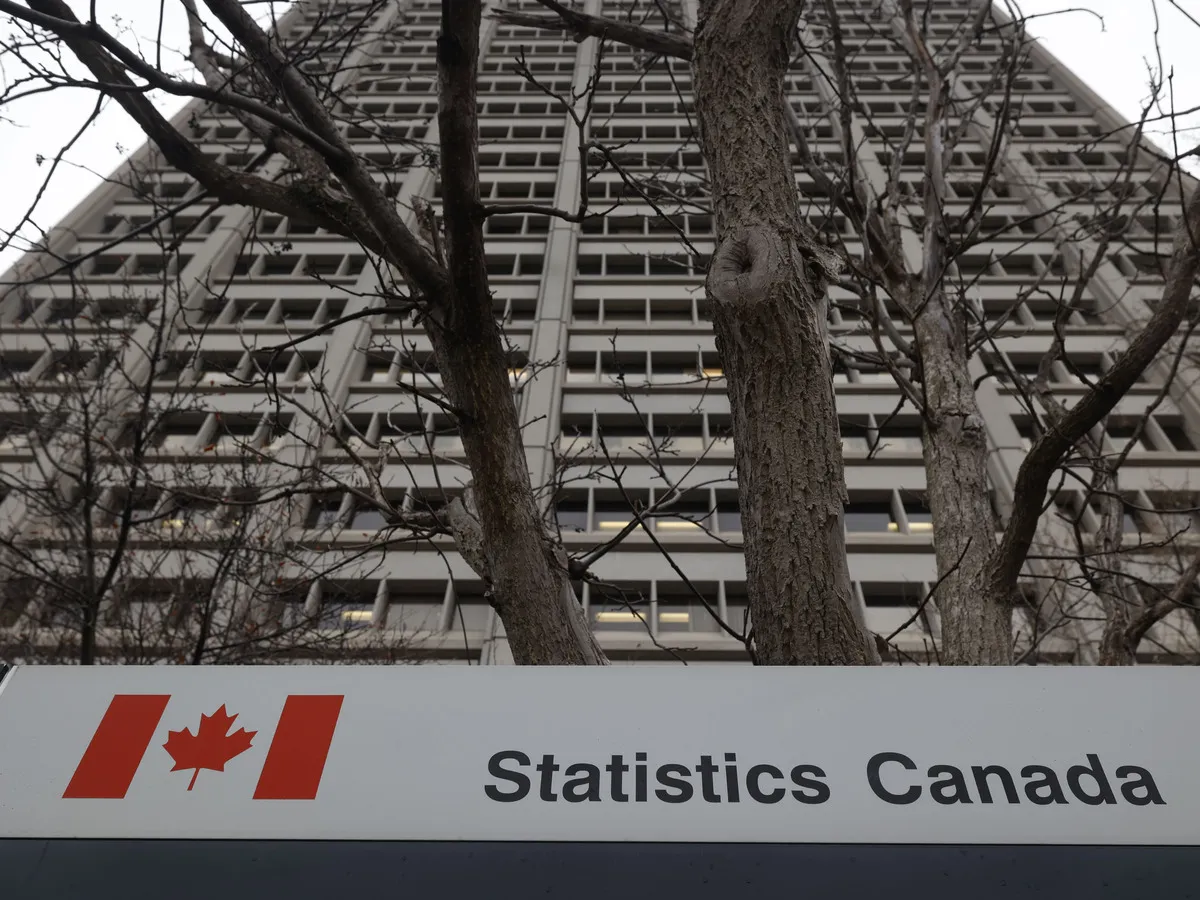
Skip to Content News Archives Economy Energy Oil & Gas Renewables Electric Vehicles Mining Commodities Agriculture Real Estate Mortgages Mortgage Rates Finance Banking Insurance Fintech Cryptocurrency Work Wealth Smart Money Wealth Management Investor Personal Finance Family Finance Retirement Taxes High Net Worth FP Comment Executive Women Puzzmo Newsletters Financial Times Business Essentials More Innovation Information Technology FP500 Podcasts Small Business Lives Told Tails Told Shopping Financial Post Store Obituaries Place a Notice Advertising Advertising With Us Advertising Solutions Postmedia Ad Manager Sponsorship Requests Classifieds Place a Classifieds ad Working Profile Settings My Subscriptions Saved Articles My Offers Newsletters Customer Service FAQ News Economy Energy Mining Real Estate Finance Work Wealth Investor FP Comment Executive Women Puzzmo Newsletters Financial Times Business Essentials HomeWealthStatistics Canada to end in-depth quarterly household wealth reports, which could cause 'costly mistakes,' policy group saysTimely data is vital to track Canadians' status at a time of 'oil price shock and the volatility in financial markets,' economist saysLast updated 17 minutes ago You can save this article by registering for free here. Or sign-in if you have an account.Statistics Canada said its national balance sheet and financial flow accounts, which provide a quick overview of aggregate household wealth trends, will continue to be released on a quarterly basis. Photo by TONY CALDWELL, Postmedia.Statistics Canada will no longer publish detailed quarterly data breaking down the economic well-being and financial stability of Canadian households, a move some economists warn could cloud the picture of wealth distribution at a crucial time.Subscribe now to read the latest news in your city and across Canada.Exclusive articles from Barbara Shecter, Joe O'Connor, Gabriel Friedman, and others.Daily content from Financial Times, the world's leading global business publication.Unlimited online access to read articles from Financial Post, National Post and 15 news sites across Canada with one account.National Post ePaper, an electronic replica of the print edition to view on any device, share and comment on.Daily puzzles, including the New York Times Crossword.Subscribe now to read the latest news in your city and across Canada.Exclusive articles from Barbara Shecter, Joe O'Connor, Gabriel Friedman and others.Daily content from Financial Times, the world's leading global business publication.Unlimited online access to read articles from Financial Post, National Post and 15 news sites across Canada with one account.National Post ePaper, an electronic replica of the print edition to view on any device, share and comment on.Daily puzzles, including the New York Times Crossword.Create an account or sign in to continue with your reading experience.Access articles from across Canada with one account.Share your thoughts and join the conversation in the comments.Enjoy additional articles per month.Get email updates from your favourite authors.Create an account or sign in to continue with your reading experience.Access articles from across Canada with one accountShare your thoughts and join the conversation in the commentsEnjoy additional articles per monthGet email updates from your favourite authorsSign In or Create an AccountorThe Distributions of Household Economic Accounts (DHEA) reports are returning to an annual release, with data for the 2026 reference year to be released on April 13, 2027, alongside other reductions and changes Statistics Canada has implemented this year amid cost savings efforts.However, the Canadian Centre for Policy Alternatives (CCPA) think tank said in February that the agency’s cuts could result in “costly mistakes.”Get the latest headlines, breaking news and columns.By signing up you consent to receive the above newsletter from Postmedia Network Inc.A welcome email is on its way. If you don't see it, please check your junk folder.The next issue of Top Stories will soon be in your inbox.We encountered an issue signing you up. Please try again“A cut to Canada’s foremost data department is a cut to evidence-based decision-making,” the CCPA said in an open letter in February to Mélanie Joly, the minister responsible for Statistics Canada.The agency said its national balance sheet and financial flow accounts, which provide a quick overview of aggregate household wealth trends, will continue to be released on a quarterly basis.Statistics Canada began releasing its household wealth distribution reports on a quarterly basis in 2020. Before this, the DHEA was published on a yearly basis after every fourth quarter.The DHEA datasets break down income, consumption, savings and wealth to highlight trends and inequalities among various demographic groups, such as age and income cohorts, generations, provinces and regions. The quarterly releases of the DHEA also served as an in-depth complement to the agency’s national balance sheet reports.Jasmine Emond, communications and media relations officer at the agency, said in an email that the decision to return to annual releases was “made after careful deliberations on the best use of resources” as part of Statistics Canada’s 2026-27 departmental plan following the federal government’s fall budget and its comprehensive expenditure review to generate long-term savings.“One of the decisions … was to reduce the frequency of various statistical releases, and the DHEA was among the releases affected,” Emond said.In the agency’s 2026-27 departmental plan, released in March, the agency said it was slashing 900 full-time staff and planning spending reductions of about $52.9 million in 2026-27, $69.7 million in 2027-28 and $95.9 million in 2028-29.Statistics Canada said it would achieve these reductions by “program realignment through targeted reductions and rescoping” and “implementation of program cost-saving efficiencies.”In response, the CCPA published its open letter in February, urging that these cuts be reconsidered.“The Statistics Canada cuts will result in reduced data collection, diminished data quality, loss of vital expertise, silenced marginalized voices, less government accountability to the public, costly mistakes, less information in a time of turmoil and mis/disinformation,” the CCPA wrote in the letter.However, economists differ on whether the frequency of reports affects the quality of data.Switching to annual releases could potentially result in more accurate and precise data reporting, said Maria Soloveiva, a Toronto-Dominion Bank economist who frequently comments on the agency’s household wealth reports.“In my view, the quality of the data is more important, so if moving to annual reporting improves data quality, I’d support that approach,” Soloveiva said.On the other hand, Shelly Kaushik, senior economist at Bank of Montreal, who publishes commentary on the national balance sheets, said more frequent data generally provide a better picture of when things change, which can help determine cause and effect with more certainty. This is especially true in the case of household wealth distribution, “at a time when house prices and financial markets are going in different directions,” she said.“Higher frequency might be helpful to see how patterns and distributions change as we go through the oil price shock and the volatility in financial markets, while most of the housing market remains subdued.”Data utility degrades with time, said David Macdonald, senior economist at the CCPA. “As it becomes less frequent, it also becomes less relevant for policy making,” he said. “If you find out two years later that wealth plummeted among the bottom quarter, it’s too late.”This reversal in the frequency of DHEA releases is just the “tip of the iceberg” on data implications due to Statistics Canada cuts, said Macdonald, who added that other Statistics Canada programs are being cut or reduced as well amid the federal government’s heightened defence spending.Statistics Canada released a list of reduced or adjusted programs and discontinued activities in April, which did not mention the DHEA releases.“These government-wide measures are intended to reduce spending on operations while protecting priority programs and investing in areas that support Canada’s economic and social well-being,” the agency said. “There will be reductions in scope, frequency and/or granularity to elements of various statistical programs.” Join the Conversation This website uses cookies to personalize your content (including ads), and allows us to analyze our traffic. Read more about cookies here. By continuing to use our site, you agree to our Terms of Use and Privacy Policy.
Statistics Canada to end in-depth quarterly household wealth reports, which could cause 'costly mistakes,' policy group says
Statistics Canada will no longer publish detailed quarterly data breaking down the economic well-being Canadian households. Read on.
1,288 words~6 min read