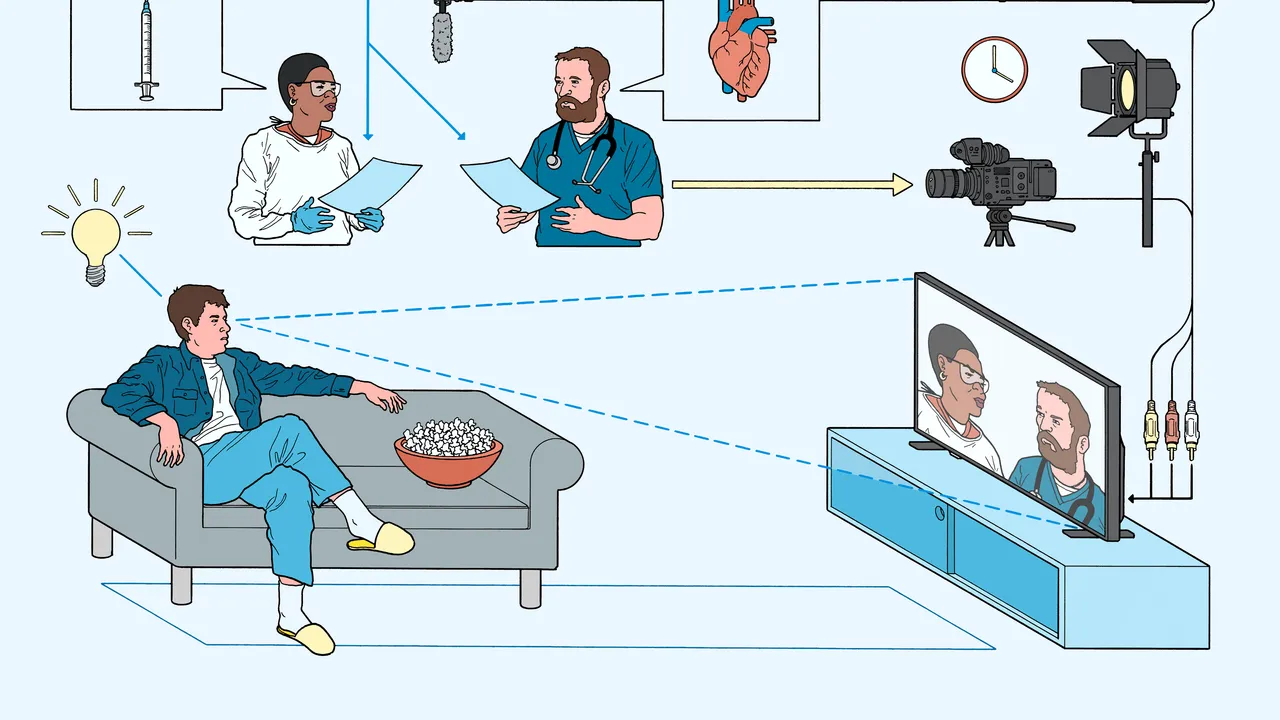
Calling something “didactic” has become grounds for immediate dismissal. But do the merits of works with an educational bent—from “The Pitt” to “Elizabeth Costello”—suggest we should think again?May 16, 2026Illustration by Kyle EllingsonAnother patient has hit the emergency room, this one with a malfunctioning pacemaker. As doctors begin the complex process of inserting a wire into his chest, a question-and-answer session begins. “Why do we inflate the balloon now?” one asks. A student doctor answers, “So it’ll float into the right ventricle.” The operation is a success, but the doctors are pulled away immediately—first to a patient who needs to be told about her high mercury level, then to a person who just nearly drowned. We’re midway into the first season of HBO’s medical drama “The Pitt,” and though we may not learn how to perform a heart procedure, we do get another lesson. As Dr. Langdon, one of the senior residents, remarks to his colleague, “The average emergency doctor gets pulled from task A to task B every three to five minutes.”“The Pitt” is filled with moments like this—pinpricks of education in which the natural speech of a character warps as the script bends to convey a message. We learn about how the shortage of nurses limits hospital-bed space; the rate at which patients assault nurses; the fact that the space of Retzius (a part of the pelvis) is named after a nineteenth-century professor of Swedish anatomy. Highly earnest—sometimes even maudlin—the show is a throwback to the serial medical dramas that were omnipresent in the nineties and twenty-tens. Noah Wyle, who plays the show’s protagonist, Dr. Robinavitch, is to some degree reprising his role as a doctor on “E.R.”Shows like that one very often embedded neat social messages within the kernels of patients’ case histories, but “The Pitt,” more than any of its forerunners, projects its conscience plainly on the screen. Each season unfolds in the course of a single day, thus concentrating all the hospital’s lessons into a tight timeframe. When an anti-vaccine parent refuses to let her son have a spinal tap, there is little question that she is in the wrong. When ICE agents show up at the hospital with a woman whom they have detained, there is little ambiguity that these are very bad guys. Beyond these overt displays, the show’s lessons are many: the urgency of providing the right care, the mental and emotional toll that medical work can take, and the politics outside the operating room that hamper doctors’ efforts. The show is incredibly popular and widely lauded; last year, it was nominated for thirteen Emmys and won five, including for Outstanding Drama. It is also, at its core, an exponent of an unpopular form: didactic art.Lately, to call anything didactic can become grounds for dismissal, an elevated synonym for “heavy-handed,” “preachy,” or “too on the nose.” In a recent “Word of the Day” article, the New York Times noted that the word had been used in fifty-eight of its articles in 2025. It cited the film critic Manohla Dargis’s praise for the Timothée Chalamet vehicle “Marty Supreme”: “The film touches on big, weighty subjects like Jewish identity, family, community, class, assimilation and success, but it isn’t didactic and doesn’t serve up any life lessons, in the pious finger-wagging manner of many American independent movies.” In Variety, a review of “One Battle After Another”—a film widely debated for how correctly or faithfully it represents radical politics—similarly praised the film’s light touch, writing that “it’s not some in-your-face didactic absurdist thing.” And a recent Times review of children’s books asserted, “These aren’t didactic works. They are art, with soul-stirring depth and resonance.” Apparently, today, even children ages two to eight have become too subtle for education.The modern reader may cringe at the mention of the didactic, but it was once normal to think that art might instruct. Hesiod’s long poem “Works and Days,” written around 700 B.C.—one of the oldest and most widely read poems in Greek antiquity—is, among other things, a farming manual. A century later, Aesop’s tortoise and hare gave us an instructive image that, even as a cliché, has lasted millennia. Ovid’s “Ars Amatoria,” from 3 B.C., guided readers on finding a suitable lover (though perhaps his instructions were a little too exciting, as Ovid claimed they hastened his expulsion from Rome). Examples of great work premised on our desire to learn stretch into the twentieth century. Consider Alain Resnais’s “Night and Fog,” which documented the horrors of the Holocaust; the inventive, chaotic, and politically radical films of Jean-Luc Godard; or the artist Hans Haacke’s installation “Shapolsky et al. Manhattan Real Estate Holdings, a Real-Time Social System, as of May 1, 1971,” a meticulous presentation of a shady New York landlord’s records, complete with paperwork documenting its transactions.Among the few genres of art in which the didactic flourishes today is science fiction. Its most famed practitioners all give lessons: Octavia Butler’s novels overtly examine divides between sexes, genders, and races; Kim Stanley Robinson’s “The Ministry of the Future” offers a cautionary vision of climate inaction. “The Dispossessed,” by Ursula K. LeGuin—one of the greatest science-fiction authors—takes place on two planets: one where capitalism dominates and another that is a hardscrabble anarchist would-be utopia. Maybe the dichotomy beats you over the head a bit to begin, but with time the novel fills in its blueprint with richly imagined characters and societies. Miniature lessons the characters undergo throughout are also lessons for the reader, compare-and-contrast exercises that allow us to consider how our own society works, and why choices are made to keep it that way.Of course, it’s slippery to call one work didactic and another not. Almost all works of art, to an extent, presuppose and endorse points of view, thereby acquiring the hue of instruction. As the critic Barbara Rose wrote in an influential essay in Artforum, from 1967, “All valid art, of course, teaches something,” but only some works’ “primary intention is to instruct.” In the serious and arguably more rarefied realm of literary fiction, work that foregrounds this intention is vanishingly rare. One prominent example is the Nobel-winning writer J. M. Coetzee’s “Elizabeth Costello,” from 2003, much of which takes the form of lectures. These lectures are delivered by the eponymous Costello, a respected elderly novelist. (Her most famous work is narrated from the perspective of a character who echoes Molly Bloom, the wife of the protagonist in James Joyce’s “Ulysses.”) One chapter is almost entirely constituted by a speech in which Costello gives an impassioned and gracefully argued defense of the rights of the animals who are slaughtered by the billions in factory farms.Coetzee is well aware of the risks one takes in trying to instruct the audience: the readers’ disagreement with the lesson, or, worse, their boredom. But the wide fictional scope of “Elizabeth Costello” allows him to introduce clashing perspectives about the morality of meat consumption (along with the other questions the novel raises); we get to see, for example, the responses of Costello’s son and his wife, who regards Costello as possessing a sense of moral superiority. At one point, after her speech, Costello’s son asks her if she really expects to change anything with her activism. She does not think so, she says, an admission of uncertainty that leaves the question open for the reader to consider. Coetzee puts us to the test, in style, imagination, and argument, helping us imagine what narrative art in the twenty-first century might become.In a season that perhaps lacked the cohesiveness or clarity of the first, one moment of instruction in the second season of “The Pitt” stood out. Didactic art has a bad reputation because so often it simply falls flat—a canned lesson in the mouth of a character has tough work to do against the uncanny surprises of reality. But maybe, then, it’s just that our idea of teaching needs to be recalibrated. In the seventh episode, a patient who has been sexually assaulted during a Fourth of July party is treated in the E.R. The charge nurse, Dana, explains to her nurse protégée, Emma, that she will examine the patient, because it might take too long for a SANE to come, given that it is a holiday. What is a SANE, you might ask? Well, Emma, on her first day, can be told that “SANE” stands for Sexual Assault Nurse Examiner. Some viewers will already know—a burst of information can’t hit everyone equally—but many probably will not, that there is a specialized protocol for collecting evidence into what is more commonly known as a rape kit.And what, exactly, goes into the making of a rape kit? The show’s explanation is partly a methodical recitation of facts, but one that is given space to breathe. The patient, named Ilana, is reluctant to be examined, and Nurse Dana cannot leave the room until the process is finished. In a frenetic show, paced literally around the clock, in which every second counts, the viewer is now exposed to a kind of time that we haven’t yet seen: waiting, not just to know what’s wrong with the body but to see if there can be any remedy at all. Doubt and emotional ambiguity come to the fore. We see Ilana’s slowly growing discomfort as she takes off her clothes and gives her testimony, Dana’s effort to remain neutral and responsive. The alleged perpetrator is a friend; Ilana changes her mind midway through the process, deciding she doesn’t want to go through with it. (“It didn’t mean anything,” she says.) Ilana takes a break from the examination while Dana stays in the room, until Ilana eventually decides to finish. The scene is dramatic, but also discomfitingly mundane. In a show known for its depiction of surgeons’ cowboy maneuvers in the operating room, this incident teaches something about patience, and about how easy it might be to look away.As Ilana’s exam progresses, the show lays out the meticulousness of the rape-kit process. Every article of Ilana’s clothing must be carefully preserved and packaged for evidence. Pictures are taken of Ilana’s bruises, and the SD card storing them is sealed in an evidence envelope. A blue light is run over her body, and a sample is taken from her skin. She is swabbed under her fingernails and internally. An experience that might be abstract and easily glossed over is made real for every agonizing moment. And, after all that, the staff also worry whether the police will even come to pick up the kit. “The Pitt” is at its best when it forces us to stop and consider something we might not otherwise be willing to pick apart. The show is not an after-school special but a humane act of attention.If the idea that art can teach us something is an old one, how did it become so taboo? There is no one answer. As good a place to start as any is with Immanuel Kant, who in his “Critique of Judgment,” from 1790, developed a theory of beauty as self-contained: beautiful things don’t have any purpose other than to be their beautiful selves—a flower doesn’t stop us in our tracks because it does anything for us but simply because we admire its form. By the nineteenth century, this theory of art had slowly ripened into aestheticism and the idea of “art for art’s sake.” In the twentieth century, enemies of didacticism multiplied: a tradition of university arts education that prized ambiguity as more sophisticated than a direct statement from the artist, the rise of a leisure class and a culture industry in which consumption became the primary metric of value, an American-grown sense that the socialist-realist art of the Eastern Bloc was regressive and authoritarian—that anyone trying to tell you what to think is trying to control you.Today, the disdain for the didactic also reflects a new uncertainty about what, exactly, our educations are for in the first place. For the past few decades, the university has increasingly been conceived of less as an environment for learning than as a vehicle for obtaining a credential and entering the job market. That anxiety has only intensified with the rise of large language models, which have bewildered teachers around the world; what’s the point of assigning homework if students can produce approximately correct answers without doing the work themselves?In the age of social media, a new variety of instruction has arisen, rooted in passive exposure to facts and embodied by YouTube explainer videos and short-form how-tos on TikTok—a kind of simulated enrichment that never really sates us. (Of course not: that would be against the platforms’ interests.) Social-media feeds are flooded with drips and drabs of art. When we lay our weary heads down, fast-twitch and low-effort clicks prevail. One day you emerge from a daze and find that you’ve been watching isolated YouTube Shorts of the TV show “Suits” instead of whole episodes of the real show. This Candy Crush-ification of culture makes any single object seem a little less worthwhile, and a little more disposable. Perhaps, then, it’s no surprise that audiences don’t expect to be taught, just as we no longer expect to encounter the sacred. We don’t expect art to change us. We curl up and stream, and watch to forget, or to go numb.The one way in which instruction seems to be allowed—indeed, even encouraged—to manifest in art lately is in the form of political signalling. Some might say that the didactic spirit is already all around us, in the perilous guise of “wokeness.” “The Pitt,” one might argue, is a perfect example, given its faithful adherence to liberal tropes. Does it toe the party line? Certainly. In the show’s second episode, when a Black patient arrives screaming, she is mistreated by E.M.T.s until a conscientious doctor of color, Dr. Mohan, picks up her case, and identifies her as suffering from a kind of sickle-cell disease, which disproportionately affect people of African descent. Naturally, Mohan is researching bias—another small set piece designed to inform the viewer of both wrongs and how they might be righted. The first season’s centerpiece event is a mass shooting at a nearby music festival. One story line in Season 2 concerns the pitfalls of A.I.; a head doctor tells the residents that it will save them up to eighty per cent of the time they spend charting, but later a patient is put in danger when an automated system spits out an inaccurate case history.Today, we are shy to talk about what older artists might have called morals—now we have politics alone. The frequent appearance of works that consistently foreground or endorse liberal concerns and arguments has inspired no shortage of bad feelings. The right argues that “identity politics” and other pieties are being forced upon the public through the mediums of film and TV. (Whether this is, usually, a conscious act of persuasion or a symptom of art reflecting its context is an open question, and likely varies from work to work.) We might see the embrace of a heightened ambiguity with respect to political subject matter—a gesture increasingly to be found among left- or liberal-leaning artists and critics—as a response to this, too. Nowadays, it’s not uncommon to find works that invite topical conversation while avoiding any stance about the political actions and disagreements they depict. Of course, it’s audiences who provide the ultimate readings, but there are often ghostly suggestions that these works have “something to say.” Ari Aster’s “Eddington,” for instance, and Paul Thomas Anderson’s “One Battle After Another”—which the Oscars anointed last year’s Best Picture—invoke themes of polarization and revolution but, by not reaching for conclusions, convert these references to a swirl of signifiers. (Possibly, this is a practice that the streaming platforms like, too, because interpretive instability leaks down into comments sections and Letterboxd reviews, generating engagement.)Often enough, something that might be construed as didactic is actually an exercise in feeding the audience what they already know. When lessons peek out occasionally in pop culture today, as in America Ferrera’s monologue in “Barbie” about the contradictory standards of contemporary womanhood, or in Adam McKay’s straightforward allegory for climate denial, “Don’t Look Up,” the liberal audience can take pleasure in being good listeners. They are not sexists, nor climate deniers. Consider some other recent HBO hits, such as “Succession” or “The White Lotus,” that play out the follies of the feckless rich. These shows attain a vaguely political charge as they display their characters’ petty indulgences (whether these images ultimately reinforce our fascination with the obscenely rich, well . . .), but their fundamental premise—those crazy élites!—doesn’t cause a bat of the eye. The shows’ glimmers of social critique provide an alibi that we may be watching something important, yet often their audiences are just participating in rote recitation, not the experience of learning. These shows are symptomatic of a particular contemporary phenomenon: the reassuring comfort watch, in which conventional opinions are reflected back to us, confirming our world view. This is the creative logic of the algorithm, recording the received wisdom, the likes and dislikes, and spitting out more of the same.A close neighbor of “didactic” is the term “agitprop,” borrowed from the Soviet lexicon for works that were designed to push directly for political change. The term is also usually taken as clearly negative, but it’s worth asking if a work might advance a defined opinion and still maintain nuance, even elegance. In some cases, seeking to confront the audience with explicit ideas might actually be more daring than presenting them with a gauzy web of signs. It’s true that no one has grasped the final lessons of “King Lear,” and that that is part of the reason the play is great. Lovers of the highbrow (I count myself among them) have long defended the value of so-called difficult art—of works that stretch the imagination both formally and conceptually. But it has to be said that, barring a few exceptions, this kind of work is typically made for a small audience, one made up of people who understand a work’s context, its history, and know specific cues. For that reason, it can also risk sterility. To open the channel of the didactic is, in part, to expect more of ourselves and of others—to hope that we might grow together.As gruesome cases cascade through the E.R. of “The Pitt,” the viewer is repeatedly reminded that we are in a teaching hospital. It is a show about students learning to become practitioners as much as it is about saving any patient. Most people in America aren’t doctors; most of show’s audience won’t be, either. The viewer without a medical education will see the show’s hospital through its students’ eyes. As the story lines progress, viewers will glimpse many of the endless intricacies of emergency medicine, sensing the vast store of knowledge that the job requires. They won’t necessarily remember what exactly a REBOA is, but they’ll come away with a sense of the enormous complexity of the American health-care system, and of what it takes to keep people well.Certainly, “The Pitt” is topical, but it could also be seen as a sneaky piece of socialist realism (or perhaps center-left liberal realism) hiding in plain sight. It is a clear appeal for the way we ought to treat life in America, amid panic and collapse. It shows us doctors’ anxieties and overconfidences, their successes and mistakes. It is about the struggle to help life triumph over death, the responsibility to preserve our humanity against the dehumanizing failures of the body, and, above all, the collective effort required to do these things. It does not conceal its belief in the project of medicine, and it attempts to help us understand that project’s difficulties. It is entertainment, yes, but its ambitions give it an urgency that raises the stakes and, ultimately, makes it a more compelling show.Bertolt Brecht, the twentieth century’s great master of didactic art, imagined a theatre that might help its viewers break out of the strictures of modern, mechanized society. He changed the medium by writing dramas that reimagined the artist’s relationship to his audience. In such plays as “Mother Courage and Her Children,” about the success and ultimate failure of a wartime profiteer, and “Galileo,” about the quest for knowledge against a dogmatic authority, Brecht dispensed with the illusion of reality, which audiences tended to expect, using deliberately unusual gestures and speeches, and breaking the fourth wall. His plays made life strange while asking familiar moral questions: Why do some of us eat better than others, while having done nothing for it? Why do we close our ears to new ideas? Who chooses whether we’re allowed to live or die? In doing so, they incited viewers to pay attention, to involve themselves, to think twice.This prospect might at first seem like a recipe for difficulty, but in his theoretical writing, Brecht insisted that art must also be fun. The audience, he wrote:Must be entertained with the wisdom that comes from the solution of problems, with the anger that is a practical expression of sympathy with the underdog, with the respect due to those who respect humanity, or rather whatever is kind to humanity; in short, with whatever delights those who are producing something.Brecht believed that the audience could be challenged. He wanted to make them participants in the work. And don’t we want to be involved, not just passively eating up whatever content floods our senses, thoughtlessly reacting to A.I. slop? “The Pitt” is nowhere near as strange or as aesthetically radical as “Mother Courage,” but it is strange in its own way. When we learn, we are confronted with strange things all the time, simply in that we do not yet understand them. Watching the show invited me to see the hospital as a prism for our society, in everything from its financial workings to its depiction of how near we are to death. Although I occasionally roll my eyes at a preachy moment, these don’t really detract from my enjoyment. Why should they? As for the show’s student doctors, the knowledge we require—to perform our jobs, to improve the world, to live better lives—is extensive. And just as the worth of knowledge that enlivens us is endless, the work of acquiring it never ends. But in the work of acquiring it, we do not have to be dulled. ♦A scientist with a Ph.D. from Harvard fatally shot three of her colleagues. Then revelations about her family history came to light.
Can Art Teach, and Should It Try?
Describing a work of art as “didactic” has become a way of writing it off. But works such as HBO’s “The Pitt” push us to reconsider the merits of trying to teach.
3,755 words~17 min read