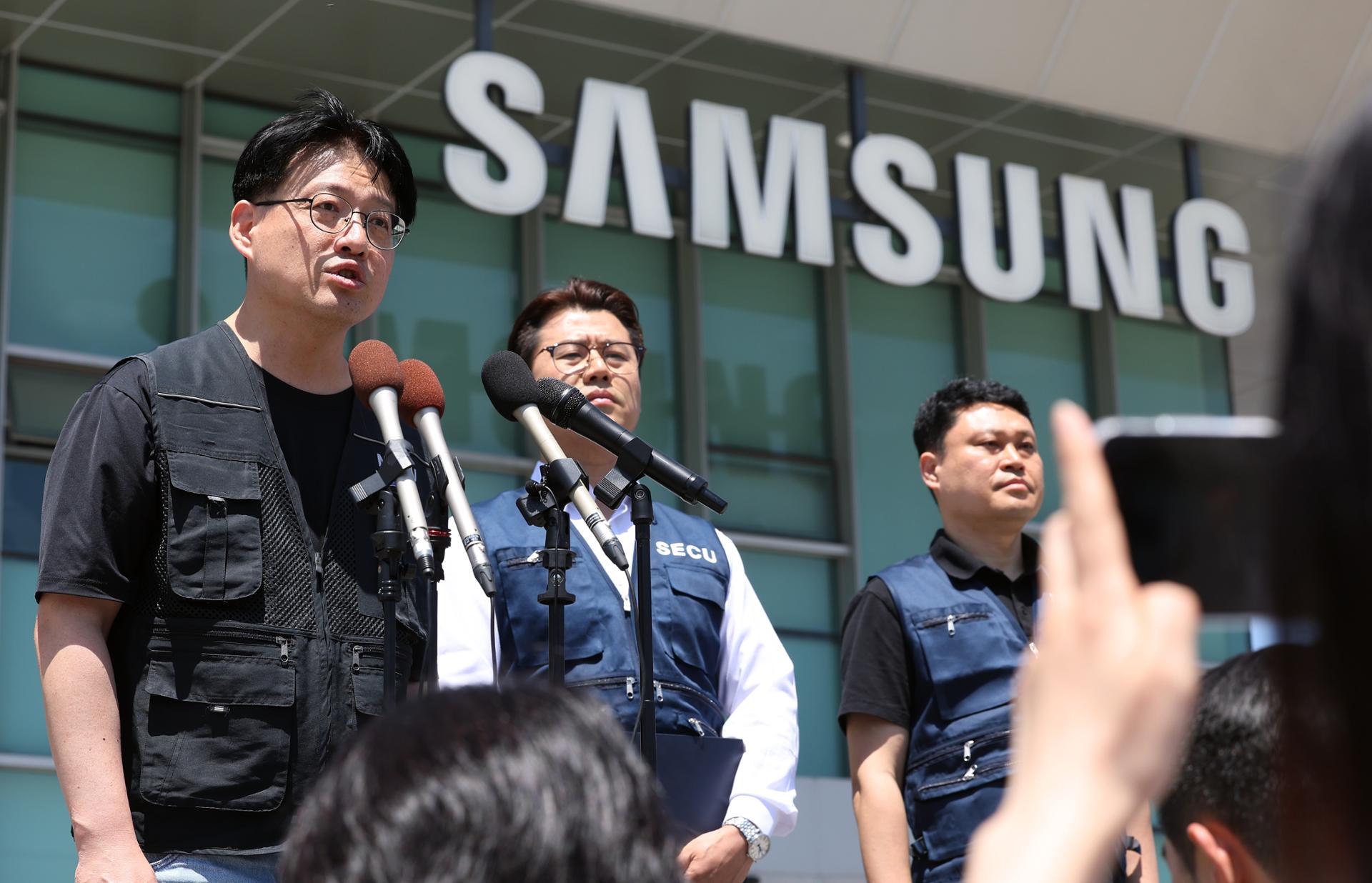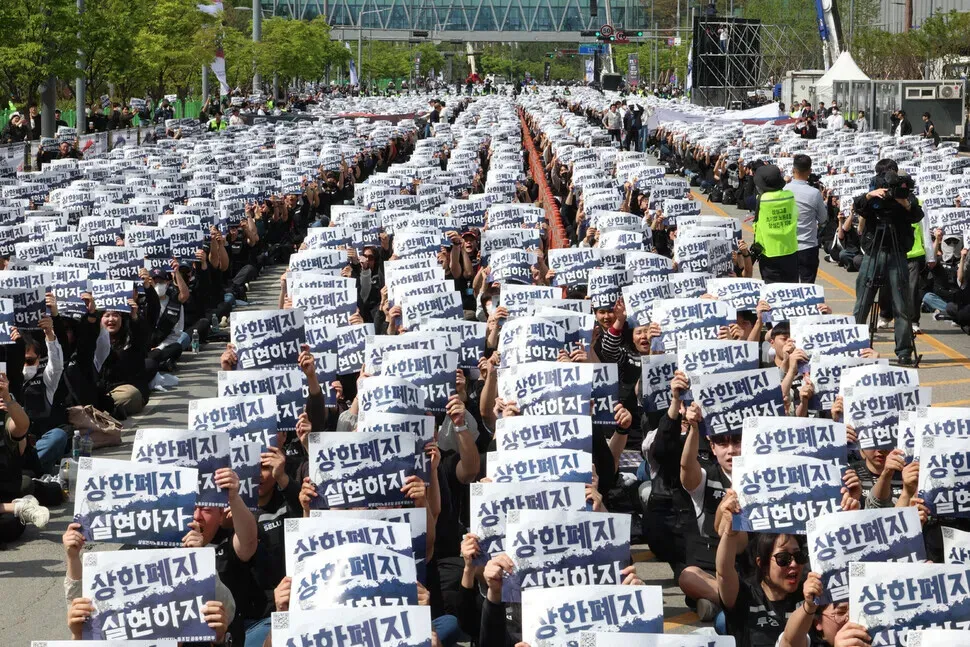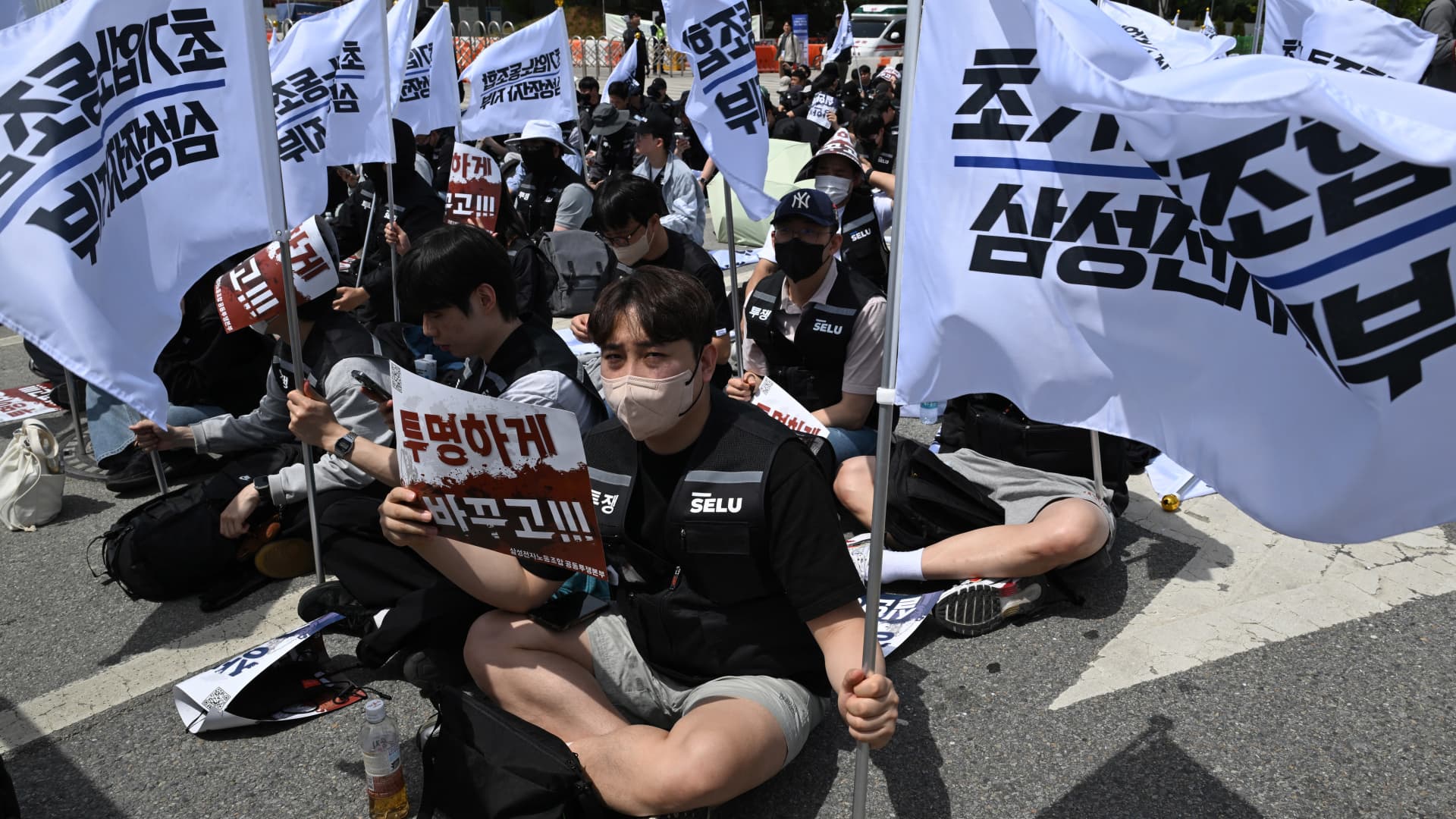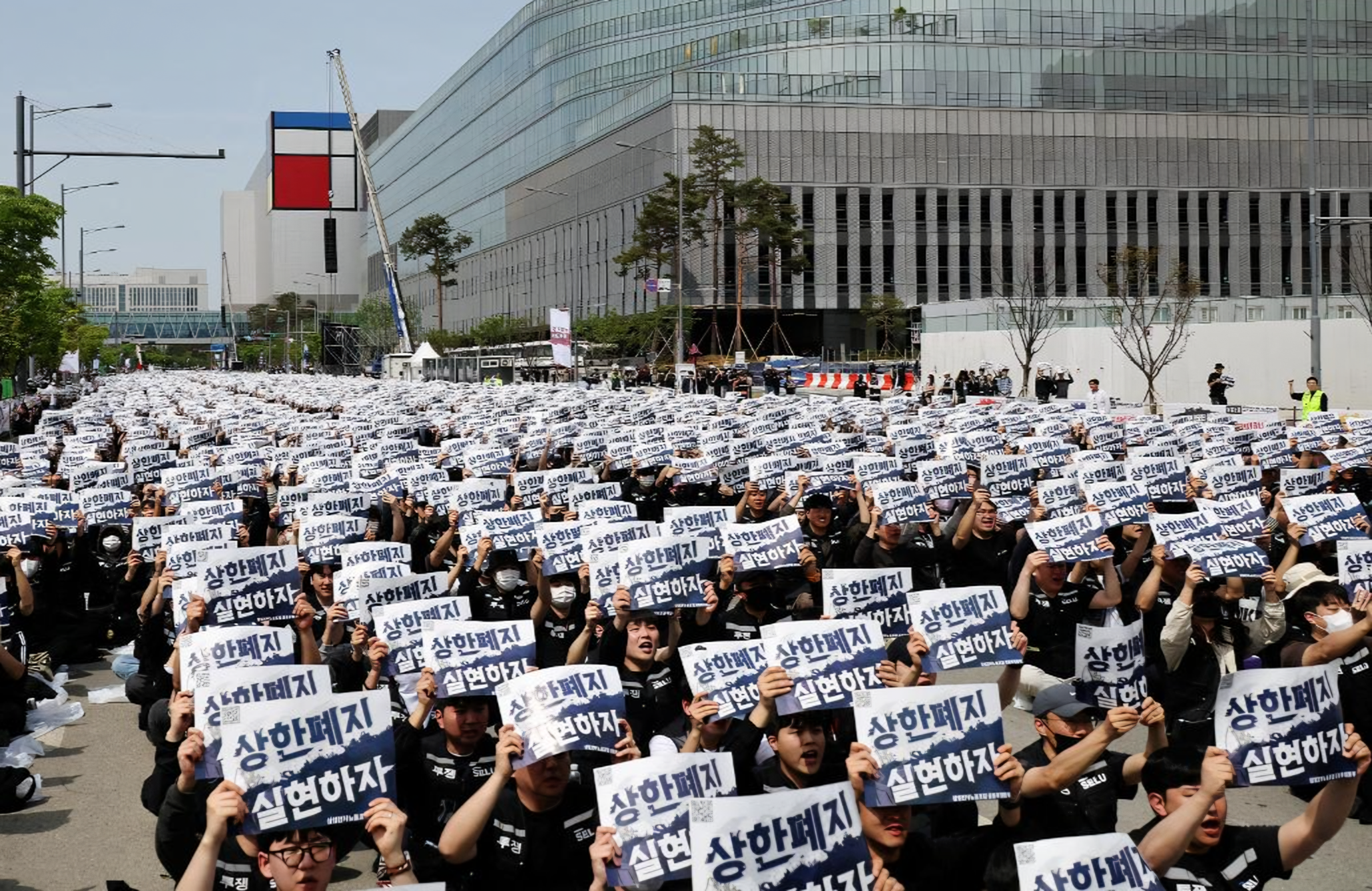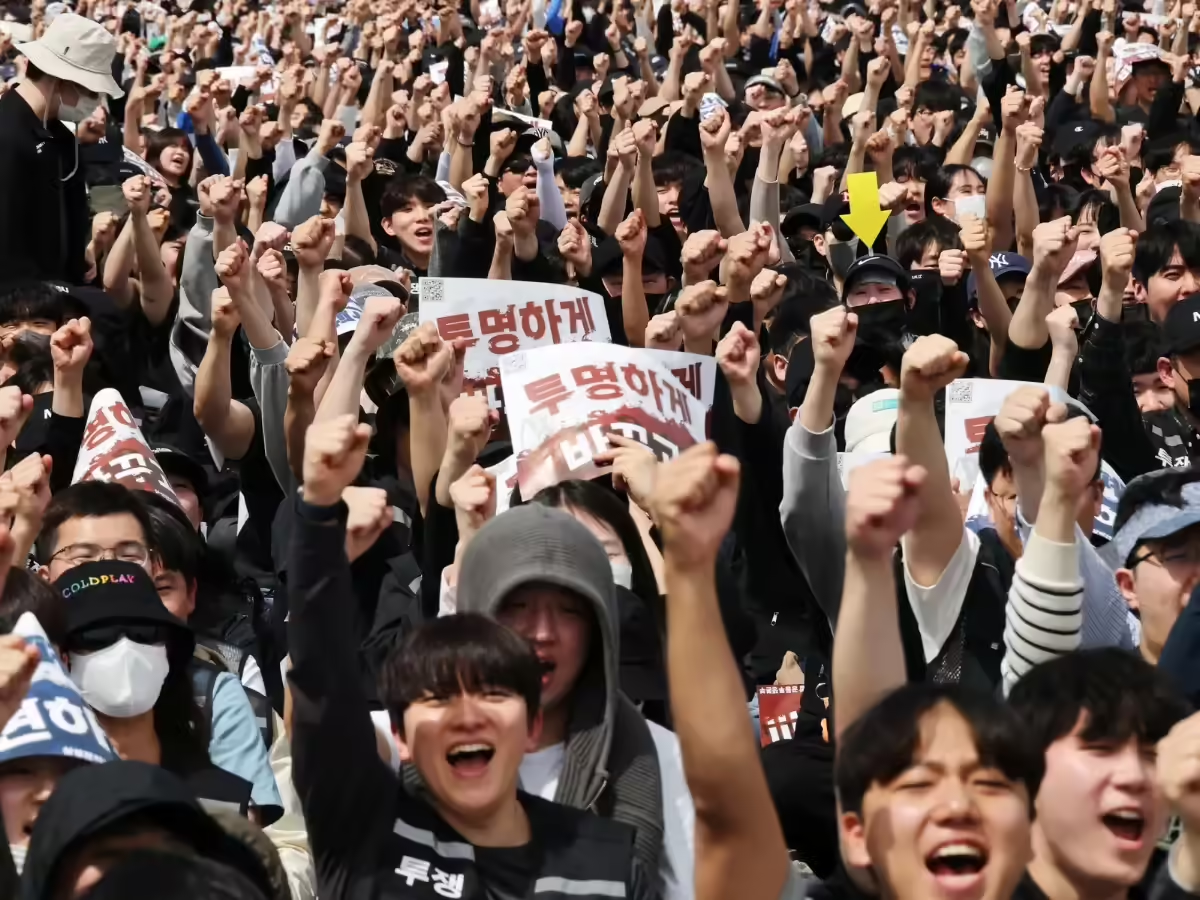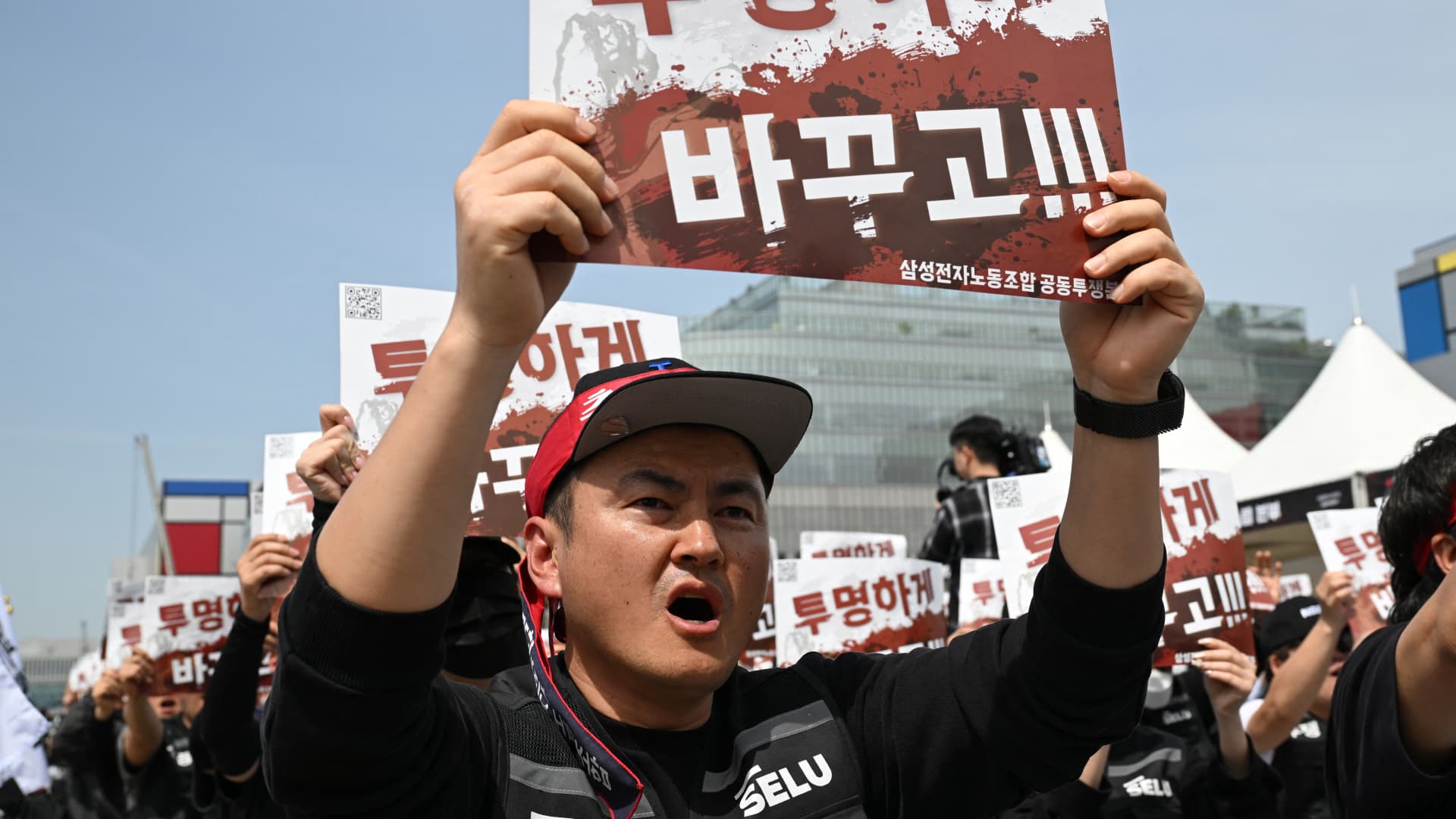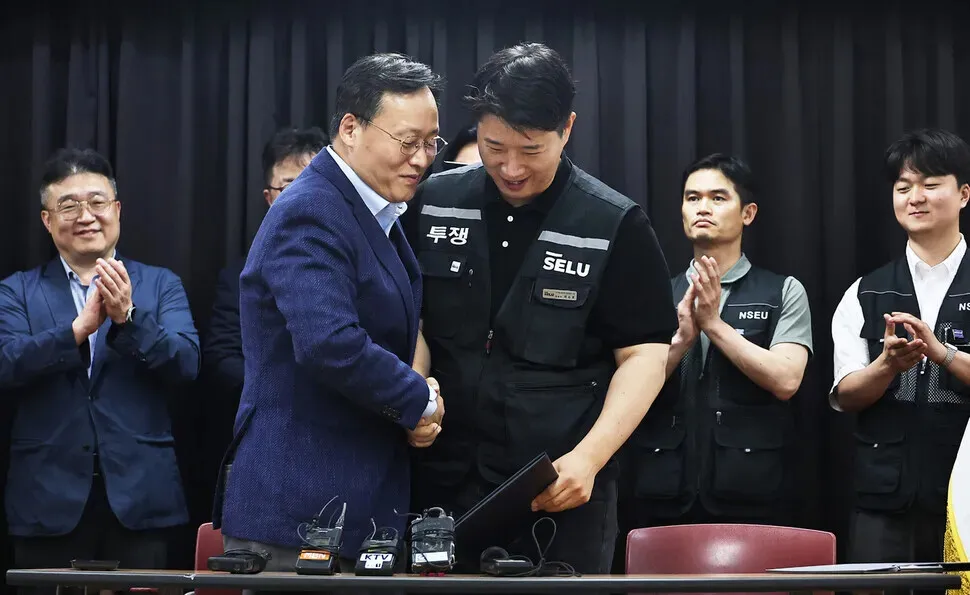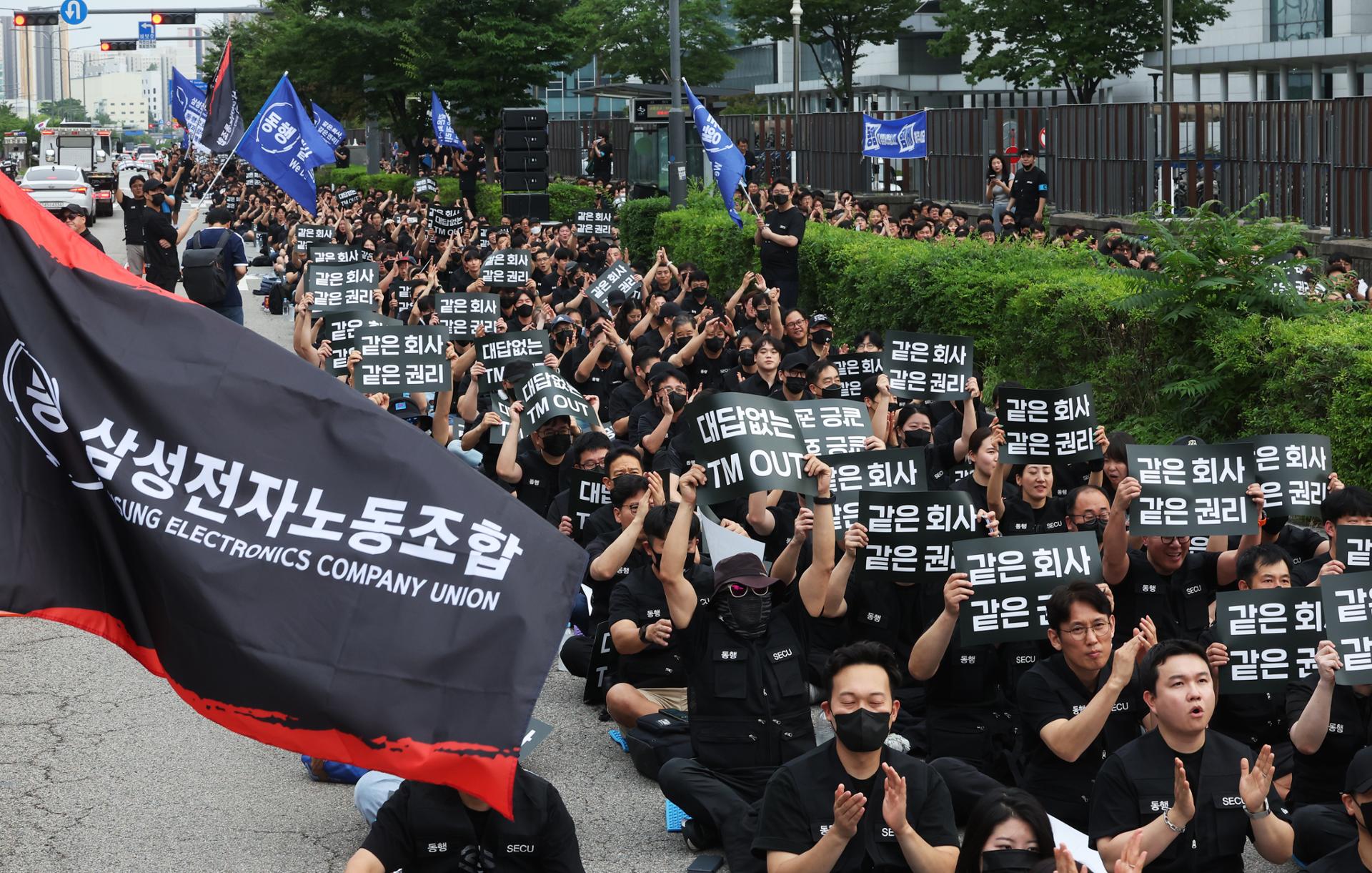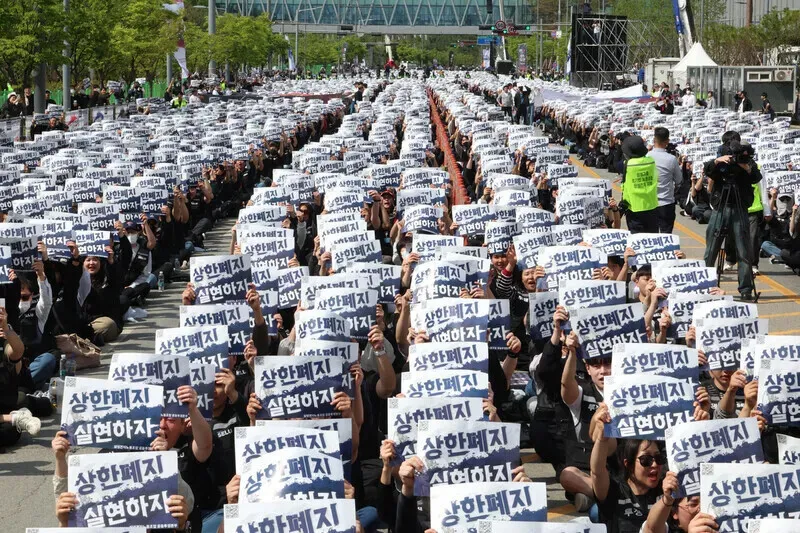
Samsung Electronics union members protest outside the company's semiconductor plant in Pyeongtaek, South Korea, on April 23, 2026. (Choi Hyun-su/Hankyoreh)
By Jun Sung-in, former professor of economics at Hongik UniversityWage negotiations at Samsung Electronics have been drawing national attention. Whatever their outcome, the negotiations pose important questions for Korean society.The first is to what extent the government should intervene in an individual company’s wage negotiations.Prime Minister Kim Min-seok said that Seoul will “consider all available means of response [. . .] including emergency adjustment,” with President Lee Jae Myung chiming in that “corporate management rights are also important.”Park Su-keun, the commissioner of the National Labor Relations Commission, bluntly stated that the union “shouldn’t go on strike.”As the comments above indicate, the Korean state is openly intervening in these wage negotiations. Furthermore, that intervention is based on the assumption that the union should be kept from striking under any circumstances.At the same time, the government is encouraging the union to do its best in the wage bargaining. Some kind of encouragement that is! What employer would offer concessions when striking is off the table?The employer will breeze through the bargaining, and any resulting deal will come at the expense of workers’ rights.That’s why some describe the government’s meddling as unconstitutional.In addition, overt state intervention in an individual company’s wage negotiations is liable to have a negative impact on the company going forward. Samsung Electronics has a rival in the field: SK Hynix. If the Samsung union has to swallow an unfavorable deal, talented workers may seriously consider taking offers at SK Hynix or other competitors.There are certainly Koreans around the country who are eager to work for Samsung Electronics even if that means accepting very low wages. But what’s less certain is whether Samsung could fill the technical vacuum caused by a brain drain.The second question is how we should regard demands for higher wages by workers who already enjoy considerable privileges. The image of the worker conventionally depicted by the progressive front is one who is exploited by ruthless employers and whose very survival is in danger. (It would be pointless to mention the conservative front’s default canard of workers as being card-carrying commies.)The progressive narrative has produced the stereotypical view of the labor movement as being a fight for survival.But there’s a serious omission in that stereotype. It fails to capture the struggle for wages being fought by the “privileged” unions at Samsung Electronics and other leading firms.That’s the attitude behind such snarky remarks as “You’ll be fine without a raise” and “You should be ashamed to ask for more when other workers, including those at Samsung’s own suppliers, struggle to make ends meet.”But the fundamental issue with that attitude is that it narrows the purpose of the three labor rights enshrined in the Constitution to merely protecting workers whose survival is endangered. That’s wrong. Yes, the Constitution protects the rights of workers whose survival is at risk — but it also protects the rights of workers who live lives of plenty. The third issue concerns President Lee’s comment about protecting the company’s “management rights” in the process of wage negotiations. What on earth is that even supposed to mean? Generally speaking, corporate management rights refer to a company’s authority to make routine decisions necessary for carrying out business. Such authority, of course, also includes a firm’s authority to bargain with its workers about wages and compensate them accordingly. Have those rights been infringed upon in the process of the recent wage negotiations at Samsung Electronics? Of course not. The labor union isn’t commanding the company to raise wages; it’s asking Samsung to negotiate with it on the level of wage increases. That is, it’s not taking away Samsung’s management rights, but encouraging the company to exercise them. Of course, unions say that they will go on strike if negotiations fall through, but employers also always have the option of a lockout. The current conflict simply reflects the fact that the threat of a strike is high, while the threat of a lockout is low. The outcome of the wage negotiations should take that imbalance into account.Perhaps the biggest reason this year’s wage negotiations at Samsung have garnered so much attention is the sheer scale of the money involved. From the hundreds of trillions of won in annual operating profits for Samsung, to the billions of won for bonuses that the union is demanding, and the bonuses per worker in the hundreds of millions of won, these are all numbers that ordinary office workers could only ever dream of. But this may just be the new normal going forward, and we may need to adapt. Artificial intelligence has created a new world. What will be important in this new environment is fair rules and fair enforcement of them. The wage negotiations at Samsung Electronics have, perhaps counterintuitively, opened society’s eyes to how important it is to keep outside forces from interfering at will, and how crucial it is to adhere to the rules of the game and accept its outcome. Please direct questions or comments to [english@hani.co.kr]