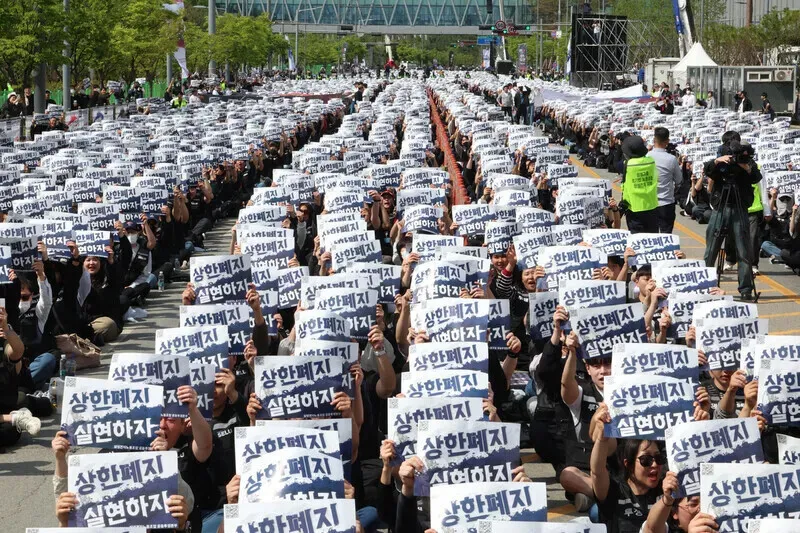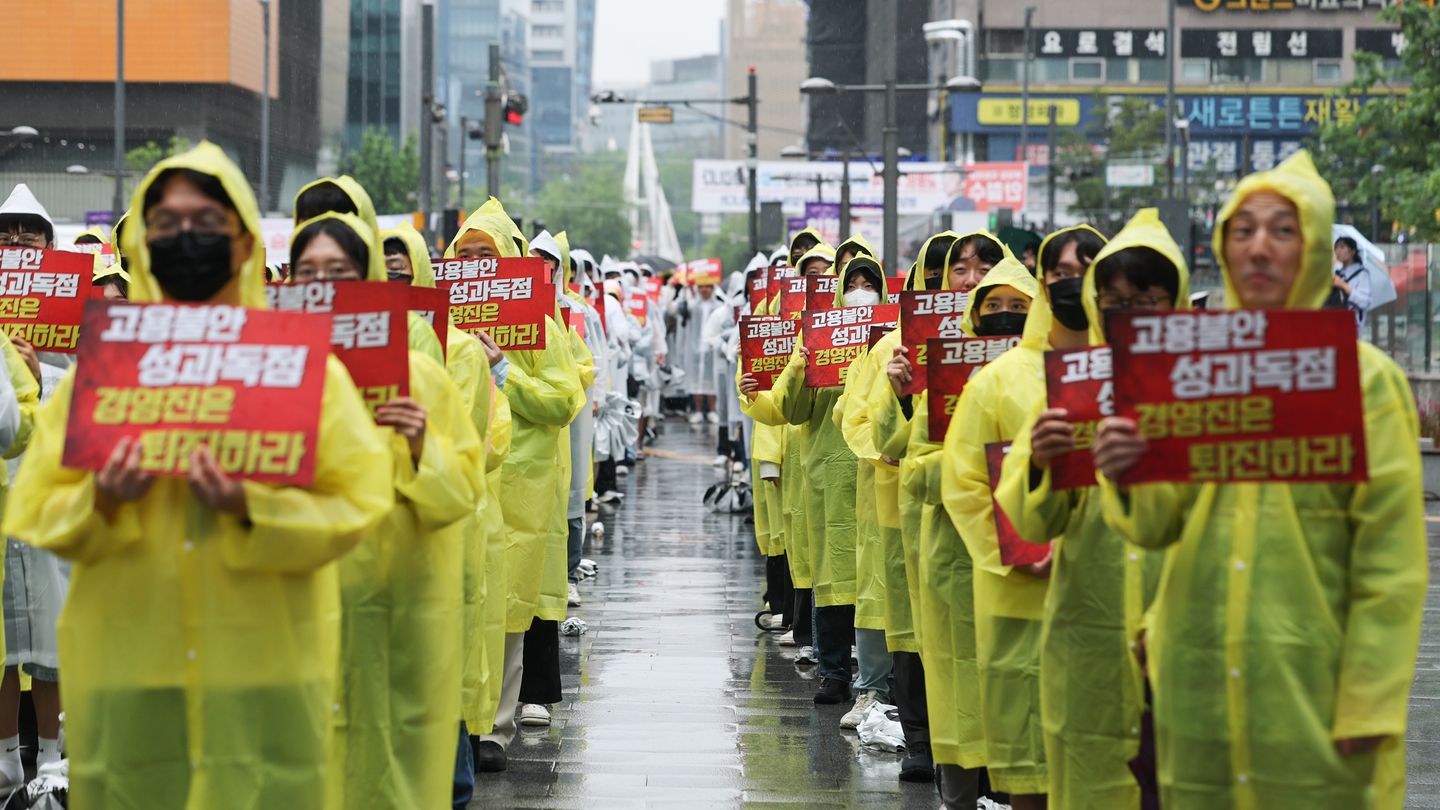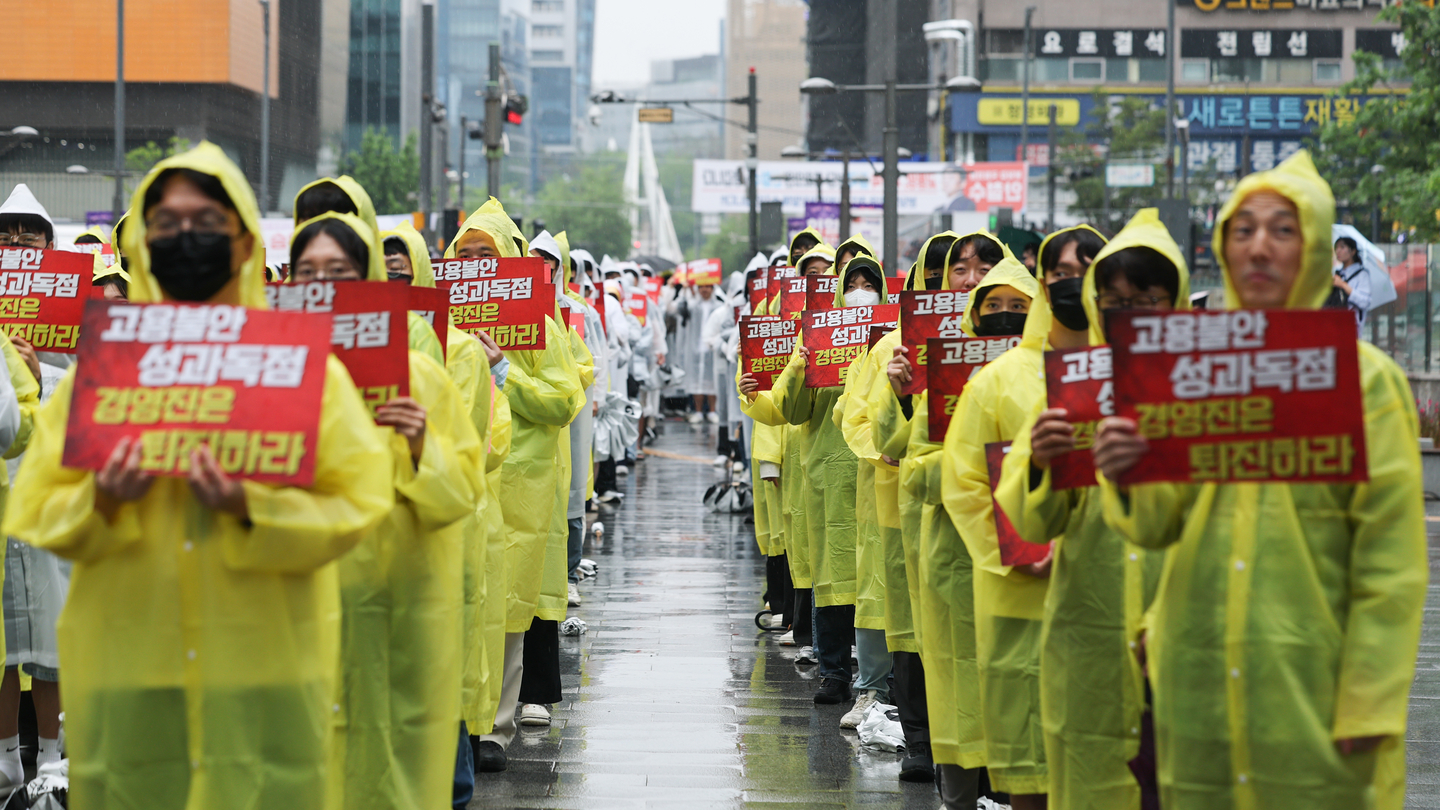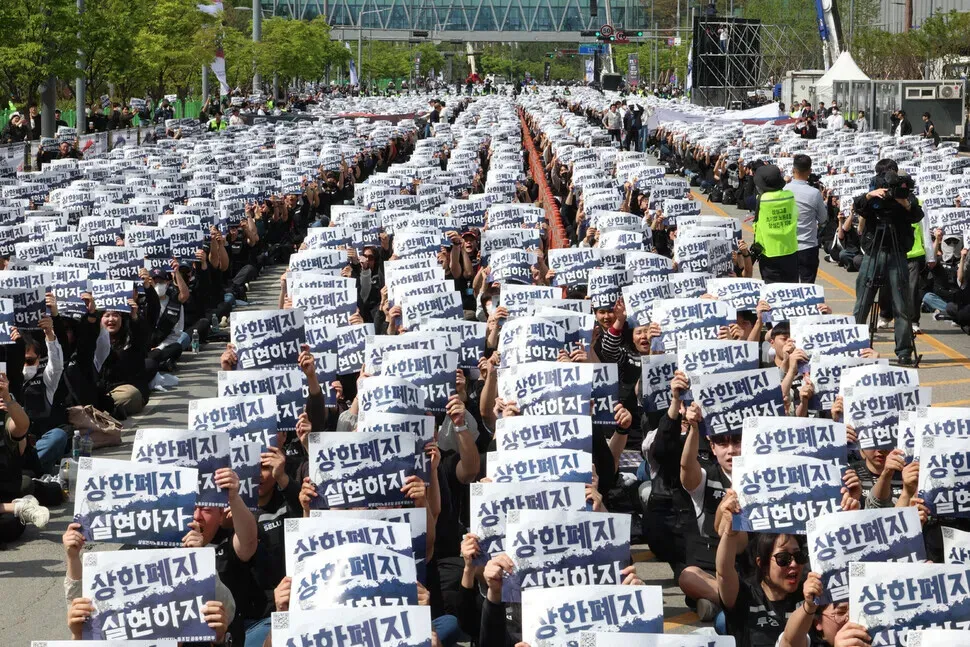
Samsung Electronics union members protest outside the company's semiconductor plant in Pyeongtaek, South Korea, on April 23, 2026. (Choi Hyun-su/Hankyoreh)
The issue of bonuses at Korea’s major chipmakers has become a topic of national interest.The Samsung Electronics labor union wants 15% of operating profit to be distributed as employee bonuses and has threatened to strike if that demand is not met by May 21. As of yet, managers and the union remain at odds.Finding an appropriate way to distribute chipmakers’ excess earnings and invest them in the future is an important challenge that Korean society must face.Ordinary Koreans are not amused by the debate over bonuses at chipmakers. In a poll of 1,310 Korean adults around the country published on Thursday, 74.7% of respondents said the bonuses demanded by workers at Samsung Electronics and SK Hynix were “very high,” while 50.2% said that “social discussion is needed.”Koreans are not only interested in this question because of the sheer value of the bonuses, which would run into the tens of trillions of won. They also see the issue as a litmus test for the social responsibility of companies that are key employers and drivers of growth in the Korean economy.It’s unfortunate that management and labor are absorbed in dividing the spoils among themselves, while giving short shrift to other stakeholders, direct and indirect.Both the Korean government and society as a whole have underwritten enormous costs to cultivate the semiconductor industry.In 2023, for example, the government sold off priceless land around the greater Seoul area — in Yongin, Pyeongtaek and Hwaseong — to set up an industrial complex for semiconductors.Despite objections that the project undermined government efforts to rebalance national resources away from Seoul, the project was given all-of-government support because of the semiconductor industry’s need for the concentration of material and human resources.In January, the National Assembly drafted the K-Chips Act, agreeing that taxpayers would foot the bill for the massive electricity and water infrastructure required for a chip cluster.That same act offers chipmakers a 20% tax credit for R&D and a 40% tax credit for facility investment. That change to the tax code let Samsung Electronics and SK Hynix save 6.55 trillion won and 5.24 trillion won in taxes, respectively, and that’s just for last year.The two companies could only receive such support from the state because of a consensus in society that the growth of the semiconductor industry, in the end, will serve the interests of all Koreans.That’s why these companies’ managers and union organizers need to give thought to social cooperation and responsibility beyond their narrow interests.Symbiosis and solidarity are the values that Samsung’s leaders and union members must seek to realize. If management and labor were to supplement their negotiating agenda with a proposal for sharing excess earnings with society by (for example) launching a social solidarity fund, they would greatly reinforce the national consensus about state support for the industry.Please direct questions or comments to [english@hani.co.kr]