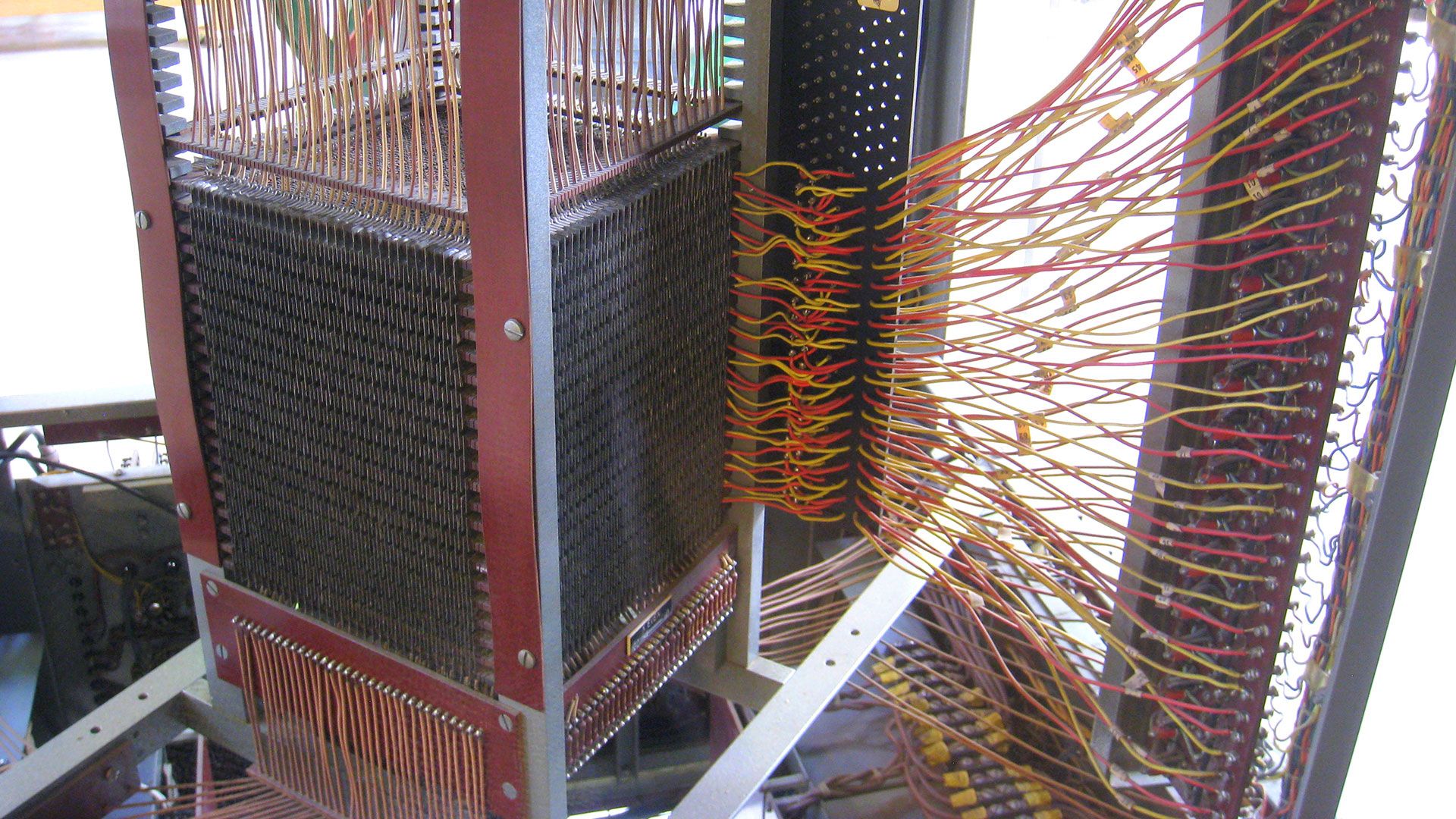
75 years ago this week, on May 11th, 1951, MIT electrical engineer Jay Forrester filed the patent application for coincident-current magnetic core memory, a technology that became the dominant form of random-access storage in digital computers for two decades.Granted as U.S. Patent 2736880 in February 1956, Forrester's invention evolved from MIT's Project Whirlwind, where unreliable vacuum-tube memory was failing to meet the demands of real-time Cold War air defense.
A screenshot from Jay Forrester's patent application. (Image credit: United States Patent Office)While Forrester applied for the patent in 1951, it took five years for it to be granted, and a series of legal battles soon followed. RCA engineer Jan Rajchman had filed a similar application eight months earlier, and Harvard researcher An Wang had separately patented a different core memory technique that IBM purchased in 1955 for $500,000. Wang used the proceeds to expand Wang Laboratories.IBM then spent years challenging Forrester's broader patent. MIT responded with forensic thoroughness, according to its archival records, tracing purchase orders, examining telephone bills and travel vouchers, and analyzing lab notebooks to establish Forrester's priority. RCA eventually withdrew its claims, and in 1964, IBM settled for $13 million, the largest patent payout in history at the time. Forrester personally received $1.5 million.Get Tom's Hardware's best news and in-depth reviews, straight to your inbox.Forrester left digital computing in 1956, the same year his patent was granted, joining MIT's Sloan School of Management, where he founded the field of system dynamics. He died on November 16th, 2016, at 98.Follow Tom's Hardware on Google News, or add us as a preferred source, to get our latest news, analysis, & reviews in your feeds.