Wanted: Technology creators
| Photo Credit:
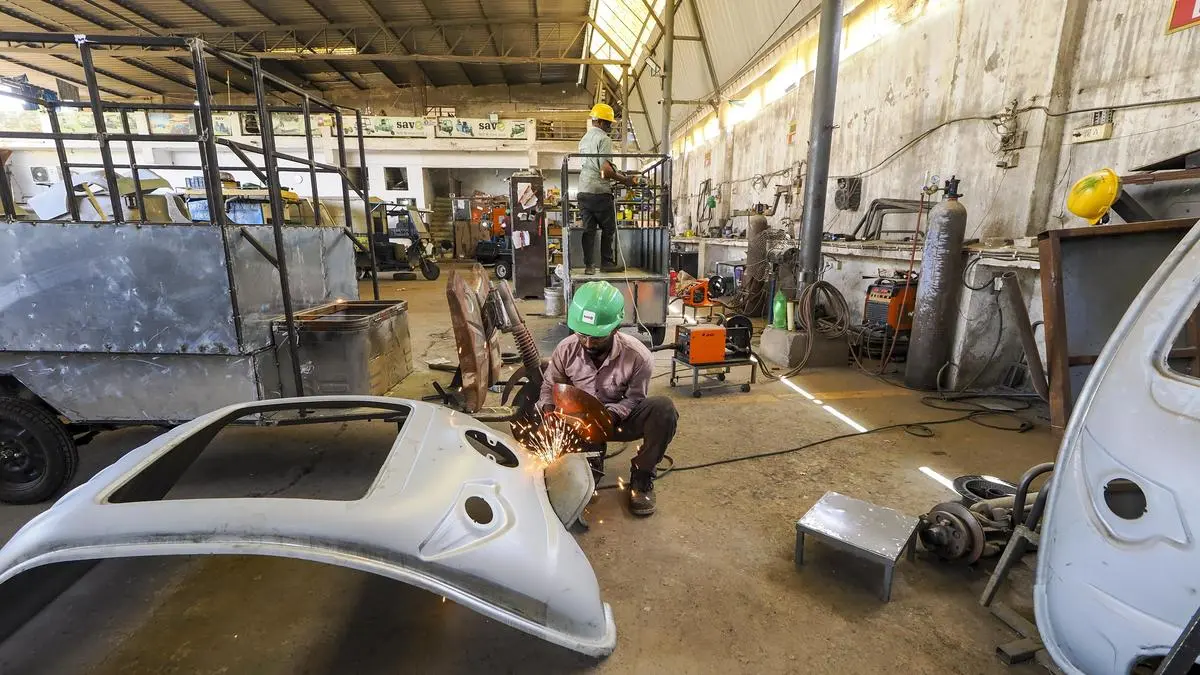
Kotak’s Warning and the MBA Dilemma: Are We Producing Managers for Markets or Builders of Industry?When Uday Kotak recently warned at a Confederation of Indian Industry forum that India was becoming “over-financialised” and excessively focused on quarterly performance, he raised a concern that goes far beyond stock markets. His remarks touched the very character of Indian capitalism and the direction in which India’s managerial and entrepreneurial ecosystem is evolving.Kotak argued that Indian businesses must move beyond quarterly obsessions and begin thinking with a three-to-five-year horizon. In a world shaped by geopolitical tensions, technological competition, and supply-chain realignment, nations that build long-term industrial capability will emerge stronger than those driven mainly by short-term valuation gains.As someone associated with MBA teaching, and also as a global online educator interacting with students across countries, I increasingly find that MBA curricula worldwide have become remarkably standardised. Whether in India, Europe, or North America, the dominant frameworks remain similar — corporate finance, valuation, consulting models, marketing analytics, and short-cycle business optimisation.Curriculum standardisationSuch standardisation may suit mature developed economies where industrial ecosystems are already established. India’s developmental needs, however, are different. The country is still building manufacturing depth, technological capability, and supply-chain resilience. Its management education therefore cannot merely replicate templates designed for post-industrial service economies.Yet much of Indian MBA education continues to mirror globalised managerial frameworks without adapting sufficiently to India’s strategic realities. Classroom case studies and simulations are overwhelmingly designed around quarterly profitability, rapid scaling, and valuation maximisation because such outcomes are easier to measure academically.However, nation-building challenges do not fit conveniently into PowerPoint slides or simulation software.This educational orientation is reinforced by market incentives. Across Indian MBA campuses, finance, consulting, analytics, and consumer-oriented sectors dominate student aspirations because they offer significantly higher compensation and social prestige than manufacturing or industrial operations.PSU thrustThis was not always the case in India. During the mid-1980s, many public-sector enterprises represented some of the country’s most aspirational workplaces. Large organisations in energy, telecommunications, steel, and heavy engineering attracted brilliant graduates from institutions like the Indian Institutes of Technology because they offered not only respectable salaries, but also professional prestige, housing, healthcare, social infrastructure, and long-term career stability. Engineers and managers felt they were participating in national development and industrial creation rather than merely pursuing individual advancement.Over time, however, liberalisation, financial-sector expansion, and service-led growth altered the hierarchy of opportunity. Today, many manufacturing companies struggle to offer the compensation and professional ecosystem required to attract top managerial and technical talent.MBA institutes therefore need to redesign parts of their curriculum with greater industry immersion in factories, industrial clusters, and deep-technology enterprises can help students understand the realities of productive capability creation beyond balance-sheet management. In fact, the NationalEducation Policy already provides a broader interdisciplinary framework that can support such industry-oriented and application-driven management education.Manufacturing pushKotak’s warning becomes particularly relevant in the context of India’s startup ecosystem. Over the past decade, India has created a vibrant startup culture, but much of it has also become heavily valuation-driven. In many cases, entrepreneurship appears oriented toward fundraising rounds and aggressive valuation expansion rather than building enduring industrial enterprises.Kotak rightly hinted that India must move beyond a “proof-of-concept” mindset. A start-up should not merely demonstrate an idea attractive enough to secure the next funding round. It should aspire to evolve into a robust industrial or technological institution capable of generating long-term productive capacity.India therefore faces a strategic challenge. The country must encourage entrepreneurs not merely to become assemblers, traders, or digital intermediaries, but genuine manufacturers and technology creators. At present, many businesses marketed as “manufacturing” remain heavily dependent on imported components with limited domestic value addition.If India wishes to become a true industrial power, government incentives must increasingly distinguish between superficial assembly-led activity and deep manufacturing capability.Ultimately, Kotak’s remarks raise a larger national question: Is India creating an economy optimised for short-term financial gains, or one capable of sustaining long-term industrial power?Published on May 20, 2026