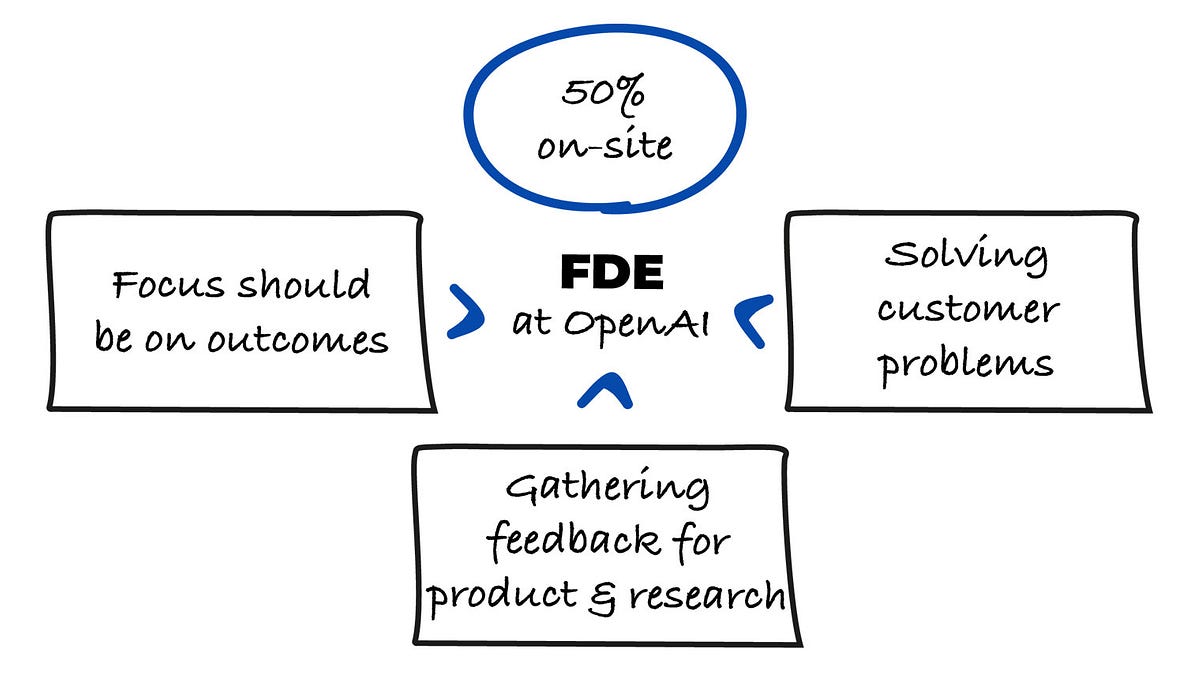
I’ve been interested in writing about the FDE role for a while, as I’ve seen the big increase in popularity in recent years.And especially after attending the Salesforce TDX in SF and speaking with Nick Johnston, SVP, Global Consulting Partnerships & Partner Sales at Salesforce, it became clear that the role’s popularity is just increasing.We talked for 30+ minutes just about FDEs and what they do! Here is also the picture:Today, I am sharing my thoughts on whether I think you should become an FDE or not, what FDEs really do, and who the role is best suited for.This is an article for paid subscribers, and here is the full index:- What is a forward deployed engineer?- Why the role exists- What a forward deployed engineer at Salesforce does- What a forward deployed engineer at OpenAI does- What a forward deployed engineer at Palantir does🔒 Should you become a forward deployed engineer?🔒 The pros🔒 The cons🔒 Who thrives in this role?🔒 Is it a good career move?🔒 Last wordsLet’s start!Forward deployed engineer (FDE) has gained a lot of popularity in recent years, especially among tech companies that work directly with businesses (B2B).What my feeling is, talking with different engineers and engineering leaders about the role is that a lot of people have some sort of idea about what FDEs do, but in reality, the roles are quite different from one company to another.The role varies based on the requirements of a specific company. Which means the skills needed (especially on the tech side) are different, but one thing is clear. Customer empathy is really important, and it’s highly unlikely to be a great FDE without being able to put yourself in the shoes of the customers.I like to personally view this role as an intersection between software engineering, customer success, and product/business. The reason is that FDE’s primary role is to help customers use their products.Therefore, they need to be technically savvy and, at the same time, be able to communicate well with the customers and have a good understanding of the product and the overall business, so they can find the right solutions.Think of the role as a consultant who is also a main developer, integrating the solution directly. In many ways, you’re not just building software, you’re solving business problems in real time.If you’re considering this path, it’s worth understanding what the job really involves, who it’s best suited for, and the trade-offs you’ll face. Let me share, next, why the role really exists in the first place.Especially companies that offer more complex products to their customers, can face issues between what their product can do and what customers actually need. FDE is the person helping to fill this gap.They help:Increasing adoption of the productCustomize implementations for specific customers (if needed)Gather feedback from customers to improve the product itselfLet’s go through, next, what FDEs at Salesforce, OpenAI, and Palantir do.Nick mentioned that there is no single recipe for the role, and it may vary a lot from customer to customer, but the core responsibility is clear:Help customers get value from technology faster.An FDE typically starts by understanding the customer’s needs, pain points, and, of course, their current environment:What systems are already in placeWhere customer data livesHow that data flows across systemsOnce that is a lot clearer, they focus on defining use cases that would help the customer.Example use cases:Adjusting the data flowNot just within Salesforce, but also in external systems in order for the customer to be able to integrate with Salesforce successfully.Setting up AI agents in order to automate a certain business processThis is another use case (which seems to be a popular use case, based on my impression from the Salesforce TDX conference).As we mentioned in the article, 3 Key AI Trends, EGI (Enterprise General Intelligence) is something that should be a clear focus for all enterprise companies. And EGI means using AI, its tools, and systems to perform business-specific tasks with high capability and consistency.Implementing the right guardrails for the customerAnd a third use case that Nick has mentioned is implementing the guardrails, which may be security, governance, compliance, or something else. Especially important for bigger companies, which need to ensure compliance with specific standards.These are just examples of use cases that FDEs deal with. To sum up, the core focus of FDEs is to ensure they understand the customer’s needs very clearly and find the optimal solutions to help them get the best results.1. Salesforce FDEs (internal)These engineers are closely connected to the product organization. Customer work is secondary unless a client explicitly requests Salesforce involvement. Their main goal is to:Gather feedback on product featuresTest new features in live environmentsHelp improve the product2. Partner FDEsThose are FDEs from companies like Accenture and Deloitte, who work directly with the customers:To deliver specific implementations for a customerProvide direction or solution designHave support from Salesforce FDEsThis partner model helps Salesforce to scale without building a massive internal services organization.I’ve checked all the different openings of a forward deployed engineer position at OpenAI, and here is what I found out.FDEs are expected to:Design, architect, and develop full-stack solutionsBuild production AI systems and integrationsDeploy advanced AI models on customer infrastructureThis is a combination of being a solutions architect, software engineer, and AI engineer.They provide a hybrid work model of 3 days in the office per week, and travel up to 50% is required. Which means that FDEs are consistently traveling to customers and working directly on-site.A lot of the FDE roles are general, defined as Model Deployment for Business, which means that they can contain any kind of work related to OpenAI. From creating custom GPTs for the customer to helping integrate OpenAI into the logic of the customer’s applications, or something else.There are also some more specific focused FDE roles like “FDE, Financial Services”, which means that FDE works mostly with Fintech companies.Palantir is the company that first invented the role, and from doing research, the reason was that their software was too complex for customers to just “plug it in”, therefore a dedicated person was needed to get a specific customer up-to-speed.Here is the definition of an FDE from their official blog:FDE is a software engineer who embeds directly with our customers to configure Palantir’s existing software platforms to solve their toughest problems.While a traditional software engineer focuses on creating a single capability that can be used for many customers, FDEs focus on enabling many capabilities for a single customer.Additionally, they mention that FDEs need to be iterating closely with customers across various industries and require a unique and broad skillset, ranging from software development to data engineering to customer engagement and creative problem-solving.FDEs need to address questions like:What products are we deploying for this use case?Why are we deploying them?How will we spin up workflows that utilize these products to address the customer’s specific needs?FDEs need to be able to answer these questions, and at the same time, also implement these solutions.Now that we better understand the role and what it looks like based on different companies, let me share whether you should actually become an FDE yourself.
Should You Become a Forward Deployed Engineer?
What do FDEs at Salesforce, OpenAI, and Palantir really do, and should you become one?
1,182 words~5 min read