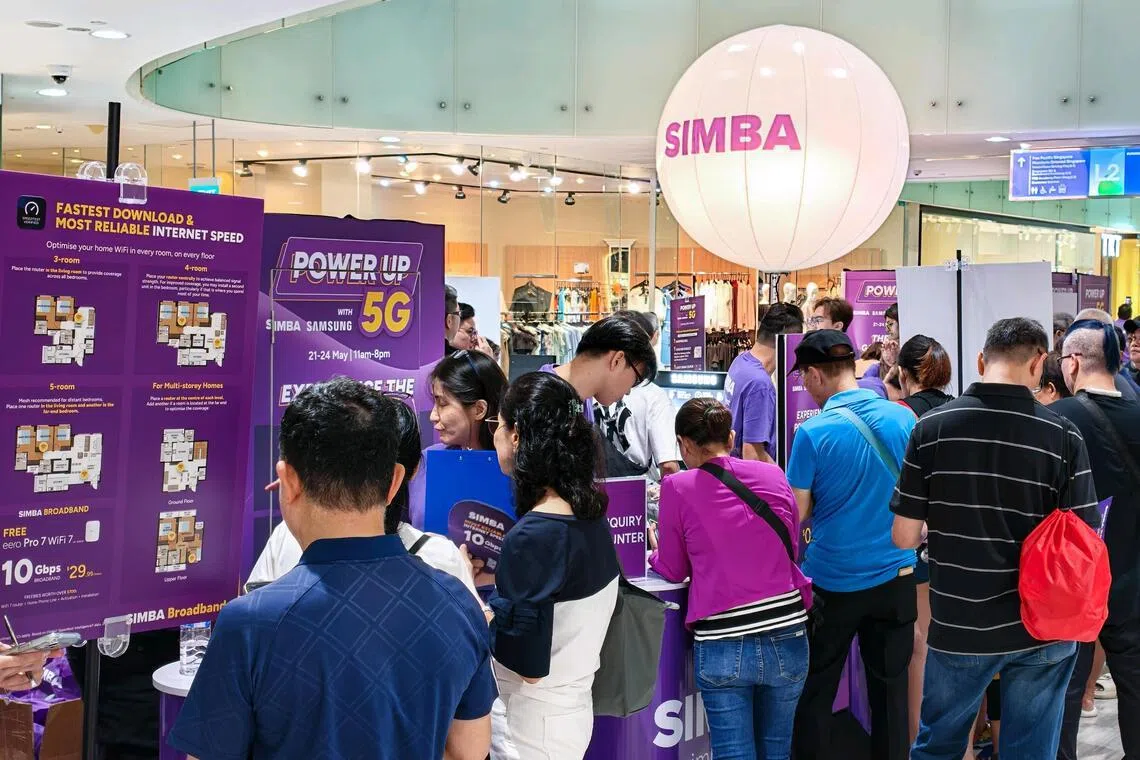
SINGAPORE – Slower customer service for complex queries and discontinuation of existing products are among potential impacts on consumers that might result from a telco restructuring, said experts.Such issues would also reflect the immediate concerns of users, they said, amid unexpected news of M1’s 90-day plan to drive efficiency by cutting network and technology platform costs, using AI for automation and doing product rationalisation.These are priorities within the telecoms company’s “Plan B” that it has resorted to in the face of a planned merger with Simba Telecom that is expected to fall through.In general, the earliest impact that consumers might feel from a company undergoing restructuring is in changes to customer service responsiveness, said senior business lecturer Kenny Tee of James Cook University (Singapore campus).This is particularly so when organisations are balancing cost optimisation with operational changes, said Dr Tee, adding that consumers may be concerned about longer waiting times, reduced human support or slower resolution of issues.This could occur if restructuring reduces the number of human agents, or shifts more customer interactions to AI agents or self-service channels, said Associate Professor Hyeokkoo Eric Kwon from the Nanyang Business School at Nanyang Technological University.“Routine queries may be handled more efficiently, but complex or non-standard cases may take longer to resolve if they require escalation to a smaller pool of human staff,” said Prof Kwon.He added that customer service might also become less flexible due to product rationalisation. This refers to the business process of deciding products to keep, modify or discontinue within a portfolio in order to improve profitability.“Front-line staff may have less discretion to offer customised solutions, exceptions or case-by-case adjustments.”Product rationalisation also raises the uncertainty over whether services that consumers rely on will remain available, said Mr Tan Chee Seng, deputy director of Singapore Polytechnic’s School of Electrical and Electronic Engineering.“Consumers may be concerned that certain services could be discontinued if they have low take-up rates or are no longer aligned with the company’s revised strategic focus,” he added.In some cases, restructuring might also temporarily slow down investment in infrastructure upgrades or improvements to services as companies focus their attention on managing cost and operating efficiently, said Dr Tee.For telcos, providing optimal network coverage might become a challenge in the light of such cost-cutting measures, said Professor Lawrence Loh of the National University of Singapore Business School.“The telco may have difficulties meeting quality of service benchmarks required by regulation, particularly the minimum coverage thresholds outdoors, in buildings and tunnel areas.”Consumers may worry about service interruptions or degraded call quality, particularly if they are paying the same price for what they expect to be the same level of service, said Mr Tan.Just a day earlier on May 18, the authorities said they had suspended their review of Simba’s $1.43 billion bid for the telecommunications business of M1 amid a probe into an alleged breach of radio frequency bands usage.Simba, which is owned by Australia-listed firm Tuas, is being investigated for alleged use of certain radio frequency bands to provide mobile services without authorisation.Hence, the sale and purchase agreement between the two telcos is expected to lapse when the contractual deadline arrives on May 21. This puts M1 back on the market while the telco works towards becoming more operationally efficient and attractive for potential divestment.While companies restructure, it is crucial for brands to communicate proactively as consumers look for reassurance and transparency, said Ms Felicia Wee, course chair for the Diploma in Marketing course at the School of Business at Temasek Polytechnic.“Beyond technical performance, how clearly and confidently the companies communicate with customers will play a major role in maintaining trust,” she said.
Limited choices, slower customer service among key consumer concerns amid telco restructuring
Communicating proactively with consumers is also key for restructuring firms to maintain trust, said experts. Read more at straitstimes.com. Read more at straitstimes.com.
604 words~3 min read