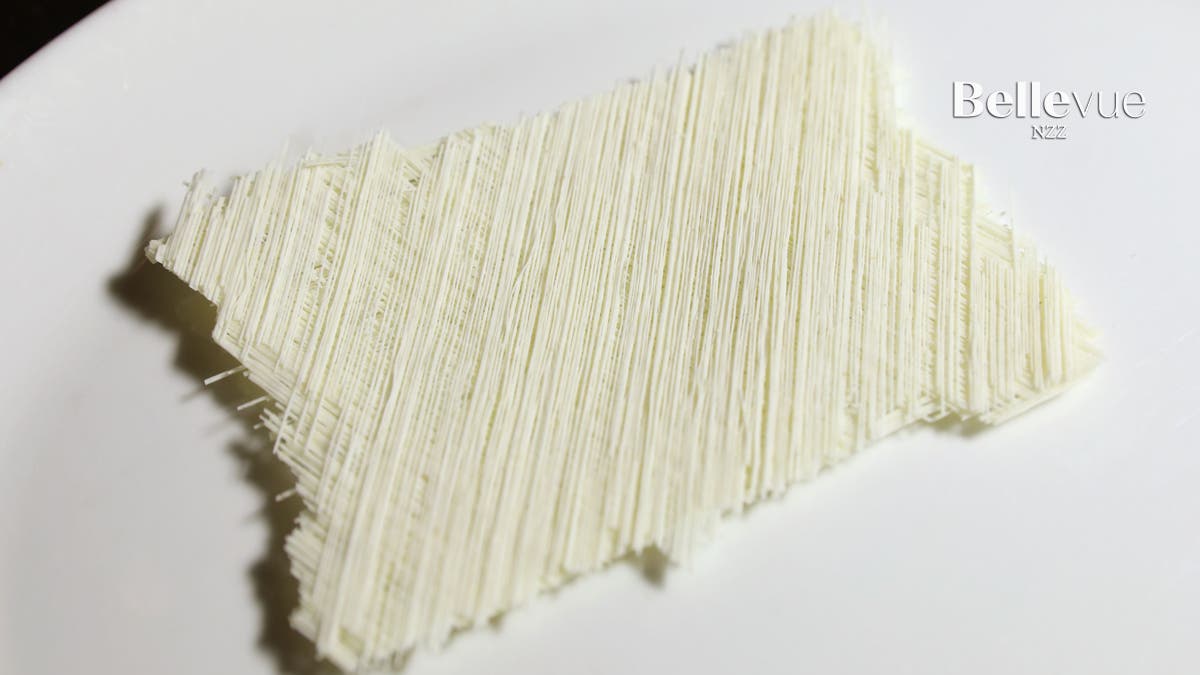
A rockface rises in the distance, reflected pink with morning light as foliage sways in the foreground. Su filindeu is closely bound to its home in the north of Sardinia, a sparsely populated tableau of verdant flora and sheer stone, hearty food and strong beliefs. Fabric hanging from buildings on a narrow street sways in the breeze. Two birds fly into view in the distance. Much of the island’s history and culture have been defined by isolation, nowhere more so than Nuoro, which Grazia Deledda, the 1926 Nobel Prize-winning writer who grew up there, called “the most cultured and combative town on the island.” People are gathered inside a church. A priest wearing a white robe walks down the aisle, shaking holy water into the air. At the heart of that culture is a biannual Catholic pilgrimage, which begins in the church of Rosario di Nuoro in May and October. An older woman with short hair, glasses and a smile holds two children in heavy jackets close to her. Some of the town’s oldest, and youngest, citizens make the trek. A large crowd of people, many wearing backpacks, walk down a street lined with trees. The sky is dark, with light coming from several streetlamps. At midnight on May 1, hundreds of pilgrims set out from Nuoro. Together they traverse over 20 miles of mountainous terrain to the Chiesa di San Francesco in Alghero. The crowd of people walks toward the camera down a narrow, darkened street. Some travel in groups of family and friends, telling stories and trading gossip deep into the night. Others prefer a solitary journey of reflection through the darkness. Orange light peeks out from behind a mountain as the sun rises, a small forest in the foreground. The first groups of pilgrims arrive at San Francesco di Lula shrine just as the sun rises above the limestone crest of the Monte Albo massif — a spiritual journey now illuminated. A man, barefoot, carries a religious banner. He walks at the front of a group of people. In the background are trees and, in the far distance, mountains. Paolo Lado makes the pilgrimage twice a year, barefoot. “I owe it to Saint Francis,” he said. “He saved my mother. I was 13 years old, and since then, over half a century has passed. I haven’t stopped coming.” A white statue of a man with a bird in his hand, a second bird sitting on his shoulder. Roses and other flowers are arranged at his feet. Three people come up to the statue and make the sign of the cross on their chests. Local lore has it that a bandit back in the 17th century was falsely accused of murder. After being exonerated, he built a church outside the village of Lula and dedicated it to Saint Francis of Assisi, defender of the poor and steward of nature. A woman wearing a blue windbreaker and a backpack looks up, then wipes tears from her eyes. The overnight journey evokes a wide range of emotions in Sardinia’s pilgrims — joy, hope, solemnity and catharsis. A person’s feet resting in a footbath as a fireplace flickers in the background. Water from a metal pitcher is poured into the bowl. The pilgrims endure the journey and the community responds with restorative hospitality: water and coffee, a footbath, and eventually, a bowl of pasta. An older man wearing glasses, a jacket and a yellow scarf, holds up a long brochure with stamps of various kinds across it. Francesco Calledda, 89, completed his 87th pilgrimage in May, though he begins his journey in Cagliari, 125 miles away. “I don’t plan to stop anytime soon,” he said.
The World’s Rarest Pasta Is Hidden in the Mountains of Sardinia
In the mountains of Northern Sardinia, a 300-year-old pilgrimage comes with a serving of the world’s rarest pasta.
614 words~3 min read