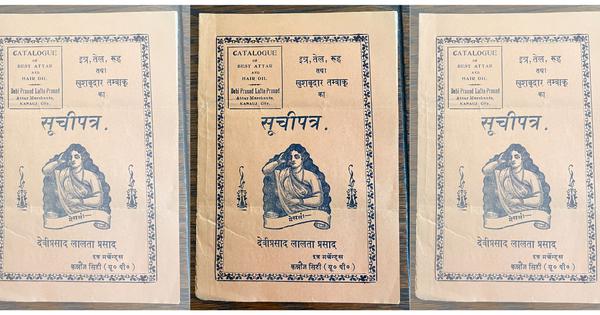
One of the great ironies of Indian public life is that in our haste to celebrate deep histories, we often ignore the equally rich, if not richer, recent histories that connect us to our antiquities. The very celebration of hoary antiquity ends up blinding us to the innovative ways in which traditions, to survive, have repeatedly been updated. Consider, for instance, the “perfume capital of India”, Kannauj.Kannauj attars received a GI tag a little over a decade ago and since then, innumerable media outlets have spoken of the ancient town’s almost ageless association with perfumery. This repeated emphasis on “thousands of years of history” has contrapuntally also served to erase a history of rich innovations throughout the last century and a half. Kannauj has emerged, willy-nilly, as a town stuck in time.A new industryYet what makes Kannauj attars accessible to us today is precisely the fact that a series of enterprising innovators throughout the past century and a half have adapted it to changing contexts. They introduced new techniques and materials in both production and marketing. Moreover, many of these innovators were not scions of ancient craftsmen. Rather, they were inventive men who learnt and then adapted the traditional arts of fragrance-making.Today, one of the oldest firms still making attars in Kannauj is that of Debiprasad Sunderlal. According to family lore, the firm was started in 1870 and the founder, Lala Debiprasad Khatri, was a retired colonial police officer with roots in the Punjab. Lala Debiprasad’s decision to enter the attar trade likely stemmed from a shrewd assessment of then-expanding opportunities. The decades following the uprising of 1857 had witnessed the rapid decimation of several traditional industries. But in the case of the attar industry of Kannauj, the late 19th century created new opportunities. The government gazetteer of the Farrukhabad district, to which Kannauj then belonged, mentioned in 1908 that this “ancient industry” was flourishing and a lowering of the costs of oils employed had led to an expansion of the industry.Pace the colonial gazetteer, the success of the industry could not be put down simply to the lowering of the cost of ingredients. Firms like that of Lala Debiprasad were also inveterate innovators. It was around 1908 that Debiprasad seems to have modernised his office by introducing what would then have been the cutting-edge of modern office technology, a Remington No 10 typewriter. Remington, an American company, had begun producing the very first typewriters in the mid-1870s. While they had indeed taken the world’s offices by storm, they were still fairly novel, high-end technologies even in the offices of Calcutta and Bombay, let alone the small businesses of Kannauj.A Remington No 10 typewriter at Lala Debiprasad's firm.A decade later, in 1918, we find Debiprasad advertising in the leading nationalist newspapers of the time, such as Sisir Kumar Ghosh’s Amrita Bazar Patrika (Calcutta) and Madan Mohan Malviya’s Leader (Allahabad). Newspaper advertising, that too in major, English-language metropolitan dailies, was clearly an innovation in marketing. The commodities offered for sale were also innovative and went much further than the traditional attars. There were a variety of scented tobacco-based commodities, including little scented tobacco pills that came in three different colours: black, gold, and silver. There were also several fragrant oils and waters, such as gulabjal, kewdajal and even a water with the fragrance of pumpkin! Amongst the attars were the traditional fragrances such as Gulab, Kewda, Khus, Hina, Champa, and Aam. But there were also some new fragrances such as Khus Istanbul and Surangi.Debiprasad was not alone in developing new fragrances. Surviving price lists of a few other older firms show them too introducing new fragrances. Ayodhyaprasad Upendranath Itrwale, for instance, advertised peppermint as a “nayi cheez” (new thing), while another manufacturer named Debiprasad Laltaprasad introduced lavender fragrance. Besides expanding the range of choices, the introduction of exotic fragrances like lavender also helped appeal to the European market in British India, who often found traditional fragrances like jasmine, vetiver, mango and orange unappealing.The Kannauj edgeIt is doubtful whether the adoption of new smells alone would have helped Kannauj succeed. Until the dawn of the 20th century, at least three other local centres of attar production – Jaunpur, Ghazipur, and Lucknow – remained almost as important. By the end of the first decade of the 20th century, however, Kannauj was clearly pulling ahead. What underwrote this runaway success was Kannauj’s new ability to distil large quantities of sandalwood oil, the base upon which all attars were made. Previously, the other centres too distilled small quantities of sandalwood, usually procured from the forests of Bahraich. The establishment of steam distillation machines in Kannauj greatly enhanced their capacities, and they gradually began to import sandalwood from southern India and significantly expanded the volume of production. This drove down the prices of the oil and, in a short time, made Jaunpur and Lucknow dependent on Kannauj for sandalwood oil. Consequently, Kannauji producers gained a distinct edge over the other cities in terms of pricing and transportation.The man who set up the new distillation plant was Mathuraprasad Surajprasad Dubey. The enormous wealth he came to accrue in the process is the stuff of legends. Old Kannaujis still recall how, on one occasion, during a Ramnavami procession, finding large potholes along the way, Dubey had them filled in with sandalwood dust from his factory. By the mid-1930s, he even entered into exclusive contracts with the princely state of Mysore to become the sole legal distiller of Mysore sandalwood. The modern mechanical apparatus used in his factory was most likely manufactured in Yorkshire.Yorkshire-made machines, exotic new fragrances, efficient new office machinery, and modern advertising, all deployed by new entrants into the trade, helped radically reimagine attar production in Kannauj. While these early 20th-century manufacturers certainly built on older networks and practices, what they did with those older traditions was utterly new.Ironically, it was precisely around the time when Kannauj’s perfume industry was in one of its most innovative phases, a 1940s government report by PA Narielwala and JN Rakshit lamented that, “to us it appears that the day of Indian attars is over”. Yet, today, more than 80 years later, the industry is still around and thriving. The ability of the industry to repeatedly defy predictions of obsolescence cannot be chalked down merely to its alleged antiquity. It is the history of constant reinvention and innovation that has given it its longevity. Traditions survive not because they are unchanging fossils, but because they are constantly transformed and remade.Projit Bihari Mukharji is a Professor of History at Ashoka University.
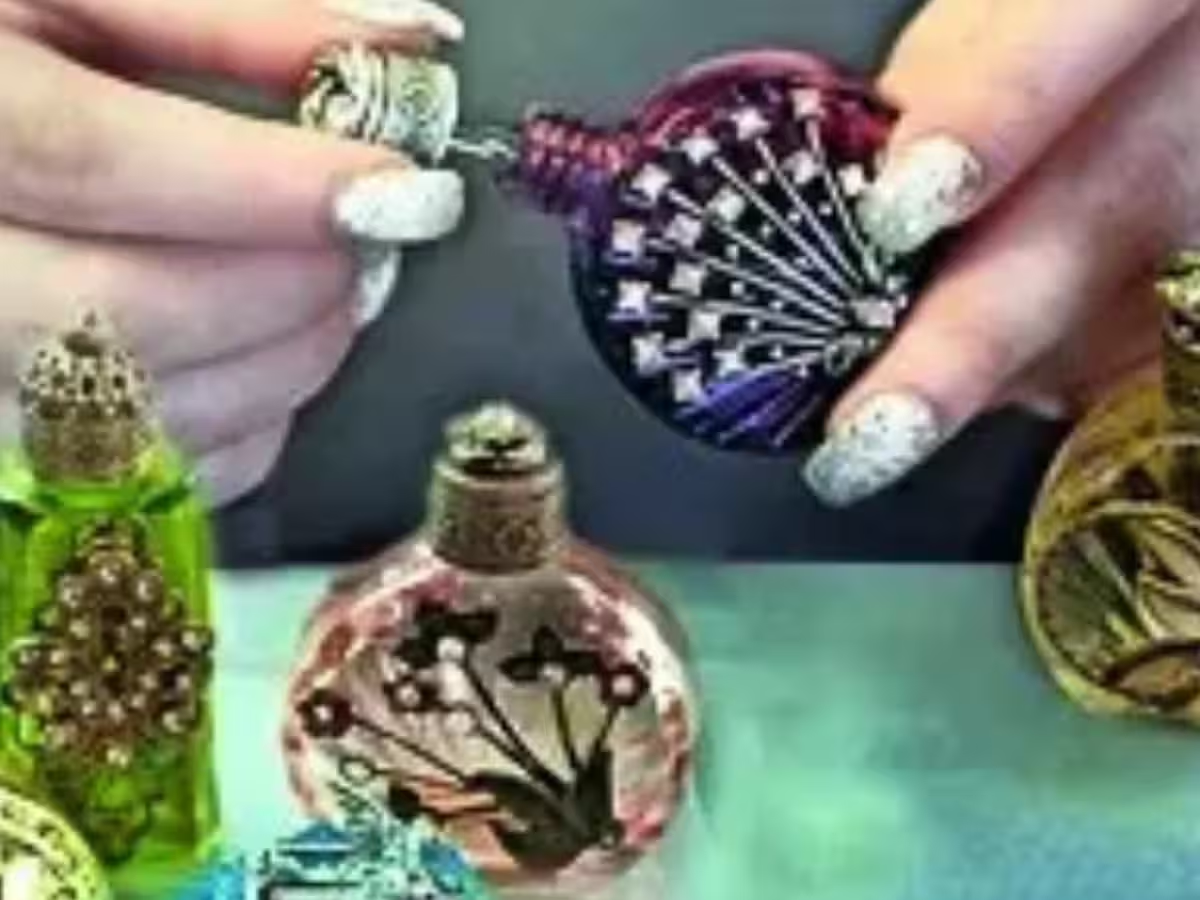
The modern innovations of the 20th century that give Kannauj attars their famed fragrances
What underwrote this runaway success was Kannauj’s ability to distil large quantities of sandalwood oil, the base upon which all attars were made.
1,099 words~5 min read