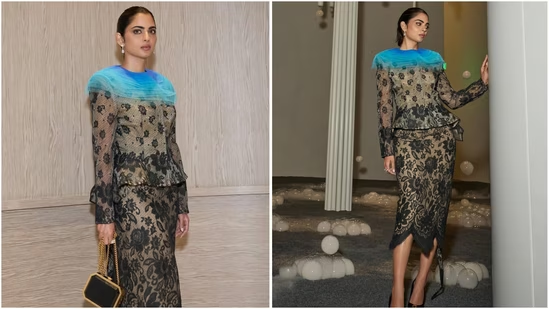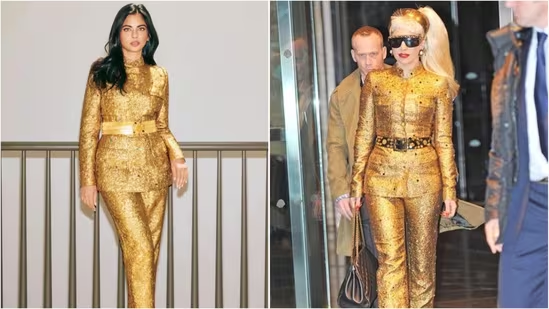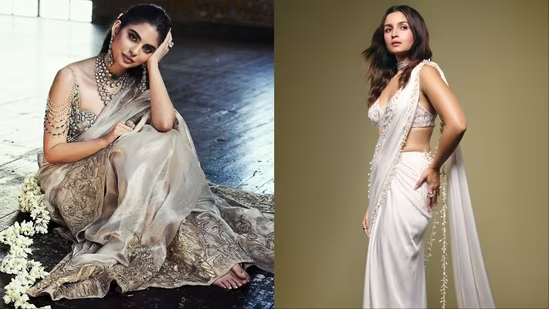
Once fleeting and fragrant, jasmine is now being reworked into something lasting across couture, craft, and form. Here's a peek into the latest fashion buzz. At the Met Gala 2025, businesswoman Isha Ambani's look stood out for its reinterpretation of Indian elements. Styled by Anaita Shroff Adajania, her custom Gaurav Gupta saree was paired with a jasmine hair sculpture by Brooklyn-based artist Sourabh Gupta. Each mogra bud was individually shaped individually shaped in paper, copper, and brass over 150 hours. This interpretation turned the highly perishable gajra into something immortal.Designers are rethinking jasmine beyond tradition, turning it into something constructed and enduring. (Credits: Instagram)Isha wasn’t alone, actor Alia Bhatt also reimagined jasmine in her own way. At a recent award show, her Gaurav Gupta saree threaded strands of mogra directly into the drape. Pearls were strung together to create the illusion of hundreds of mogra flowers tied on a thread.What we’re seeing isn’t a revival of jasmine, but a rethinking of it. The flower is being taken apart and rebuilt across mediums, transformed from something fleeting into something lasting, now holding permanence in fabric, metal, and form.Jasmine as we know itTraditionally, jasmine has existed within a fixed visual vocabulary in South Asian contexts. Costume stylist Sia Seth points out, flowers have always been embedded in cultural life: “Across cultures, they’ve been used for centuries - not just as decoration, but as a way to express identity, celebration, femininity, ritual, romance, and connection to nature.”Across regions in India, it has been worn by brides, dancers, and women in everyday life for generations. One of the most recent examples is how actor Rashmika Mandanna wore a gajra in her hair during her Telugu wedding ceremony with Vijay Deverakonda.Breaking the gajra apartSeth adds, “Jasmine is returning strongly this season because fashion is moving away from ultra-minimal ‘quiet luxury’ into something more emotional, sensory, handcrafted, and nostalgic. Flowers, especially jasmine and mogra, fit perfectly into that shift. They are becoming a bridge between heritage and modern luxury.”With Kimaya Singh, founder, Mirchi by Kim, the shift becomes even clearer. Her jasmine look for content creator Seerat Saini at Coachella '26 doesn’t use the gajra at all yet its presence is unmistakable. Cutwork and embroidery mimic the delicacy of petals, while 3D appliques create dimension and movement. Singh says, “The gajra is one of those objects that carries deep cultural and emotional weight. It’s intimate, everyday, and generational. Reinterpreting it allowed us to work with the memory, meaning, and feeling of the flower beyond using it in a literal sense.”When jasmine became permanentSingh notes, “The gajra is one of those objects that carries deep cultural and emotional weight. What makes it feel relevant in fashion right now is the openness to reinterpret that familiarity. There’s more room for nuance, authorship, and personal reading of our symbols.”That idea reaches its most conceptual form at Raw Mango’s London Fashion Week debut in February. The collection, titled It’s Not About The Flower, dismantled the gajra entirely. Jasmine appeared as laser-cut silk blooms, hand-assembled into textiles, or suggested through repetition and clustering. Additionally, the showspace featured hundreds of spherical glass containers lined on the floor each holding tiny garlands of mogra to mark the runway.Sanjay Garg, founder and textile designer - Raw Mango, explains, “Our system of design derives from the culture. Especially for this collection, we looked at flowers that are found in abundance and are not tied to any specific geography in the subcontinent. Jasmines are part of our every day. It is a clear and recognizable motif across South Asia. Jasmine flowers and garlands are everywhere, and that’s how they show up in the collection. Sometimes in bundles, sometimes on their own.”The making of a motifWhile this may look like a trend, it begins far more quietly as it rooted in personal memory long before it enters the collective imagination.Designer Karan Torani concludes, “What is interesting is that while the gajra may feel like an emerging visual language on runways today, for us, its journey began much earlier almost a year and a half ago. And that is often how fashion evolves. What begins as a deeply personal moment, memory, or cultural instinct slowly trickles into the collective imagination and eventually transforms into a trend.”
How jasmine became couture's most lasting bloom
Once fleeting and fragrant, jasmine is now being reworked into something lasting across couture, craft, and form. Here's a peek into the latest fashion buzz.
708 words~3 min read