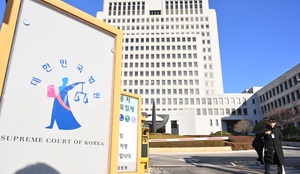
South Korea's Supreme Court, located in Seocho-gu, Seoul. (Im Se-jun/ The Korea Herald) The Supreme Court recently ruled that payments received by a US firm from a South Korean company in exchange for technical know-how could be subject to corporate tax in Korea, sending the case back to a lower court for further review.According to legal circles Monday, the Supreme Court overturned a lower court ruling in favor of US pharmaceutical company Genosco in its suit against the head of the Dongjak Tax Office, which had refused to issue a tax refund.Genosco signed a technology transfer agreement with Yuhan Corp. in 2016 to transfer technology and know-how related to compounds for targeted liver cancer treatments in exchange for royalties.Yuhan paid Genosco 500 million won ($330,000) as part of the royalties that year and withheld corporate tax before paying the Korean tax authorities.Under Korea’s Corporate Tax Act, foreign corporations that earn Korea-sourced income are subject to corporate tax. Although the foreign company is the taxpayer in principle, the Korean company may withhold the tax before paying its foreign counterpart and pay the withheld amount to Korean tax authorities on its behalf.Genosco sought a refund, claiming that royalties paid for the transfer of know-how were not subject to corporate tax. When tax authorities refused, the company filed suit.At issue was whether the payment for know-how constituted income related to a capital asset, which is exempt from taxation under the Korea-US tax treaty.The Seoul High Court sided with Genosco, ruling that the know-how constituted a capital asset and that the payment was therefore exempt from taxation.The Supreme Court disagreed and remanded the case to the lower court.The top court said the concept of “capital assets” is not found under Korean law and interpreted the term in the context of US tax law at the time the Korea-US tax treaty was signed in 1976. Under US tax law at the time, depreciable property was excluded from capital assets.The Supreme Court found that technical know-how also falls under depreciable property and is “generally excluded” from the scope of capital assets under the Korea-US tax treaty, making it subject to corporate tax.However, the court added that the know-how in question could fall under “intangible personal property” under the treaty. In that case, the income should be treated as having arisen where the know-how was sold, the court said, adding that further review is needed to determine where the sale took place.
US firm's know-how payments may be taxable in Korea
The Supreme Court recently ruled that payments received by a US firm from a South Korean company in exchange for technical know-how could be subject to corporat
406 words~2 min read