South Korea's labour minister called on the country's major tech firms to share the spoils of their massive windfall profits, warning that unprecedented chip-sector gains stemming from the AI boom risked widening a gap in inequality. In an interview, Kim Young-hoon told Reuters that companies like Samsung Electronics that outperform profit targets should consider sharing excess gains with suppliers, subcontractors and their workers, after deducting taxes, given their contributions to corporate growth. The South Korean government, businesses, unions and suppliers should engage in a public dialogue on how to share such "excess profits" and narrow the gap between large conglomerates and smaller suppliers, he said. Kim, a former labour activist who was appointed by left-leaning South Korean President Lee Jae Myung, helped broker a last-minute pay deal between Samsung and its union that averted a major strike and delivered hefty bonuses to its memory-chip workers. His distribution proposal, made in his first interview with foreign media since the Samsung deal, points to some of the unusual ideas that top South Korean policymakers are considering as they grapple with the massive windfall the country has received from the global artificial intelligence boom. "We should set new rules for distribution through social dialogue," said Kim. "It is undeniable that Samsung's remarkable achievements are the result of the dedicated efforts of labour and management." "But there are also 1,700 suppliers, as well as contributions from local communities, including the supply of water and electricity." Profits for Samsung and peer SK Hynix have soared as the rising use of AI stoked demand for memory chips. Samsung has agreed to give special bonuses to employees if it achieves more than 200 trillion won ($129.3 billion) in annual operating profit from 2026 to 2028. Kim first raised the idea of a public dialogue on what to do with excess corporate profits in late May and has since said that he plans to host a forum on the matter. He shared his ideas on what the excess profits are and how they could be shared - such as adjusting supplier prices - for the first time with Reuters. But Kim has been criticised by South Korea's conservative opposition People Power Party (PPP), which said he had raised "a dangerous idea of state intervention that undermines the foundation of the free-market economy." South Korea's presidential office did not respond to a request for comment on this story. It has previously said Kim's comments raised important questions for the country and welcomed the idea of a debate. A high-ranking South Korean policymaker also last month suggested paying citizens a "dividend" using excess tax revenue from AI profits. Samsung and SK Hynix declined to comment. Kim: Reinvestment, not communism Kim rejected the PPP's claim that his proposal amounted to "communism," saying it would represent reinvestment in the supply chain, improve competitiveness and help South Korea overcome its low-growth challenges. "What I mean by distribution is sharing profits with suppliers," he said. "This is clearly reinvestment." Kim said adjusting contract prices for suppliers could be one of the ideas to be discussed. He said such profits could be invested in talent at small suppliers. South Korean job seekers prefer large conglomerates like Samsung to smaller companies because of wage gaps, benefits and other factors. That divide is expected to widen as workers at big companies receive hefty performance bonuses driven by the AI boom, he said. "This is worrisome," he said. South Korea's income gap between the bottom 20% and top 20% of households widened by the most in six years in the first quarter, government data showed. Worsening inequality would curb growth in Asia's fourth-largest economy, Kim said. Samsung strike averted It is rare for a South Korean labour minister to intervene in negotiations between companies and unions. Kim said he had done so at the request of Samsung management and the union after talks repeatedly broke down, threatening an 18-day-long strike that could have badly hurt South Korea's economy and stock markets. Both Samsung and the labour organisers lacked experience in such negotiations - as Samsung had long maintained a no-union policy - and figuring out how to share the unprecedented profits among different stakeholders within the company was also a daunting challenge, Kim added. "I told President Lee that I would leverage my background as a senior figure in the labour movement to build a relationship with them," he said. Analysts have said the Samsung deal could embolden unions at other companies, which are also demanding better remuneration. Kim said he did not want to be involved in every negotiation, which is why he believes there needs to be a framework that could aid union-company negotiations going forward. But challenges remain for Samsung. Its management needs to address internal discontent over the pay gap between its memory-chip and non-memory-chip divisions, Kim said, which could lead to defections among some foundry workers. "Of course, there must be rewards for short-term performance," he said. "However, the company also needs to invest in and motivate strategic talent over the mid-to-long term."
South Korea labour minister calls on tech firms to share excess AI profits with suppliers, staff - The Economic Times
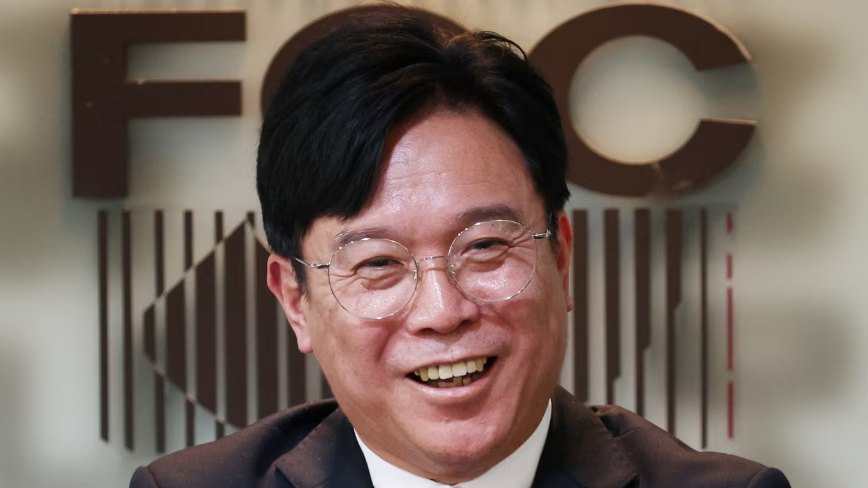
In an interview, Kim Young-hoon told Reuters that companies like Samsung Electronics that outperform profit targets should consider sharing excess gains with suppliers, subcontractors and their workers, after deducting taxes, given their contributions to corporate growth.
TL;DRAI
South Korea's labour minister calls on Samsung, SK Hynix to share excess AI profits with suppliers and workers. The proposal signals regulatory pressure and could establish profit-sharing precedent across Asian chipmakers, reshaping tech supply economics and wage structures.
840 words~4 min read