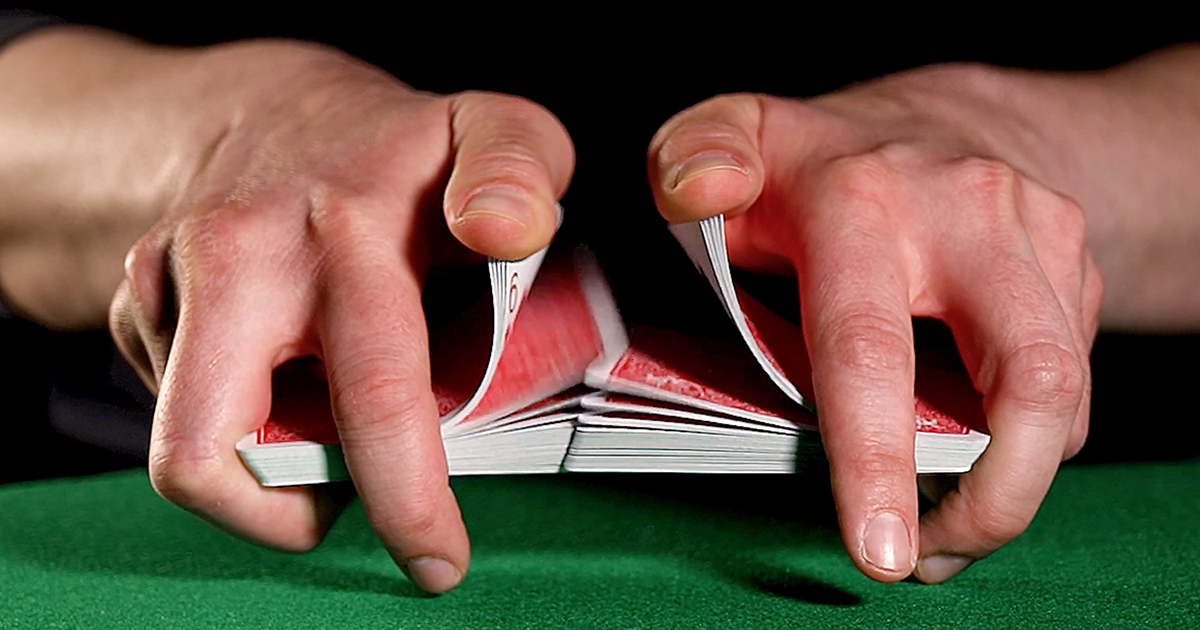
Among the many Martin Gardner books on my shelves, several contain “magic” tricks played on an audience, and one is entirely about them. Several of these tricks are attributed to the magician Bob Hummer who, according to the American Statistical Association, was a friend of Gardner. One of Hummer’s tricks, known as the Poker Chips Mystery, has been widely marketed, and is today available for purchase in downloadable PDF form.For representational purposes only. (Unsplash )It is a mathematical trick, so the magician carries out certain calculations to arrive at the result. When describing previous tricks of a similar nature in Problematics, I have often listed these mathematical steps and invited readers to work out why they work. When you know how, working out why can often be easy. I think this one is a little on the tougher side, but Problematics readers are known to be smart solvers.#Puzzle 195.1In the version Gardner describes, there are six poker chips. One chip has 5 in bold type on one face, and 0 in light type on the opposite face. Another has a bold 6 opposite a light 1. And so on, as in the illustration.The magician asks the spectator to take the six chips, shuffle them, and then arrange them in two rows of three chips each. The magician then turns his back, but before doing so he makes a mental note of which chips that have the bold face up. That is to say, he notes their positions. For example, left chip in top row.His back turned, the magician asks the spectator flip any three chips, with his choices not revealed to the magician. Then the magician gives instructions to flip additional chips in certain positions. These happen to be the positions of the boldface chips he had secretly noted, but his instructions will sound innocuous. For example, “flip the right chip in the middle row”. The magician continues to give instructions until the spectator has flipped the chips in all positions that were showing bold faces before the magician turned his back.In the third step, the spectator is asked to choose three more chips without revealing his choices, and flip all three. This time, each flipped chip is covered by a playing card. This leaves three visible chips and three covered chips on the table. The magician turns, looks at the visible chips, and announces the total on the upward faces of the three covered chips.The spectator removes the playing cards and finds that the three revealed numbers indeed add up to the announced total.For the magicians, the mental calculations are:1. Note the number of bold faces on the three uncovered chips, and multiply this number by 102. Add 15 to the product3. From this sum, subtract the sum of the numbers shown by the three visible chips.The result is equal to the total on the up faces of the covered chips.What is the mathematics that makes it work?#Puzzle 195.2Find a dictionary word that contains all the letters A, B, C, D, E, F in any order, and with any other letters that you may need. Any letter can be used any number of times. There is more than one possible answer, so any one word will do.MAILBOX: LAST WEEK’S SOLVERS#Puzzle 194.1Hi Kabir,The names of the siblings, their surnames, books and wrapping are as shown in the table. From the given conditions, it is clear that the Prasad siblings Pritha and Pranav buy Little Women and Black Beauty. But it cannot be established which sibling buys which one of these two books.— Shishir Gupta, Indore[This is something most solvers have missed, as did I while creating the puzzle. The majority finding is that Pritha buys Little Women and Pranav buys Black Beauty, which matches my original arrangement. This solution, however, is not unique, as Shishir Gupta notes. As far as I can see, his alternative solution is a valid one. The solution would have been unique if I had added just one extra condition: that no two boys buy the same book. — KF]#Puzzle 194.2Given, ab + cd = xy; abcd = xy²Put ab = P, cd = Q and abcd = Rabcd = xy²=> 100P + Q = R²=> 99P + P + Q = R²=> 99P + R = R²=> 99P = R² – R = R(R – 1)This means R and (R – 1) are consecutive integers of which one is divisible by 9 and the other is divisible by 11. Only two pairs of values for (R, R–1) satisfy the given conditions: (45, 44) and (55, 54).When R = 45, we get P = 20 and Q = 25When R = 55, we get P = 30 and Q = 25So the solutions are(20 + 25 = 45), (20² + 25² = 45²)(30 + 25 = 55), (30² + 25² = 55²)— Dr Sunita Gupta, New Delhi[There is a third possibility, 98 + 01 = 99 and 98² + 01² = 99². This will also emerge from Dr Sunita Gupta’s equation 99P = R(R – 1) if you take R = 99. Some readers have offered this combination, but Professor Anshul Kumar (after deriving the combination) observes that this does not qualify as a solution because 01 is not really a two-digit number. Nevertheless, the list of correct solvers below includes every reader who has given any one or more among the combinations (20, 25, 45), (30, 25, 55) and (98, 01, 99). — KF]Solved both puzzles: Shishir Gupta (Indore), Dr Sunita Gupta (Delhi), Professor Anshul Kumar (Delhi), Sabornee Jana (Mumbai), Yadvendra Somra (Sonipat), Ajay Ashok (Delhi), Vinod Mahajan (Delhi), Amarpreet (Delhi)Solved #Puzzle 194.1: Anil Khanna (Ghaziabad), Dr Vivek Jain (Baroda)Problematics will be back next week. Please send in your replies by Friday noon to problematics@hindustantimes.com.
Problematics | Magic with numbered chips
Here’s a trick that is easy to perform if you know the steps. What makes it work?
960 words~4 min read