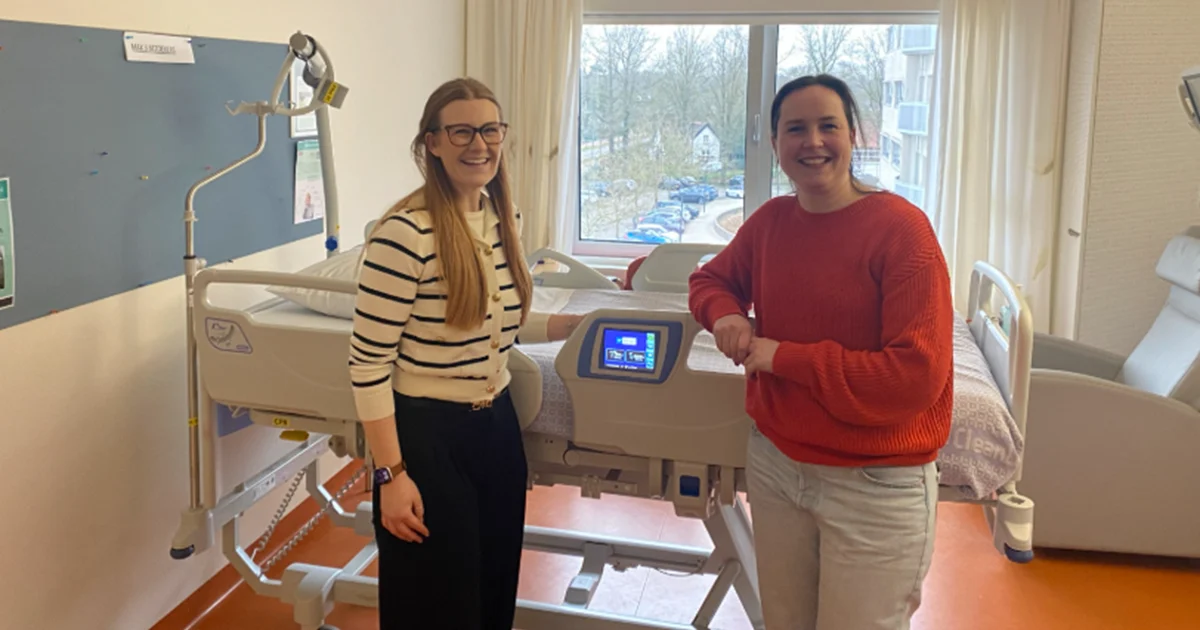
Rebecca Nash, Clinical Manager, Baxter Connected Care (left) and Inge Koopmans, Therapy Specialists at Baxter Netherlands (right)
Inpatient falls contribute significantly to increased care costs and longer stays, and can lead to blocked bedflow and poorer outcomes – all of which could have a significant impact on clinical workflow efficiency and quality of care in hospitals.From isolated alarms to connected workflowsWith research suggesting that in England and Wales, for example, up to 50% of inpatient falls cause injury and that in the Netherlands, 2.5% of patients aged over 70 fall while in hospital, in-room checks and traditional alarms that raise an alert after a specific event are only part of the answer. Now, hospitals are evaluating connected technologies to support earlier awareness and improved situational insight, with the hospital bed evolving from a physical asset into a digital touchpoint within the care environment.One Dutch hospital is working with smart bed specialist Baxter to explore how connected bed technology can support digital workflows and integrate bed status and patient movement data into existing IT systems to enhance visibility and situational awareness for care teams.At Elkerliek Hospital in the southeast of the country, this approach has initially focused on the 20-bed neurology department, with the bed seen not only as a physical device but also as a digital source of operational and safety‑related information.Saving precious clinician timeMaurice Vermaes, project manager at Elkerliek, says: “Since using the new smart beds, our hospital staff have reported perceived reductions in time spent on selected routine tasks during the pilot.“They have also said that in-bed weighing reduces the need for many manual steps, which is saving us an estimated 10 minutes per patient, which adds up to days – if not weeks – of clinician time saved each year.”(1)Patient weight captured by the bed can be transferred into the electronic record, reducing the need for manual transcription. Hospital teams say this helps to support documentation accuracy and reduce routine data‑entry tasks.By introducing smart beds with wireless connectivity, the hospital caregivers can receive system‑generated notifications related to patient movement, bed‑exit attempts, bed height and brake status.These notifications are displayed on central dashboards and routed to caregivers’ mobile devices through existing communication workflows. The aim is to support earlier awareness of patient movement events and provide caregivers with timely, actionable information rather than relying solely on in‑room checks.The connected beds are linked to the hospital’s electronic medical record via Baxter’s DeviceBridge unified platform, which standardises and transmits device data using established communication protocols such as HL7.Staff report visibility benefitsThe system combines the Accella smart bed with Baxter’s connectivity platform to provide continuous visibility into bed status and selected patient‑related events. Nurses can review key indicators remotely, allowing them to prioritise activities and allocate time based on current conditions across the unit.Staff at Elkerliek report that increased visibility into bed and patient movement status has supported confidence in daily workflows and contributed to a less interruptive care environment. During the initial limited period pilot, the hospital reported no patient falls – based on site‑reported experience.Scaling up connectivityFollowing the pilot, the 280-bed hospital has indicated plans to extend the use of connected beds to additional departments, adapting configurations and workflows to local needs.As healthcare organisations continue to pursue digital strategies that integrate medical devices with IT infrastructure, connected bed solutions represent one approach aimed at improving data flow, situational awareness, and workflow coordination—without adding new standalone systems.Click here to discover more about Baxter’s integrated approach to connected smart hospital bed technologies, and how they support data visibility, interoperability, and workflow integration within hospital care environments.DISCLAIMER(1) Examples are based on site reported experience from a single pilot site. Claims have not been independently validated, are not statistically tested, and should not be interpreted as evidence of clinical outcomes.For safe and proper use of the products mentioned herein, please refer to the appropriate Operator’s Manual or Instructions for Use. These medical devices are regulated health products which, pursuant to such regulation, bear a CE mark. Baxter recommends that you carefully read the detailed instructions for safe and proper use included in the documents accompanying the medical devices. The personnel of healthcare establishments are responsible for the proper use and maintenance of these medical devices.