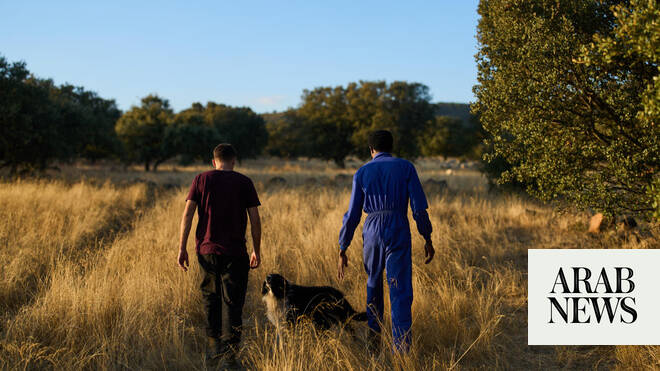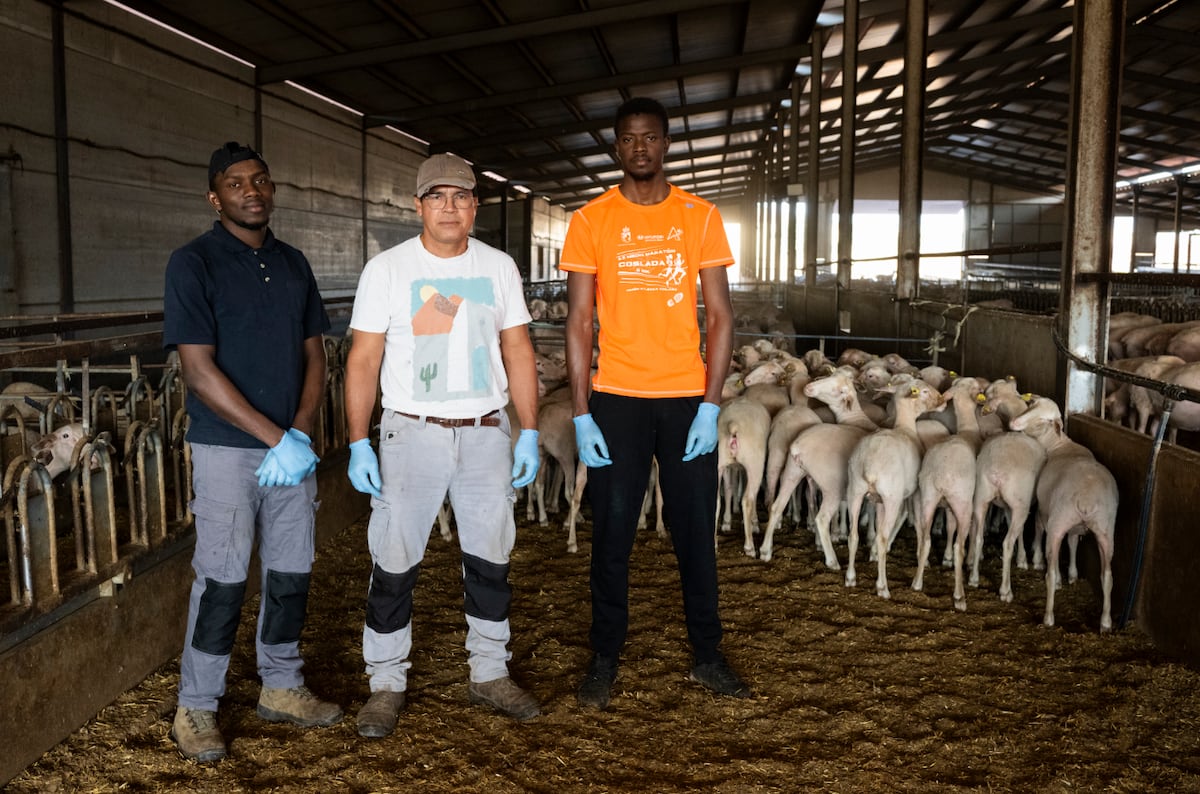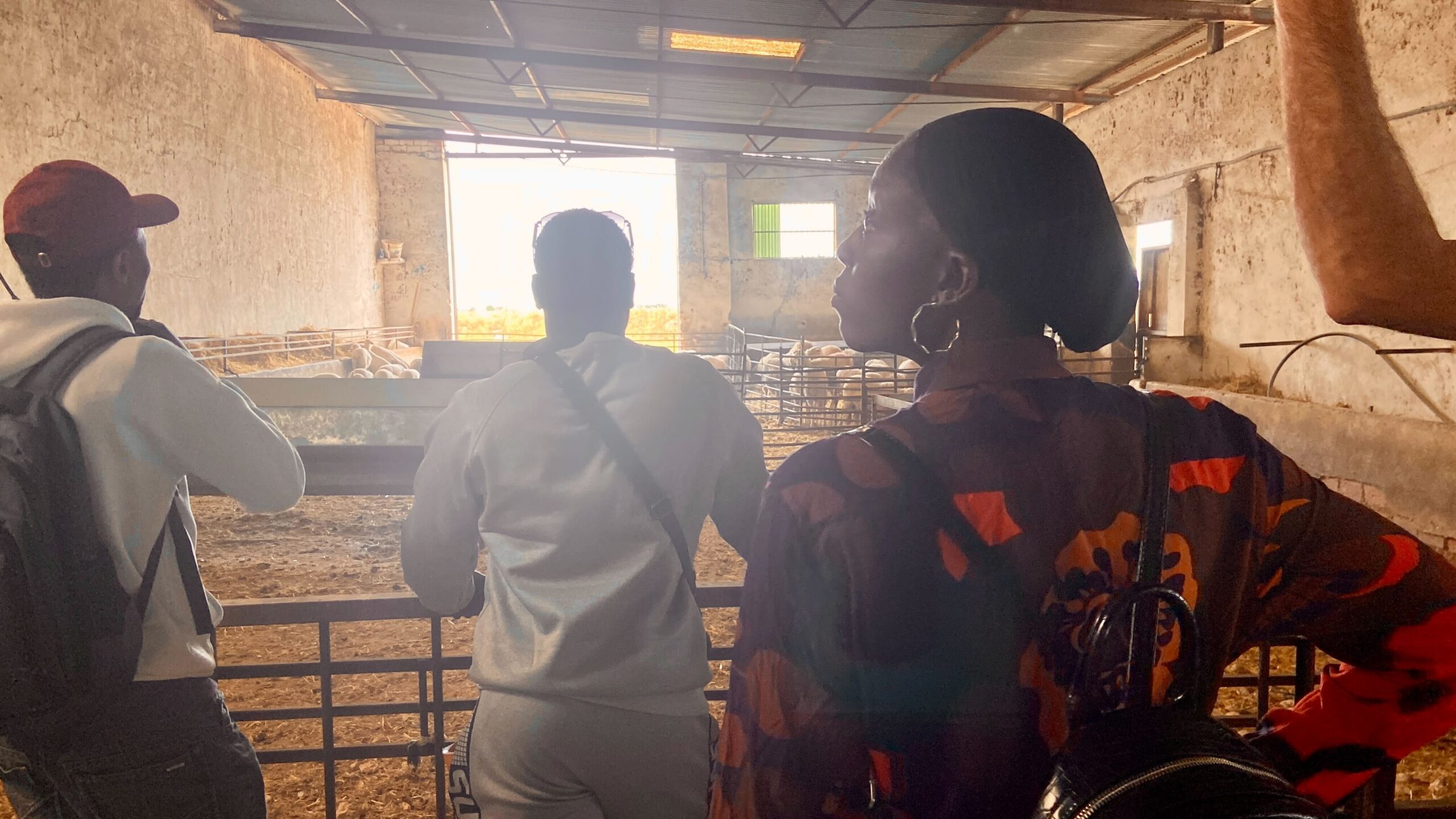
On a recent morning, in a barn on a small country farm in central Spain, 67-year-old Javi Esteban separated his sheep into two corrals — one group for milking, the other for taking out to pasture.But one stubborn ewe seemed decidedly opposed to both options. She kept skittering away. So, Esteban asked his much younger farmhand, 27-year-old Osam Abdulmumen, to catch her.It wasn’t easy, even in the enclosed space. But Abdulmumen eventually caught the ewe by a back leg and led her into a pen. He then led the entire flock outside, up a sloping green field toward the day’s grazing ground just over the ridge.Abdulmumen cuts quite the figure in the countryside. Originally from Darfur, Sudan, he’s 6 feet 5 inches tall and dressed in blue coveralls, a bit short on the sleeves.“Right now, in my country, there are problems everywhere,” he said, “not just in Darfur. I left home because of the war.”Spanish shepherd Álvaro Esteban and Sudanese shepherd Osam Abdulmumen walk through the countryside while heading to gather a sheep herd in Los Cortijos, central Spain, Oct. 7, 2025.Bernat Armangue/AP/File photoThat was eight years ago. And before reaching Spain, Abdulmumen lived for stints in Egypt, Libya, Tunisia, Algeria and then Morocco. He left home alone and hasn’t seen his parents and 10 siblings since. Last year in Morocco, he scaled a border fence in the North African Spanish autonomous enclave of Ceuta, sought asylum and then landed this gig.It’s a job that young people don’t want to do, and that older people are retiring from. But someone in Spain still needs to take care of all of the country’s sheep. There are currently lots of shepherd vacancies in the Spanish countryside, but resumes for the jobs are hardly rolling in.But there is some hope.A school in Ciudad Real, in central Spain, an hour from Esteban’s barn, is training candidates, many of whom, like Abdulmumen, are perfect for the job. These newly arrived immigrants, mostly from African countries, already have experience with livestock. And about a third of them find work soon after graduating from the week-long program.Abdulmumen said his father was elated when he managed to reach him by phone to tell him he’d become a shepherd in Spain.“Very well done, son,” he told him. “You can relax now. You have work.”Abdulmumen comes from a family of shepherds, although they also raise cattle and camels. Once in Spain, Abdulmumen said he caught wind of the Shepherds’ School of Castilla-La Mancha through an NGO and signed up.Osam Abdulmumen, 27, grapples with a sheep on a farm in central Spain. Image taken from a video.Gerry Hadden/The WorldPedro Luna is the man who started the school. In a recent class, he lectured to around 20 at-risk students — in this case, a couple of Spanish prisoners on work leave, and the rest, mostly African refugees.On the final day of the course, Luna and his students boarded a bus to a sheep farm for some hands-on learning.“I’ve placed 63 of my students in real jobs since the program started two years ago,” he said. “The biggest obstacle [for them] is learning Spanish. But once they’ve got a handle on it, it’s easy to get them work.”The host at the sheep farm that day was Juan Carlos Gonzalez.“I think this project is great, he said. “Because at least when a new worker arrives, especially an immigrant, they know exactly what they’re getting into.”Something new for many of these students, encountered in the program, was mechanized milking. Inside a barn, ewes who had just given birth entered long rows of milking stalls. They were disoriented and skittish — a bit like the students themselves.The trainees stood before the bulging pink udders, holding rubber suction cups attached to a mechanical aspirator by tubes. A farmhand instructed them to grab the udder firmly, then pop the cups over the nipples so they would seal and hold. It took a while, but most of them got the hang of it.Back outside, a young man from Zimbabwe, Limu Kanimoyo, was grinning and shaking his head.“It’s quite strange because, in Zimbabwe, I think there will be few people who will consume the milk from the sheep,” he said. “Most of it is milk from the cows.” Like Osan Abdulmumen, Kanimoyo comes from a shepherding family. He fled Zimbabwe, he said, after being attacked for supporting an opposition presidential candidate a few years ago.“A couple of times, yes, they would ambush me in front of the house,” he said. “It was becoming more difficult and a familiar situation for me, so definitely I had to leave.”On the bus ride home, the students were clearly tired. But then Pedro Luna’s phone buzzed; it was a message from a farmer who urgently needed two shepherds.One man named Sa’il, a refugee from the Palestinian-occupied territories, caught wind of the opportunity. He typed into a translator app on his phone: “I can do that job. No problem.”“He’ll most certainly be hired,” Luna said. That’s because back home, Sa’il once had sheep, too, he said before Israeli settlers in the West Bank drove him from his land.Those kinds of dangers remain far away from Spain, Abdulmumen said. As he walked back to the farm from the highland pastures, he said, “Here it is so peaceful. I love the animals.”But he did say he doesn’t so much love the award-winning Manchego cheese made from these sheep’s milk. It’s a cultural thing, he explained.A portion of 67-year-old Javi Esteban’s small country farm in central Spain. Image taken from a video.Gerry Hadden/The World“I don’t eat cheese too often,” he added. “In Sudan, we drink the animal’s milk directly.”Abdulmumen said Sudan has lots of sheep and camels. An online search revealed that Spain doesn’t have camels, except on the Canary Islands.Camel’s milk “is really good,” he smiled. “It’s sweet. It has a lot of sugar in it, more even than cow’s milk. I miss my camels.”But Abdulmumen is saving money. Once he has enough and the war in Sudan is over, he said he’ll go home and raise a glass or two of his cherished camel’s milk — in the company, of course, of his family.
Spain taps into immigrant and refugee communities to fill vacant shepherding jobs - The World from PRX
Older generations are retiring from their roles as shepherds in Spain, while young people no longer want to take up the profession. Now, a new school is training newly arrived immigrants — mostly from African countries — who already have experience working with livestock to take on the jobs.
1,028 words~5 min read